
A Comprehensive Thermal Insulation Comparison
Why a Thermal Insulation Comparison Matters Before You Buy
A thermal insulation comparison is the smartest first step before spending money on insulation — because the wrong choice can mean higher energy bills, moisture problems, and wasted money for decades.
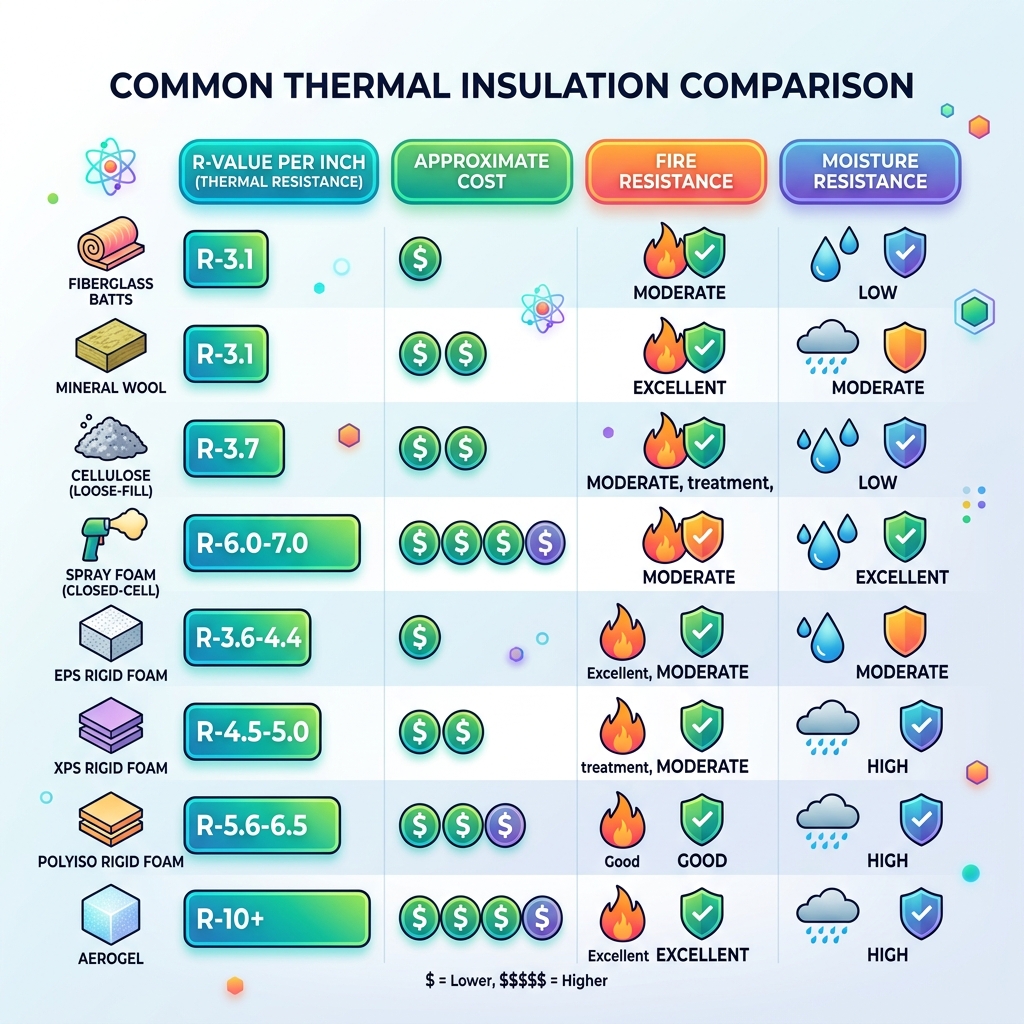
Here’s a quick look at how the most common insulation types stack up:
| Insulation Type | R-Value per Inch | Approx. Cost (per sq ft) | Best For |
|---|---|---|---|
| Fiberglass batts | R-3.1 | $ | Walls, attics, DIY |
| Mineral wool | R-3.1 | $$ | Fire resistance, soundproofing |
| Cellulose (loose-fill) | R-3.7 | $$ | Attic blow-in, retrofit |
| Spray foam (closed-cell) | R-6.0–7.0 | $$$$ | Air sealing, crawl spaces |
| EPS rigid foam | R-3.6–4.4 | $ | Below-grade, continuous insulation |
| XPS rigid foam | R-4.5–5.0 | $$ | Below-grade, moisture-prone areas |
| Polyiso rigid foam | R-5.6–6.5 | $$$ | Roofing, warm climates |
| Aerogel | R-10+ | $$$$$ | Space-restricted, industrial |
The short answer: There is no single “best” insulation material. According to Building Science Corporation, all insulation types perform equally well when properly installed and air sealed. What separates them is how they handle moisture, fire, sound, health risks, and long-term stability.
So if you’re dealing with cold drafts and sky-high heating bills, the real question isn’t just “which material has the highest R-value?” It’s which material fits your specific walls, budget, climate, and risk tolerance.
That’s exactly what this guide breaks down.
The building envelope — walls, roof, and floor — accounts for 50–60% of total heat gain and loss in a home. Insulation is your single biggest lever for controlling that. And with the global insulation market growing at a 4.5% annual rate, there are more choices than ever — which makes comparing them clearly even more important.
Comparing Thermal Insulation Performance and R-Values
When we dive into a thermal insulation comparison, the first number everyone looks at is the R-value. R-value measures thermal resistance—essentially, how well a material resists the flow of heat. The higher the number, the better the punch it packs. However, “performance” is a moving target. It depends on thermal conductivity (how easily heat moves through the material), air infiltration (how much wind blows through it), and long-term stability.
One of the most fascinating pieces of industry data comes from Building Science Corporation’s research on polyiso temperature performance. While polyisocyanurate (polyiso) boasts a staggering “label” R-value of up to R-6.5 per inch, that number is tested at a balmy 75°F. When the temperature drops to 25°F, polyiso’s performance can plummet to as low as R-3.5 per inch. This “temperature derating” happens because the gases trapped inside the foam cells start to condense, making the material less effective just when you need it most—in the dead of winter.
Furthermore, we have to consider convection loops. In poorly installed loose-fill insulation, air can actually circulate within the material itself, creating “mini-weather systems” that bypass the insulation’s thermal resistance entirely.
Understanding R-Value in a Thermal Insulation Comparison
To really grasp R-value, we need to talk about heat transfer. Heat moves in three ways: conduction (through solids), convection (through liquids/gases), and radiation (electromagnetic waves). Most insulation targets conduction and convection.
A major enemy of high R-values is thermal bridging. This occurs when highly conductive materials, like wood studs or steel frames, create a “bridge” for heat to bypass your insulation. Even if you have R-21 batts in your walls, the wood studs (which are only about R-1.2 per inch) act like a highway for heat loss. This is why many modern builders use continuous insulation—a layer of rigid foam over the entire exterior—to “break” those bridges. For a deeper dive into these mechanics, check out The Ultimate Guide to Insulating Your Home.
Material density also plays a role. Denser materials like mineral wool or high-density spray foam are better at stopping air movement than low-density fiberglass. This affects how thick your walls need to be to achieve a target R-value. If you only have 3.5 inches of space (a standard 2×4 wall), you’ll need a higher R-value-per-inch material to meet modern energy codes.
Performance Stability and Settling
Not all insulation stays the same over time. Loose-fill materials, particularly cellulose, are prone to settling. Research suggests cellulose can settle by as much as 20%, leaving gaps at the top of wall cavities where heat can escape. On the flip side, mineral wool and fiberglass batts are dimensionally stable; they don’t shrink or sag if installed correctly.
UV degradation is another factor often missed in a thermal insulation comparison. Spray foam and certain rigid foams will literally turn to dust if left exposed to sunlight for more than a few weeks. If you’re insulating a space that might see sun during construction, this is a major “watch out.” For seasonal advice on keeping your home cozy, see our Catch the Heat: Insulation Tips for Winter.
Pros and Cons of Common Insulation Materials

Choosing the right material is a balancing act between performance, safety, and price.
- Fiberglass: The “old reliable” of the industry. It’s naturally non-combustible and doesn’t absorb water. However, it is air-permeable, meaning it doesn’t stop drafts.
- Mineral Wool: Made from volcanic rock or steel slag. It is incredibly fire-resistant (withstanding over 2,000°F) and offers superior sound damping. It’s heavier and more expensive than fiberglass but won’t lose its R-value if it gets wet.
- Cellulose: Made from about 75-85% recycled paper. It has a higher R-value than fiberglass and is great at filling irregular nooks. However, it requires significant chemical fire retardants (usually borates) to be safe.
- Spray Polyurethane Foam (SPF): The heavyweight champion of R-value and air sealing. Closed-cell spray foam acts as an air barrier, vapor retarder, and insulator all in one. But it’s not without controversy. The EPA has raised health concerns regarding isocyanates and other chemicals in SPF, which can cause asthma or skin sensitization if not handled with extreme care during installation.
- Natural Fibers: Materials like sheep’s wool, hemp, and cork are gaining traction for their low carbon footprint, though they often come with a premium price tag.
- Ceramic Fiber: Used primarily in industrial settings, this can handle extreme heat (up to 2,700°F) that would melt residential insulation into a puddle.
Rigid Foam Boards: EPS vs. XPS vs. Polyiso
Rigid foam is the go-to for continuous exterior insulation and basement walls.
- Expanded Polystyrene (EPS): The white stuff (think coffee cups). It’s the most budget-friendly and environmentally stable because it’s air-blown. It doesn’t lose R-value over time.
- Extruded Polystyrene (XPS): Usually blue or pink. It has a higher R-value (R-5.0) and better moisture resistance than EPS, making it the favorite for under-slab and foundation work. However, most XPS uses blowing agents with high Global Warming Potential (GWP).
- Polyisocyanurate (Polyiso): The R-value king (at room temperature). It usually comes with a foil facing that acts as a radiant barrier and vapor blocker. It’s the standard for commercial roofs.
For more on how these fit into your overall strategy, read about Energy Saving Methods for Home Insulation.
High-Temperature and Industrial Solutions
In industrial piping and aerospace, standard fiberglass just doesn’t cut it. Materials like Aerogel (often called “frozen smoke”) provide incredible R-values (R-10 to R-20 per inch) in incredibly thin profiles. Vacuum Insulation Panels (VIPs) take it a step further, achieving R-values up to R-50 by removing all air from the panel, though they cannot be cut or punctured.
A Comparative Study on Selected Insulating Materials for Industrial Piping highlights that for steam pipes, “removable” solutions like Pyrogel or specialized jackets are superior. They allow for regular inspections to prevent Corrosion Under Insulation (CUI), a multi-billion dollar problem in the industrial sector.
Acoustic, Fire, and Health Safety Factors
A thermal insulation comparison isn’t just about heat; it’s about peace of mind.
Sound Control (STC and NRC)
If you want to drown out your neighbor’s leaf blower, look at the Sound Transmission Class (STC) and Noise Reduction Coefficient (NRC). Fiberglass and mineral wool are the champions here, often achieving an NRC of 1.00 (meaning they absorb 100% of the sound that hits them). Spray foam, while great at stopping air, is actually quite poor at stopping sound because it’s too rigid; it can even “bridge” vibrations through walls, achieving only an NRC of around 0.75.
Fire Safety
Mineral wool and fiberglass are naturally non-combustible. They don’t need added chemicals to stay safe. Cellulose, being paper, is naturally a fire hazard and must be treated with roughly 20% fire retardants by weight. Spray foam is essentially “solid fuel”—it ignites at around 700°F and releases toxic smoke, which is why building codes require it to be covered by a thermal barrier like half-inch drywall. For those interested in the fine print, the CFR regulations on cellulose fire safety provide the strict standards manufacturers must follow to prevent “smoldering combustion.”
Safety Metrics in a Thermal Insulation Comparison
Health is a major part of the conversation. Isocyanates in spray foam are a leading cause of work-related asthma. If the “A-side” and “B-side” of the foam aren’t mixed at the perfect temperature and ratio, the foam can off-gas indefinitely, leading to lingering odors and respiratory issues.
Fiberglass and mineral wool have been extensively studied and are no longer classified as carcinogens by major health organizations (IARC/NTP), provided they are installed with proper Personal Protective Equipment (PPE). Always wear a mask, gloves, and long sleeves when handling these fibers to avoid the “itch.” Keeping your family safe is part of Insulating Your Home for Energy Efficiency.
Moisture Management and Mold Resistance
Moisture is the “silent killer” of insulation.
- Inorganic materials: Fiberglass and mineral wool do not support mold growth because they aren’t a food source.
- Organic materials: Cellulose is made of wood fibers (paper), which mold loves to eat if it stays damp.
- Permeability: Open-cell spray foam allows water vapor to pass through, while closed-cell foam acts as a vapor barrier.
- Hydrophobic properties: Mineral wool is naturally water-repellent. If it gets wet, it can be dried out and will retain its R-value. Fiberglass, however, tends to mat down when wet, losing its effectiveness.
Proper moisture management often involves using vapor retarders to prevent warm, moist indoor air from hitting cold exterior surfaces and condensing. For attic-specific moisture advice, see our Attic Insulation Tips: Save Energy and Money.
Environmental Impact and Sustainability Metrics
As we look toward a greener future, the “embodied carbon” of our materials matters. The Emissions of Materials Benchmark Assessment for Residential Construction found that insulation can account for up to 26% of the total carbon footprint of a new home’s materials.
| Material | GWP (Global Warming Potential) | Sustainability Factor |
|---|---|---|
| Cellulose | Very Low / Negative | High (85% recycled paper) |
| Wood Fiber | Negative (Carbon sequestering) | High (Renewable) |
| Fiberglass | Low | Moderate (40-60% recycled glass) |
| EPS Foam | Moderate | Low (Petroleum-based) |
| XPS Foam | High | Very Low (HFC blowing agents) |
The “Circular Economy” approach favors materials that can be recycled or composted at the end of their life. While mineral wool and fiberglass can often be recycled, spray foam is destined for the landfill once it’s stuck to your wall studs.
Frequently Asked Questions about Thermal Insulation
Which insulation has the highest R-value per inch?
Vacuum Insulation Panels (VIPs) take the crown with R-values up to R-50 per inch, followed by Aerogel (R-10 to R-20). In the common residential world, closed-cell spray foam (R-6.5 to R-7.0) and Polyiso (R-6.0 to R-6.5) are the leaders. However, R-value density isn’t everything; cost and installation ease often matter more.
Is spray foam better than fiberglass for soundproofing?
Actually, no. Fiberglass and mineral wool are significantly better for soundproofing. They have higher NRC values (up to 1.00) and better STC ratings (around 43 in a standard wall) because their soft, fibrous structure “traps” sound waves. Spray foam is rigid and can actually vibrate, allowing more sound to pass through.
How does moisture affect insulation performance?
Moisture is a thermal conductor. If your insulation gets wet, its thermal conductivity increases, meaning its R-value drops. Wet insulation can also lead to mold growth and structural rot. Materials like mineral wool and closed-cell foam handle moisture best, while fiberglass and cellulose are the most vulnerable.
Conclusion
At Financefyx, we believe the best insulation is the one that fits your long-term goals. While a thermal insulation comparison often focuses on R-value, the real winners are determined by installation quality and cost-effectiveness. A perfectly installed R-15 fiberglass batt will outperform an R-21 batt that has gaps and compressed edges.
Focus on the R-value per dollar spent and don’t ignore the “extras” like fire safety, sound control, and air sealing. Whether you’re doing a DIY attic top-off or a full-scale renovation, choosing the right material today will pay dividends for the life of your home. Ready to start saving? Save energy with our expert tips and take control of your home’s comfort today!
