
How to Manage Insulation Venting in Your Attic Space
Why Insulation Venting Roof Space Is the Key to a Warmer, Healthier Home
Insulation venting roof space is one of the most overlooked factors behind high winter heating bills and cold drafts in the home. If your attic isn’t set up correctly, you’re likely losing heat, inviting moisture damage, and shortening the life of your roof — all at the same time.
Here’s the quick answer to managing insulation venting in your attic:
- Seal air leaks first — close gaps around light fixtures, pipes, and ductwork in the attic floor
- Install baffles — keep a clear airflow channel from soffit vents to the ridge
- Add insulation — cover the attic floor to the R-value recommended for your climate zone
- Balance your vents — aim for roughly 60% intake (soffit) and 40% exhaust (ridge)
- Check for warning signs — mold, ice dams, or high energy bills mean something is wrong
Most homeowners think of insulation and ventilation as separate jobs. They’re not. They work together as one system.
Here’s the problem that plays out in millions of homes every winter: insulation alone traps heat inside the attic. Without ventilation, that heat builds up, melts snow on the roof, and creates ice dams at the gutters. Moisture condenses on cold wood. Mold grows. The roof deck rots.
On the flip side, ventilation without proper insulation just lets your expensive heated air escape straight out of the house.
According to building science research, up to 40% of a home’s air leakage can happen through the attic floor. And proper insulation combined with air sealing can cut heating and cooling bills by up to 15%. Those aren’t small numbers.
The good news? Getting this right is very achievable — even in an existing home. This guide walks you through exactly how to do it.
The Critical Synergy of Insulation Venting Roof Space
When we talk about insulation venting roof space, we are describing a delicate dance between keeping heat in your living area and letting moisture out of your structure. Think of your attic like a pair of high-performance running shoes: the insulation is the cushion that keeps you comfortable, while the ventilation is the breathable mesh that keeps your feet from getting swampy.
Heat Regulation and Ice Dam Prevention
In cold climates, the primary goal of roof venting is to keep the roof deck cold. If heat leaks from your house into the attic because of poor insulation or unsealed air leaks, it warms the underside of the roof. This melts the snow sitting on top. As that water runs down to the colder eaves (the edges of the roof), it freezes again, creating a literal dam of ice. This “ice dam” forces water back up under your shingles, leading to leaks and rot.
Proper insulation venting roof space prevents this by using insulation to keep the heat in the house and ventilation to flush out any stray warmth that escapes.
Roof Deck Longevity and Condensation Control
In the summer, an unvented attic can become a literal oven, reaching temperatures over 150°F. This extreme heat can actually bake your shingles from the inside out, shortening their lifespan by roughly 10%. Furthermore, moisture from daily activities (showering, cooking) can migrate into the attic. Without ventilation, this moisture hits the cold roof deck in winter and turns into condensation—basically raining inside your attic.
To ensure your home meets modern standards, it is vital to follow Department of Energy insulation guidelines for your specific region. For a deeper dive into the materials themselves, check out The Ultimate Guide to Insulating Your Home.
| Feature | Vented Attic | Unvented Roof |
|---|---|---|
| Insulation Location | Attic floor | Underside of roof deck |
| Airflow | Natural (Soffit to Ridge) | None (Airtight) |
| Best For | Standard homes, DIY retrofits | HVAC in attic, complex rooflines |
| Cost | Generally lower | Higher (Spray foam/Rigid foam) |
| Shingle Temp | Cooler | 2°F to 3°F warmer |
How to Achieve Balanced Ventilation and Airflow
Achieving a balanced insulation venting roof space system isn’t just about cutting holes in your roof; it’s about physics. We want to create a “chimney effect.” Cool air should enter at the lowest point (the eaves or soffits) and exit at the highest point (the ridge).
The 60/40 Split
While many older building codes suggested a 50/50 ratio between intake and exhaust, modern building science experts often recommend a 60/40 split. By having slightly more intake (soffit) area than exhaust (ridge) area, we slightly pressurize the attic. This prevents the exhaust vents from “sucking” conditioned air out of your living space through tiny cracks in the ceiling.
Types of Vents
- Soffit Vents (Intake): These are located under the eaves. They are the “lungs” of the system.
- Ridge Vents (Exhaust): These run along the very peak of the roof. They allow hot, moist air to escape naturally as it rises.
- Gable Vents: Located on the vertical side walls of the attic. Note: Using gable vents alongside ridge vents can “short-circuit” the system, causing air to only move between the gable and ridge while leaving the lower attic corners stagnant.
For more on how these components interact, the About Attic Ventilation | ENERGY STAR guide is an excellent resource. You can also explore insulating-your-home-for-energy-efficiency to see how these vents impact your monthly bills.
Calculating NFVA for Insulation Venting Roof Space
How do you know if you have enough vents? We use a measurement called Net Free Ventilation Area (NFVA). This is the total unobstructed area through which air can pass.
The standard building code (IRC R806) generally requires 1 square foot of NFVA for every 150 square feet of attic area. However, if your ventilation is balanced (between 50% and 80% of the vents are in the upper portion of the roof), this requirement is reduced to 1 square foot per 300 square feet.
The Math Example: If you have a 1,200 sq. ft. attic:
- Divide 1,200 by 300 = 4 sq. ft. of total NFVA needed.
- Convert to square inches (4 x 144) = 576 sq. in.
- If using a 60/40 split, you need ~345 sq. in. of soffit intake and ~230 sq. in. of ridge exhaust.
For a more technical breakdown of these rules, see PA-1101: A Crash Course in Roof Venting | buildingscience.com.
Signs of Poor Insulation Venting Roof Space
How do you know if your system is failing? Your house will usually tell you, though it might whisper before it screams.
- Melted Snow Patches: If you see “bald” spots on your snowy roof directly over the attic, heat is escaping.
- Ice Dams: Large icicles or thick ice build-up at the gutters.
- Mold or Mildew: Check the underside of the roof sheathing for black spots or a musty smell.
- High Energy Bills: If your AC or heater never seems to stop running, your attic might be working against you.
- Hot/Cold Spots: Rooms directly under the attic feeling significantly warmer or cooler than the rest of the house.
If you are noticing these issues during the colder months, read our guide on how to Catch the Heat: Insulation Tips for Winter.
Step-by-Step Guide to Installing Attic Insulation Without Blocking Vents
Installing insulation seems simple—just roll it out, right? Not quite. If you block the airflow, you’ve just traded a heat problem for a moisture problem.
Step 1: Air Seal the Attic Floor
Before a single piece of insulation goes down, you must seal the “holes” in your ceiling. Insulation is like a sweater; it stops heat transfer but doesn’t stop air from blowing through it. Use spray foam or caulk to seal:
- Around plumbing stacks and electrical wires.
- Top plates of interior walls.
- Around recessed “can” lights (ensure they are IC-rated before covering).
- The attic hatch or pull-down stairs.
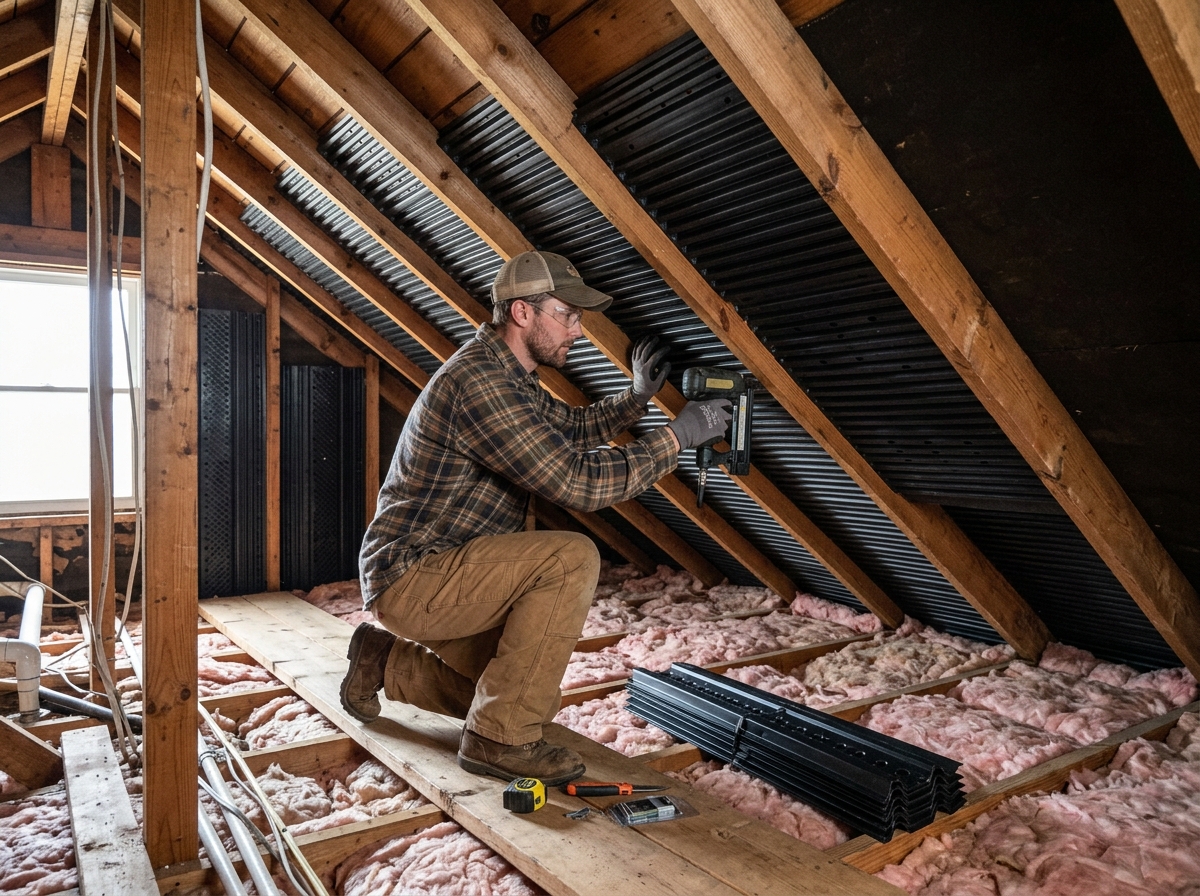
Step 2: Install Baffles (Rafter Vents)
This is the most critical step for insulation venting roof space. Baffles are channels (usually plastic or foam) that you staple to the underside of the roof deck where it meets the attic floor. They ensure that when you pile up insulation, there is still at least a 2-inch gap for air to flow from the soffit vents into the attic.
Step 3: Add the Insulation
Whether you are using fiberglass batts or a system like the Owens Corning AtticCat® system, ensure even coverage. If you’re using batts, lay the second layer perpendicular to the first to cover the wooden joists and reduce “thermal bridging.”
For more detailed DIY steps, see our Attic Insulation Tips: Save Energy and Money.
Using Baffles to Protect Airflow
Baffles do more than just keep the vents open; they prevent a phenomenon called wind washing. This occurs when wind blows into the soffit vents and pushes the loose-fill insulation away from the edge of the house, leaving the corners of your rooms uninsulated.
By sealing the bottom edge of the baffle to the top plate of the wall with a little spray foam, you create a wind-proof barrier that keeps your insulation where it belongs while still allowing the roof deck to breathe. For existing homes, this is often the single most impactful retrofit you can perform. You can find more technical details on this process in the guide for Blown Insulation for Existing Vented Attic.
Selecting the Right Insulation and R-Values
R-value measures thermal resistance—the higher the number, the better the insulation. The amount you need depends entirely on where you live.
- Fiberglass Batts: Easy for DIY, but can leave gaps if not cut perfectly.
- Blown-in Cellulose/Fiberglass: Fills every nook and cranny. Cellulose is often preferred for its higher R-value per inch.
- Mineral Wool: Excellent fire resistance and sound dampening.
Always check the latest R-value guidelines and energy standards to see if you should be aiming for R-38, R-49, or even R-60.
Advanced Strategies: Unvented Attics and Vapor Diffusion
Sometimes, a traditional vented attic isn’t the best choice. If you have your HVAC air handler and ducts in the attic, you are essentially putting your furnace in a refrigerator (in winter) or an oven (in summer). In these cases, we move the “thermal boundary” from the attic floor to the roof deck.
The Unvented (Conditioned) Attic
In an unvented assembly, we spray foam insulation (usually closed-cell) directly against the underside of the roof sheathing. This makes the attic part of the “conditioned space” of the home. It stays within 5-10 degrees of your living room temperature.
The key here is airtightness. Because there is no ventilation to remove moisture, the assembly must be perfectly sealed to prevent humid indoor air from hitting the cold roof deck and condensing. For a comparison of these two philosophies, see the Vented versus Unvented Attic | Building America Solution Center resource.
Vapor Diffusion Ports for Unvented Assemblies
What if you want an unvented attic but don’t want to use spray foam? Modern building codes now allow for vapor diffusion ports. This is a specialized setup for unvented attics using air-permeable insulation (like fiberglass or mineral wool).
Since moisture naturally rises, we create a “port” at the very top of the ridge. This port is covered with a material that is airtight (to keep heat in) but vapor-permeable (to let moisture out). It’s basically a “smart” vent.
- Ratio: Code requires a port area of at least 1:600 of the ceiling area, though experts often recommend 1:150 for better performance.
- Climate: This strategy is most effective in Climate Zones 1 through 3.
Frequently Asked Questions about Roof Ventilation
What is the most common mistake in attic insulation?
The “All-Star” mistake is blocking the soffit vents with insulation. Homeowners often try to be thorough and push insulation into every corner, inadvertently choking the house’s ability to breathe. This leads to immediate moisture buildup and ice dams.
How do I prevent insulation from blocking my soffit vents?
The only reliable way is to install baffles (rafter vents). These create a physical “hard” channel that insulation cannot enter. Even if you use blown-in insulation, the baffle keeps the air path clear.
Are attic fans better than passive ventilation?
Usually, no. In fact, they can be harmful. If your attic isn’t perfectly air-sealed from the house, a powerful attic fan can actually suck the expensive, air-conditioned air out of your living room and into the attic. Passive ventilation (soffit and ridge vents) is more reliable, costs nothing to operate, and doesn’t risk depressurizing your home.
Conclusion
Managing insulation venting roof space is about creating a balanced system where heat stays down and moisture goes up. By sealing air leaks, installing baffles, and ensuring a proper 60/40 vent split, you protect your roof’s lifespan and keep your energy bills in check.
Whether you are doing a weekend DIY project or hiring a professional for a full attic retrofit, the principles remain the same: Seal, Insulate, and Vent.
For more ways to keep your home running efficiently, explore our latest Energy Saving Tips. Taking the time to get your attic right today will save you thousands in roof repairs and utility costs over the years to come.
