
Stop Burning Money and Start Insulating Your Vintage Home
Why Old Homes Bleed Heat — and What It Costs to Fix It
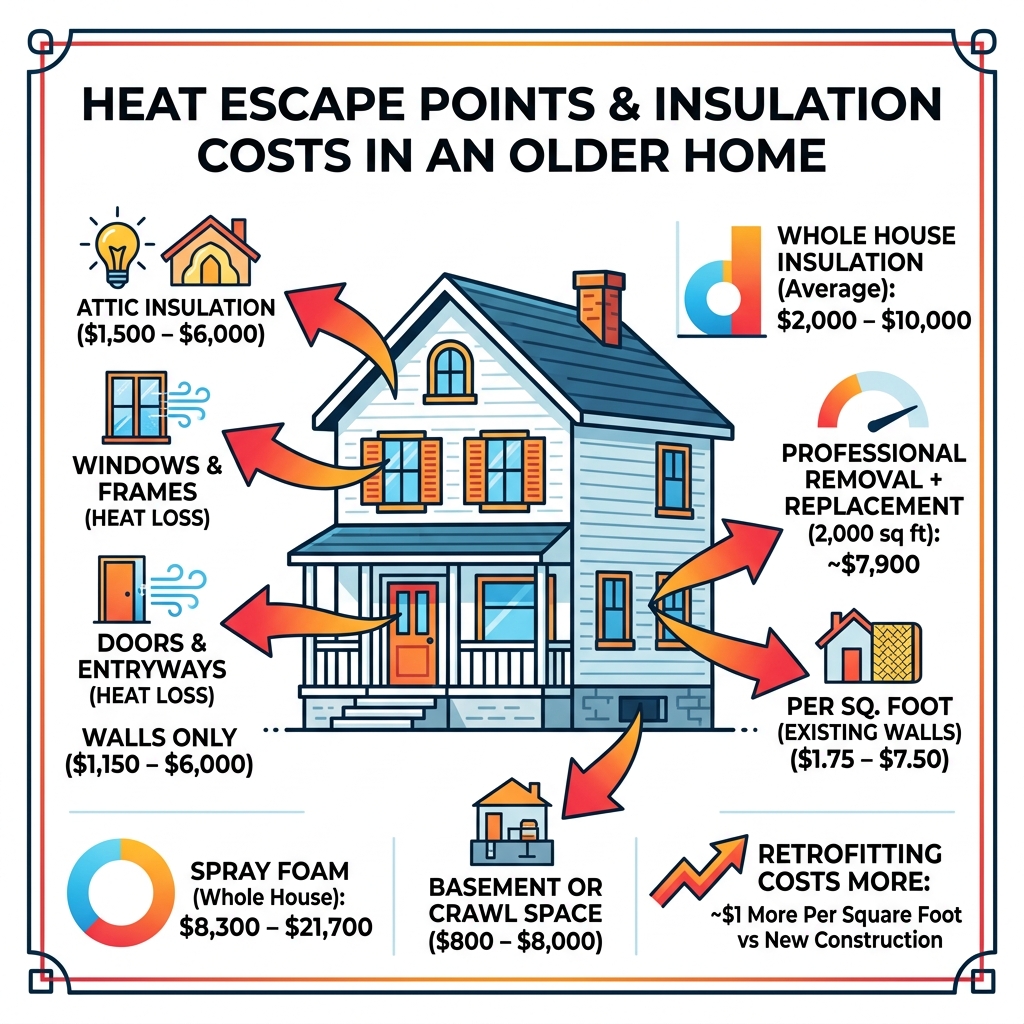
How much does it cost to insulate an old house? Here’s a quick answer before we dive deeper:
| Scope | Typical Cost Range |
|---|---|
| Whole house (average) | $2,000 – $10,000 |
| Professional removal + replacement (2,000 sq ft) | ~$7,900 |
| Per square foot (existing walls) | $1.75 – $7.50 |
| Attic only | $1,500 – $6,000 |
| Walls only | $1,150 – $6,000 |
| Basement or crawl space | $800 – $8,000 |
| Spray foam (whole house) | $8,300 – $21,700 |
Old houses have character. They also have gaps, thin walls, and insulation that was installed decades ago — or never at all.
If your heating bill spikes every winter and certain rooms never seem to warm up, your home’s insulation is likely the culprit. Older homes were simply not built to today’s energy standards, and retrofitting them costs more than insulating new construction — roughly $1 more per square foot — because contractors have to work around existing walls, floors, and hazardous materials.
One homeowner tracked their insulation-related upgrades over 16 years — windows, doors, attic and basement insulation, new siding — and spent a total of $41,700. Their words? It saved them “a TON of money” over that period.
The good news: you don’t have to do it all at once, and the energy savings start immediately.
Understanding the Average Cost to Insulate an Old House
When we talk about the price tag for bringing a vintage home up to modern comfort levels, the numbers can vary wildly. On average, most homeowners find themselves in the $2,000 to $10,000 range for a whole-house project. However, if you are looking at a full “strip and replace” mission—where a professional removes every bit of dusty, degraded 1950s fiberglass and pumps in fresh material—the average cost for a 2,000-square-foot home sits around $7,900.

The size of your “grand old lady” is the biggest driver of cost. A cozy 1,000-square-foot bungalow is a much smaller financial lift than a sprawling 4,000-square-foot Victorian. To help you budget, we’ve broken down the projected costs by home size:
| House Size (Sq Ft) | Estimated Cost Range |
|---|---|
| 1,000 | $1,650 – $15,000 |
| 2,000 | $3,300 – $25,000 |
| 3,000 | $4,950 – $35,000 |
| 4,000 | $6,600 – $45,000 |
The wide range in these numbers accounts for the difference between basic fiberglass batts and high-end spray foam. If you’re feeling overwhelmed by these figures, don’t worry—our ultimate guide to insulating your home breaks down the process step-by-step.
New Construction vs. Existing Home Costs
Why is it more expensive to insulate an old house? In a new build, the “bones” of the house are exposed. Contractors can walk right up to open wall cavities and staple insulation in place for roughly $0.65 to $6.50 per square foot.
In an existing home, we have what’s called “access difficulties.” We can’t just tear down your lath-and-plaster walls without a massive renovation bill. Instead, we have to use “surgical” methods like drilling small holes to inject foam or blowing in cellulose. This extra labor and specialized equipment push the cost up to $1.75 to $7.50 per square foot for existing walls. You’re essentially paying a “complexity tax” for the charm of your older home.
Regional Labor and Climate Impacts
Where you live matters just as much as what you’re installing. In colder climates, the International Residential Code (IRC) requires higher R-values (a measure of thermal resistance). For example, an attic in Maine might need an R-49 to R-60 rating, requiring significantly more material than a home in Florida.
Labor rates also fluctuate. In major metropolitan areas, you might pay $50 to $100 per hour for professional installers, while rural areas might be more affordable. Always check your local climate zone requirements to ensure you aren’t under-insulating for your region’s winters.
Factors Influencing Retrofit Expenses
Every old house has its secrets. When we start a retrofit, several variables can swing the budget by thousands of dollars.
One major factor is your siding type. If you have vinyl or aluminum siding, contractors can often “pop” a piece off, drill a hole into the sheathing, inject the insulation, and snap the siding back on with no visible damage. If you have a brick exterior, the process is much more labor-intensive. Technicians must drill through the mortar joints at multiple points for every single wall stud, which significantly increases labor time and cost.
Accessibility is another hurdle. If your attic has a tiny scuttle hole or your crawl space is only 12 inches high, expect to pay more for the “gymnastics” required by the crew. For more on how to prepare your home for these upgrades, check out our guide on how to seal air leaks to save energy.
Material Selection and R-Value
The material you choose is the “engine” of your home’s efficiency. According to the U.S. Department of Energy, a properly insulated home can reduce heating and cooling costs by up to 20%. Here are the common contenders:
- Fiberglass Batts ($0.50 – $2.00/sq ft): The cheapest option, but hard to install in existing walls without opening them.
- Blown-in Cellulose ($1.00 – $3.00/sq ft): Made from recycled paper, this is a favorite for old attics and wall injections.
- Mineral Wool ($1.40 – $2.10/sq ft): Fire-resistant and great for soundproofing.
- Spray Foam ($2.00 – $7.50/sq ft): The gold standard for air sealing. Open-cell is cheaper and more flexible, while closed-cell is dense, waterproof, and provides the highest R-value per inch.
Site Preparation and Hazardous Materials
This is the “scary” part of old house renovation. Before we can add the new, we often have to deal with the old. Many homes built before 1975 contain asbestos in the attic insulation (specifically vermiculite) or around old ductwork. Removing asbestos is not a DIY job and can cost between $1,190 and $3,255.
Additionally, if your old insulation has been a nesting ground for squirrels or mice, you’ll need pest extermination and potentially mold remediation if there have been roof leaks. These “pre-checks” are vital for insulating your home for energy efficiency safely.
Breaking Down Costs by Material and Location
Different parts of your house lose heat at different rates. To get the best bang for your buck, you need to know where to spend your money.
Before you start, we recommend reading up on how to catch the heat with these insulation tips for winter.
How much does it cost to insulate an old house attic?
The attic is the “low-hanging fruit” of insulation. Because heat rises, an uninsulated attic is like leaving the front door wide open all winter.
- Cost Range: $1,500 – $6,000
- Goal: Reach an R-49 to R-60 thickness.
- Methods: Blown-in cellulose is the most cost-effective, but spray foam on the underside of the roof deck (creating a “conditioned attic”) is the premium choice for total climate control. For more specific advice, see our attic insulation tips to save energy and money.
How much does it cost to insulate an old house wall?
Insulating existing walls is where things get tricky.
- Cost Range: $1,150 – $6,000
- Price Per Sq Ft: $1 – $4
- The “Magic” Solution: Injection foam. This is a specialized foam that has the consistency of shaving cream when injected. it flows around wires and pipes without expanding so much that it cracks your old plaster walls.
How much does it cost to insulate an old house basement or crawl space?
Don’t forget the floors! Cold feet are often caused by uninsulated rim joists (where the house meets the foundation).
- Cost Range: $800 – $8,000
- Crawl Space Specifics: $2,000 – $3,100
- Moisture Barriers: In old basements, we must use moisture-resistant materials like closed-cell spray foam or rigid foam boards to prevent rot. Explore more energy saving methods for home insulation to protect your foundation.
Hidden Costs: Removal and Professional Labor
When asking how much does it cost to insulate an old house, many people forget the “out with the old” phase. If your current insulation is compressed, water-damaged, or full of “critter” droppings, it must be removed.
- Removal Cost: $1.00 – $1.50 per square foot.
- Labor Rates: Expect to pay $40 to $80 per hour for a crew.
Professional labor also includes site cleanup. Spray foam and blown-in cellulose can be messy. A reputable contractor will include the cost of masking off your furniture and vacuuming the workspace in their quote.
Spray Foam Specifics for 2025
Spray foam is the most expensive option, but it is also an air-sealer and insulator in one. In 2025, a whole-house spray foam project for an existing home typically ranges from $8,300 to $21,700. That many specialized foam contractors have a minimum charge of $2,000, so it might not be cost-effective to hire them for just one small closet or a single rim joist.
Financing Your Insulation Project
We know that $10,000 is a lot of cash to have sitting around. Many homeowners use a home equity loan or a home improvement loan to fund these upgrades. Because insulation increases the value of the home and pays for itself through lower bills, lenders often see these as low-risk “smart” loans.
Maximizing ROI and Saving Money on Your Project
Is it worth it? Absolutely. According to Energy Star, homeowners can save an average of 15% on heating and cooling costs by air sealing and insulating. In an old house with zero insulation, those savings can skyrocket to 20% or even 50% in extreme cases.
Rebates, Tax Credits, and Incentives
The government actually wants to help you pay for this!
- Federal Tax Credit: Under the Inflation Reduction Act, you can claim 30% of the material costs, up to $1,200 annually, through 2032. You’ll use IRS Form 5695.
- Utility Rebates: Many power companies offer rebates ranging from $50 to $1,100 because it reduces the strain on the electrical grid.
- Resources: Check the Database of State Incentives for Renewables & Efficiency (DSIRE) or Energystar.gov for a list of what’s available in your zip code.
DIY vs. Professional Installation
Can you do it yourself?
- DIY Savings: You can save 30% to 50% on the total project cost by providing the labor yourself.
- The “Easy” DIY: Laying fiberglass batts in an open attic.
- The “Hard” DIY: Blown-in cellulose. You can rent a blower from most home improvement stores for about $100 a day, but it’s a two-person job that requires crawling in tight, dusty spaces.
- Leave it to the Pros: Spray foam and wall injections. These require chemical mixing and high-pressure rigs that can cause serious damage (or health issues) if handled incorrectly.
Frequently Asked Questions about Old House Insulation
How long does it take to insulate an old house?
A standard attic or wall injection project usually takes 5 to 12 hours. For a full-house overhaul involving removal of old materials and installation of new spray foam, plan for a two-day project. Accessibility issues, like a very steep roof or narrow crawl space, can add several hours to the timeline.
Should I remove old insulation before adding new?
Not necessarily! If your old insulation is dry and free of mold or pests, you can simply “cap” it with new material to compound the R-value. However, if it’s compressed (flat) or shows signs of moisture damage, it’s better to remove it. Adding new insulation over wet material will trap moisture and lead to wood rot in your rafters.
What is the best insulation for a 100-year-old house?
For 100-year-old homes with lath-and-plaster walls, injection foam is often the winner because it fills the irregular cavities without damaging the historic interior. For attics, blown-in cellulose is excellent because it’s treated with borate, which acts as a fire retardant and a pest deterrent—two things every vintage home needs.
Conclusion
At Financefyx, we believe that your home should be your sanctuary, not a source of financial stress. While the question of how much does it cost to insulate an old house can lead to some significant numbers, the long-term benefits of comfort, increased property value, and drastically lower utility bills make it one of the best investments you can make.
Don’t let your hard-earned money vanish through the cracks in your floorboards or the gaps in your attic. Start small if you have to—insulate the attic this year and the walls the next. Your wallet (and your toes) will thank you.
Ready to take the next step? Start saving today with our energy-saving tips and turn your drafty vintage house into a modern masterpiece of efficiency.
