
The Cold Truth About DIY Insulation for Your Garage
The Benefits and Costs of Garage Insulation DIY
When we think about home improvements, the garage is often the last place on the list. However, garage insulation diy is one of the most effective ways to lower your monthly expenses and reclaim a massive part of your square footage. By creating a thermal barrier, you stop your garage from acting like a giant radiator in the summer or a block of ice in the winter.

According to the Department of Energy, properly insulating your home can reduce energy costs by roughly 15%. Because an attached garage shares at least one wall with your living space, that uninsulated void is constantly sucking conditioned air out of your kitchen or living room. Beyond the bills, there is the matter of home value. A finished, insulated garage is a major selling point, especially for buyers looking for a home gym, workshop, or hobby space.
Even if you have an unheated garage, insulation makes a massive difference. It stabilizes the temperature, preventing the extreme swings that can kill a car battery or ruin stored paint and tools. It also provides significant noise reduction—perfect if you have a loud woodshop or a teenager practicing the drums.
DIY vs. Professional Cost Comparison
The cost to insulate a garage averages between $1,500 and $6,700 for a two-car garage when you hire a crew. By taking the DIY route, you eliminate labor costs that typically range from $40 to $80 per hour.
| Garage Size | DIY Cost (Materials) | Professional Cost |
|---|---|---|
| 1-Car Garage | $300 – $800 | $1,200 – $2,500 |
| 2-Car Garage | $600 – $1,500 | $2,500 – $6,700 |
Note: Costs vary based on the R-value and material type chosen (e.g., fiberglass batts vs. spray foam).
For more details on how this fits into your overall home strategy, check out our guide on insulating your home for energy efficiency.
Priority Order for Maximum ROI
If you can’t afford to do the whole garage at once, don’t worry. We recommend following this priority order to get the best return on your investment:
- The Shared Wall: This is the wall between the garage and your house. Insulating this reduces energy loss by 60-70%.
- The Ceiling: Especially if there is a bedroom above the garage. Heat rises, and an uninsulated ceiling is a massive thermal bridge.
- The Garage Door: This is usually the largest uninsulated surface. It acts as a “heat sink,” pulling warmth out of the room.
- Exterior Walls: These are important for comfort but less critical for your home’s main HVAC efficiency than the shared wall.
- The Floor: Usually the last priority unless you are converting the space into a full-time living area.
Understanding R-Values by Climate Zone
An “R-value” measures how well a material resists heat flow. The higher the number, the better the insulation. The amount you need depends entirely on where you live. You can find your specific region on the IECC Climate Zone Map.
- Zones 1-2 (Hot Climates): You can get away with R-13 to R-15 in the walls.
- Zones 3-4 (Moderate Climates): Aim for R-15 to R-19.
- Zones 5-7 (Cold Climates): You’ll want R-19 to R-21 in the walls and at least R-38 to R-40 in the ceiling.
- Garage Doors: Regardless of zone, aim for an R-value between R-8 and R-12 for the door.
Choosing the Best Insulation Materials
Not all insulation is created equal. The best choice for your garage insulation diy project depends on your budget and how much “itchy” work you’re willing to do.
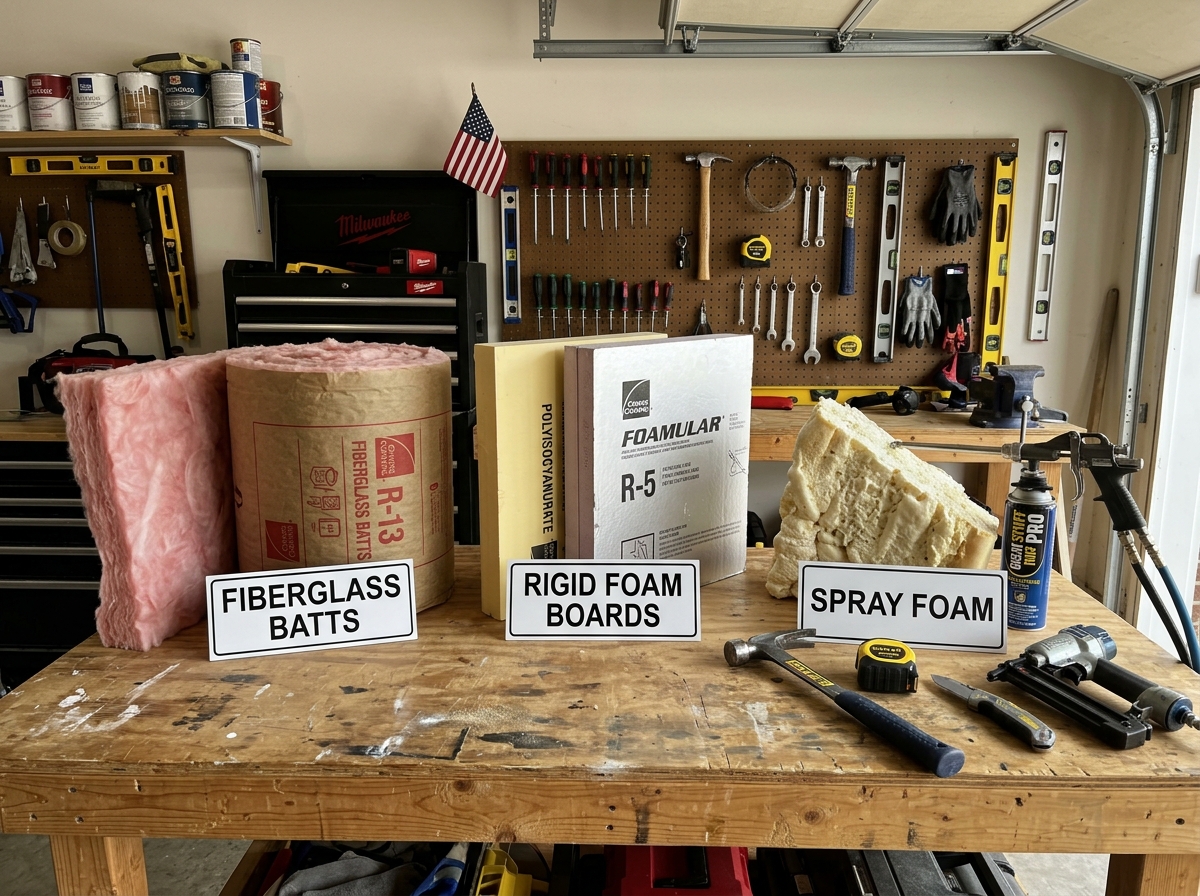
Fiberglass Batts
This is the gold standard for DIYers. It comes in pre-cut widths designed to fit perfectly between standard wall studs. It’s affordable ($0.30–$0.60 per sq. ft.) and requires no special machinery.
- Pros: Very easy to install; high fire resistance.
- Cons: Can be irritating to skin/lungs; loses effectiveness if compressed.
Rigid Foam Board
Great for thin spaces or garage doors. It provides a high R-value per inch of thickness.
- Pros: Excellent moisture resistance; doesn’t sag over time.
- Cons: More expensive than fiberglass; must be cut precisely to avoid air gaps.
Spray Foam (Open-Cell vs. Closed-Cell)
Closed-cell spray foam is the “premium” option. It acts as both insulation and an air sealer.
- Pros: Highest R-value (R-6 to R-7 per inch); creates an airtight seal.
- Cons: Usually requires a professional; expensive ($2–$5 per sq. ft.).
Cellulose and Double Bubble
Cellulose is an eco-friendly “blown-in” option made from recycled paper, often used for garage attics. Double bubble (reflective foil) is popular for metal garages because it stops radiant heat and manages moisture well on metal surfaces.
For a deeper dive into all your options, read the ultimate guide to insulating your home.
Preparation, Safety, and Building Codes
Before you start stuffing walls with pink fluff, you need to prep the space. A little work now prevents mold or fire hazards later.

Safety First
Handling insulation—especially fiberglass—requires safe fiberglass insulation installation practices. Fiberglass is made of tiny glass shards. If you touch it with bare skin, you’ll itch for days. If you breathe it in, it can damage your lungs.
- PPE Checklist: N95 mask, safety glasses, work gloves, and long sleeves/pants.
- Pro Tip: Wash your work clothes separately from the rest of your laundry to avoid spreading glass fibers!
Sealing the Gaps
Insulation stops heat transfer, but it doesn’t always stop air leaks. Use a caulking gun for small cracks and expanding spray foam for larger gaps around windows, doors, and electrical outlets. A 5% gap in your insulation can reduce its effective R-value by 25%!
Building Codes and Permits
Generally, you don’t need a permit to add insulation to an existing garage. However, if you plan to cover that insulation with drywall, check your local building codes. Most codes require a fire-rated barrier (like 5/8-inch Type X drywall) over insulation in a garage to prevent fire from spreading to the main house.
Essential Tools and Materials List
- Measuring tape (Measure twice, cut once!)
- Utility knife with extra blades
- Staple gun and 1/2-inch staples
- Straight edge or T-square for straight cuts
- Ladder
- Expanding foam (for gaps)
- Fire-block sealant (for electrical penetrations)
Step-by-Step Guide to Garage Insulation DIY: Walls and Ceilings
Ready to get to work? Follow these steps for a professional-grade finish.
Step 1: Clear and Inspect
Remove everything from the walls. Check for signs of moisture or mold. If you have a leak, fix it now! Insulation trapped against a wet wall is a recipe for rot.
Step 2: Seal Penetrations
Use your expanding foam to seal holes where wires or pipes go through the top and bottom plates of the walls. This stops “chimney effects” where air bypasses your insulation.
Step 3: Measure and Cut
Measure the height of your wall cavity. Cut your fiberglass batts about 1 inch longer than the measurement. This ensures a snug “friction fit” at the top and bottom.
Step 4: Install the Batts
Press the batt into the stud bay. Do not compress it. Insulation works by trapping air; if you squish it, you lose the R-value. Pull the paper flanges over the face of the studs (or the side, depending on your local preference) and staple every 8–12 inches.
Step 5: The Ceiling
If your garage has an open rafter system, you can use the same batt method. However, you must install rafter vents (baffles) first to ensure air can still flow from your soffits to the ridge vent. This prevents moisture buildup in the roof. If you have a finished ceiling, you might consider the blown-in cellulose option by cutting small holes and using a blower machine.
Installing Vapor Barriers Correctly
A vapor barrier (or retarder) prevents moisture from condensing inside your walls.
- Cold Climates (Zones 5-7): The vapor barrier goes on the “warm-in-winter” side (facing the inside of the garage).
- Hot/Humid Climates (Zones 1-3): You may not need one, or it may go on the exterior side.
- Check Local Codes: Incorrect placement can trap moisture and cause wood rot. When in doubt, use kraft-faced batts, which have a built-in paper vapor retarder.
Completing Your Garage Insulation DIY Project: The Door
If you insulate the walls but leave the door bare, you’re only doing half the job. A standard metal garage door has an R-value of nearly zero.
Using a Kit
The easiest garage insulation diy method for doors is a retrofit kit. These usually feature R-8 fiberglass or foam panels.
- Clean the door: Wipe down the panels so the adhesive sticks.
- Apply retention clips: Measure the center of each panel and stick the adhesive squares and clips.
- Cut and fit: Cut the insulation to fit the panel.
- Secure: Push the insulation onto the clips and snap the caps on.
The “Weighty” Issue
Insulation adds weight. A heavily insulated door might become difficult to open or cause the garage door opener to strain. If the door doesn’t stay open halfway when disconnected from the opener, you may need a professional to adjust the spring tension. Warning: Garage door springs are under high tension and can be dangerous; always call a pro for spring adjustments.
Don’t forget the weatherstripping! Replace the bottom seal and add vinyl weatherstripping to the sides and top to stop drafts. This also offers security benefits by making the door harder to pry and much quieter.
Common Mistakes and Maintenance Tips
Even the best DIYers can make mistakes. Watch out for these common pitfalls:
- Compression: We’ve said it before, but it bears repeating. Don’t stuff an R-19 batt into a 2×4 wall. It will perform worse than an R-13 batt that fits properly.
- Skipping Air Sealing: Insulation is not a windbreaker; it’s a sweater. If you don’t seal the gaps with caulk or foam, the wind will blow right through it.
- Vapor Barrier Blunders: Putting the plastic on the wrong side can trap moisture against your studs, leading to mold.
- Leaving it Exposed: Most insulation is flammable. Always cover it with fire-rated drywall to meet safety codes.
Maintenance and Longevity
Fiberglass and rigid foam can last 20 to 100 years if they stay dry.
- Routine Inspections: Once a year, check for sagging or damp spots.
- Pest Control: Mice love nesting in fiberglass. Keep your garage sealed and use peppermint oil or traps if you see signs of visitors.
- Check Seals: Replace your door’s bottom weatherstripping every few years as it cracks and wears down.
For more long-term strategies, see our energy saving methods for home insulation.
Frequently Asked Questions about Garage Insulation
Should I insulate my garage if it is not heated?
Yes! Even without a heater, insulation keeps the garage 10–20 degrees warmer in winter and significantly cooler in summer. If your garage is attached, it’s essential for protecting the energy efficiency of the rest of your home.
Do I need a permit to insulate my garage?
Usually, no permit is required for adding insulation to an existing structure. However, if you are adding electrical outlets or structural changes alongside the insulation, or if you are finishing the walls with drywall for the first time, a quick call to your local building department is a smart move.
Can I install insulation over existing drywall?
You can’t easily put batts over drywall, but you can have a professional blow loose-fill cellulose into the wall cavities through small holes. Alternatively, you can install rigid foam boards directly over the drywall and then add another layer of drywall on top, though this is more labor-intensive.
Conclusion
At Financefyx, we believe that smart home ownership is about more than just financing; it’s about making your space work for you. Garage insulation diy is a rare project that pays for itself through lower energy bills, increased home value, and the simple joy of having a comfortable place to work on your car or hit the treadmill.
By prioritizing your shared walls, choosing the right R-value for your climate, and taking the time to seal air leaks, you can transform your garage from a drafty storage unit into a high-performance part of your home. Ready to save even more? Discover more energy saving tips on our blog and start your next project today!
