
Everything You Need to Know About External Wall Insulation
Why Finding the Right External Wall Insulation Installer Near Me Could Cut Your Heating Bills in Half
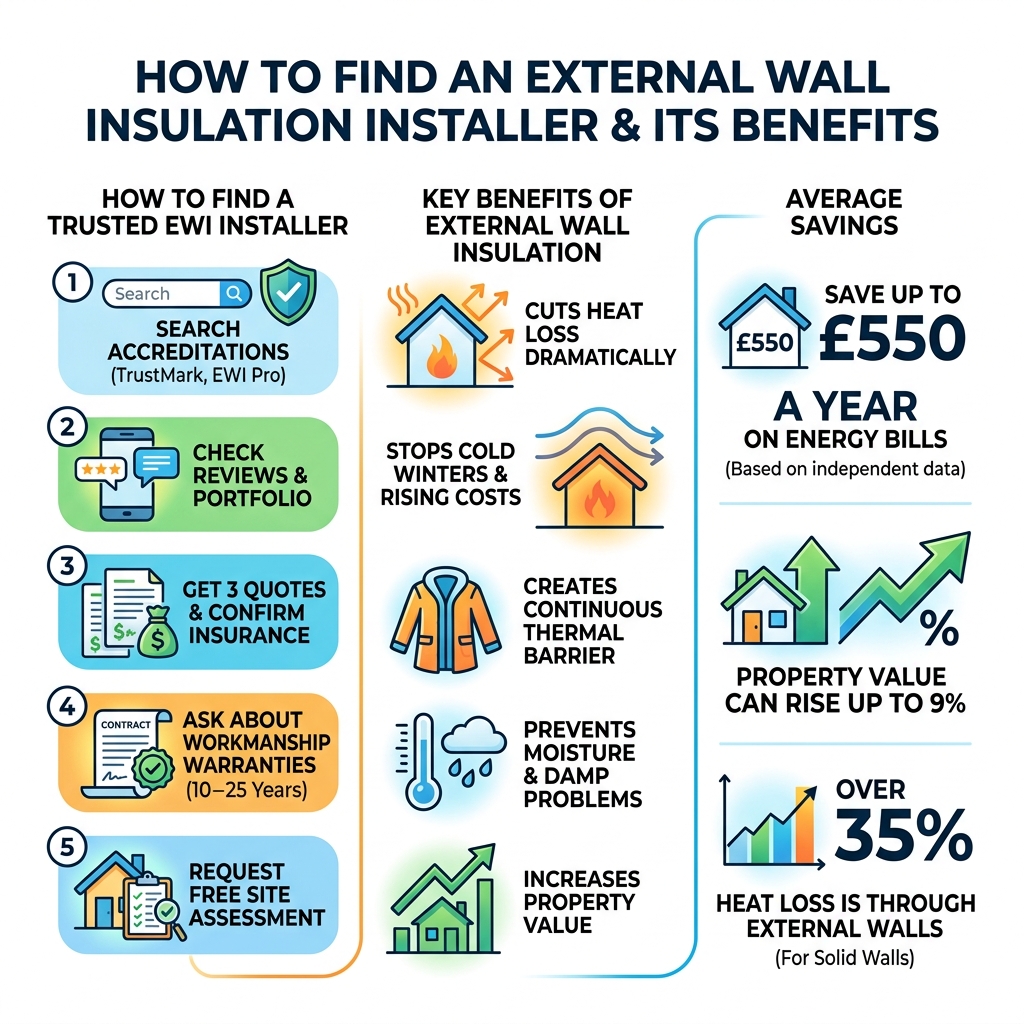
Finding a trusted external wall insulation installer near me is one of the smartest moves you can make as a homeowner dealing with cold winters and rising energy costs. Here’s what you need to know upfront:
Quick answer — how to find a reliable EWI installer near you:
- Search for installers with TrustMark or EWI Pro accreditation
- Check Google reviews and ask for a portfolio of recent local projects
- Get at least 3 quotes and confirm each installer carries full insurance
- Ask about workmanship warranties (reputable installers offer 10–25 years)
- Request a free site assessment before committing to any contract
Around 35% of all heat lost from a home escapes through the external walls. If your house was built before the 1920s, it almost certainly has solid walls — and solid walls lose heat fast.
The good news? External wall insulation (EWI) can cut that heat loss dramatically. Independent data suggests homeowners can save up to £550 a year on energy bills after installation — and property values can rise by as much as 9%.
But the savings only come when the job is done right. A poorly chosen installer can leave you with damp problems, cracked render, or insulation that simply doesn’t perform. That’s why choosing the right local professional matters as much as the product itself.
This guide covers everything — from understanding what EWI actually is, to finding vetted installers, comparing materials, navigating grants, and knowing what questions to ask before you sign anything.
What is External Wall Insulation and How Does It Work?
At its core, external wall insulation (EWI) is like giving your house a high-tech winter coat. Instead of trying to stuff insulation into a tiny wall cavity or losing precious floor space by insulating from the inside, we apply a protective thermal layer directly to the outside of your property.
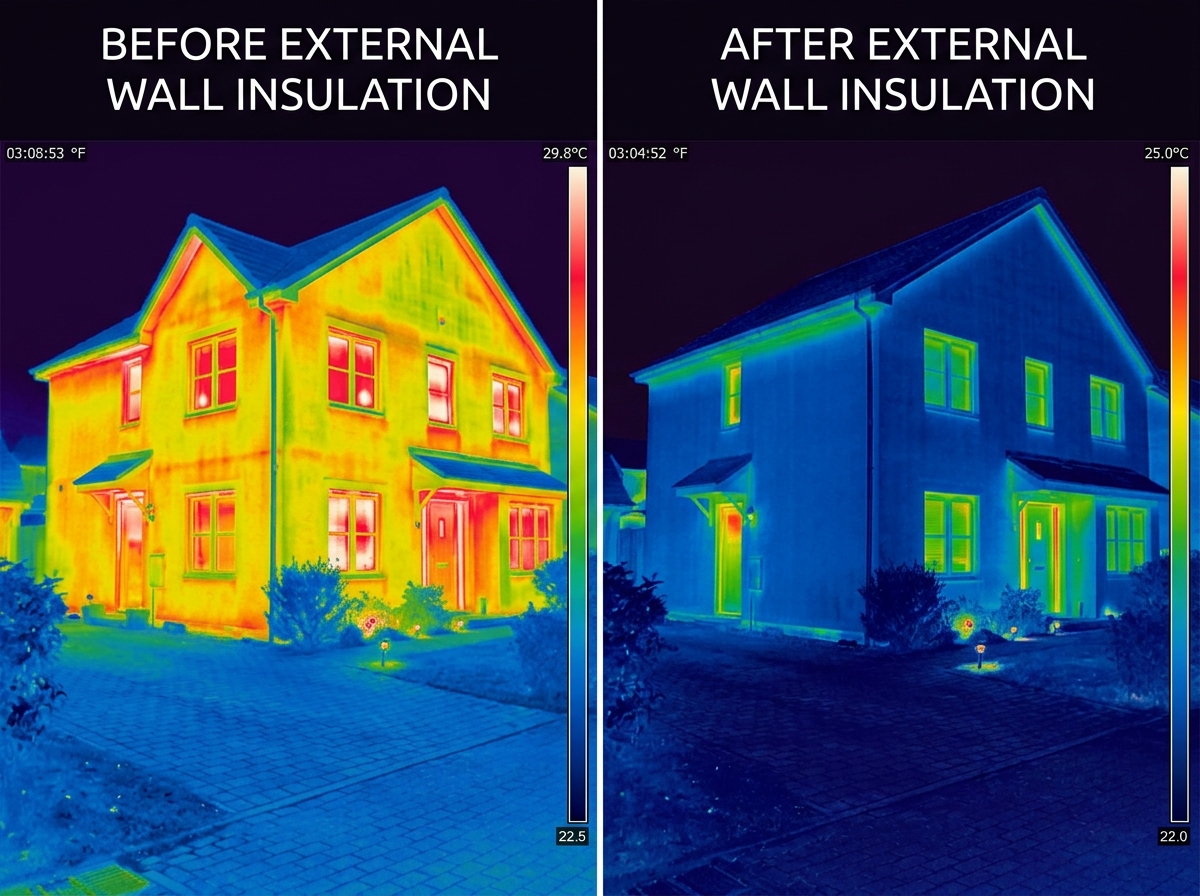
The system works by creating a continuous thermal barrier. This barrier prevents heat from escaping during the winter and stops the sun’s rays from baking your rooms in the summer. Because the insulation is on the outside, the actual structure of your walls stays warm. This is a massive win for your home’s health because warm walls are much less likely to suffer from the dreaded “interstitial condensation”—that hidden moisture that can rot timbers and cause structural damage over time.
The Anatomy of an EWI System
When you hire an external wall insulation installer near me, they won’t just slap some foam on the brickwork and call it a day. A professional system is built in layers:
- Adhesive/Fixings: The insulation boards are glued and mechanically fastened to the existing wall.
- Insulation Board: This is the “meat” of the system (EPS, Mineral Wool, etc.).
- Base Coat & Mesh: A cementitious layer reinforced with fiberglass mesh to provide strength and impact resistance.
- Primer: Prepares the surface for the final look.
- Decorative Finish: This is the render or cladding that makes your house look brand new.
Common EWI Materials
Choosing the right material is vital. While we cover this more in the ultimate guide to insulating your home, here is a quick breakdown of what most installers use:
- Expanded Polystyrene (EPS): The most popular choice. It’s lightweight, cost-effective, and incredibly easy to install.
- Mineral Wool: Excellent if you are worried about noise or fire safety. It’s breathable and provides great acoustic insulation.
- Phenolic Resin: The “premium” option. It has the highest R-value, meaning you can use thinner boards to achieve the same level of warmth.
- Woodfibre: A sustainable, eco-friendly option often used in “breathable” traditional builds.
| Material | R-Value (Efficiency) | Relative Cost | Best For |
|---|---|---|---|
| EPS | Moderate | Low | Budget-friendly retrofits |
| Mineral Wool | Moderate | Medium | Fire safety & soundproofing |
| Phenolic | High | High | Maximum warmth with thin walls |
| Woodfibre | Moderate | High | Eco-conscious/Historic homes |
Key Benefits of Hiring an External Wall Insulation Installer Near Me
Why bother with the outside of the house? Well, beyond the obvious “it makes the place look shiny and new,” the functional benefits are staggering. Research shows that properly insulating can save 10% on yearly energy bills just by sealing up leaks and adding barriers to attics and basements. When you add EWI into the mix, those savings skyrocket.
1. Massive Energy Bill Reductions
External wall insulation can save you up to £550 a year on energy bills. In some cases, homeowners have reported a 45% reduction in their heating costs. Because your walls act as a “thermal mass,” they hold onto the heat longer, meaning your boiler doesn’t have to work nearly as hard.
2. Boosting Property Value
First impressions matter. A fresh silicone render or modern brick-slip finish can transform a tired-looking house into the best-looking property on the street. Studies from University College London suggest that EWI can increase your property value by 8% to 9%. It’s one of the few home improvements that pays for itself through both savings and equity.
3. Banishing Damp and Mould
If you live in a solid-wall home, you’re likely familiar with black mould in the corners of rooms. This happens because warm, moist air hits a cold wall and turns into water. By moving the “dew point” to the outside of the wall, EWI keeps the interior surface warm, effectively eliminating the conditions mould needs to grow.
4. Noise Reduction
If you live near a busy road or under a flight path, you’ll love the acoustic benefits. The thick layers of insulation and dense render act as a sound buffer, making your home a much quieter, more peaceful sanctuary.
Finding a Reliable External Wall Insulation Installer Near Me
You wouldn’t let a random person perform surgery on you, so don’t let an unvetted contractor perform “surgery” on your home’s exterior. The EWI industry is specialized. To ensure you’re getting the best results, we recommend exploring energy saving methods for home insulation to understand the technical standards required.
When searching for a pro, look for these specific “trust signals”:
- TrustMark Endorsement: This is a government-backed quality scheme.
- PAS 2030/2035 Certification: Essential if you are looking to access government grants.
- Manufacturer Accreditation: Many top material brands only give warranties if the installer is specifically trained on their system.
What to Look for in a Local External Wall Insulation Installer Near Me
Local knowledge is king. A local external wall insulation installer near me will understand the specific weather challenges of your area and will be familiar with local building codes.
Here is your “Hire Right” checklist:
- Insurance: Do they have Public Liability and Professional Indemnity insurance?
- The “Sniff Test” on Quotes: If a quote is 50% cheaper than everyone else, they are likely cutting corners on the number of fixings or the quality of the render.
- Site Assessment: A reputable pro will never give you a final price over the phone. They need to see the condition of your brickwork, check for damp, and measure the “reveals” (the areas around windows and doors).
- Portfolio: Ask to see a house they did three or four years ago—not one they finished yesterday. You want to see how the finish holds up against the elements.
The Installation Process and Post-Installation Maintenance
We know what you’re thinking: “Is my garden going to be a building site for six months?” Actually, the process is surprisingly streamlined. Because all the work happens outside, you don’t even need to be home while they work.
The 5-Step Timeline
- Preparation (Days 1-2): Scaffolding goes up. Pipework, satellite dishes, and alarm boxes are moved or extended. Any loose render is hacked off.
- Insulation Fitting (Days 3-5): The boards are glued and “pinned” to the wall using specialized mechanical fixings.
- Reinforcement (Days 6-8): A base coat is applied, and a fiberglass mesh is embedded into it to prevent cracking.
- Priming and Rendering (Days 9-12): The final decorative layer is applied. This is usually weather-dependent—you can’t render in a downpour!
- Completion (Days 13-14): Scaffolding comes down, everything is cleaned, and fixtures are put back.
Maintenance: Keeping it Fresh
One of the best things about modern silicone renders is that they are “self-cleaning.” The hydrophobic surface means dirt mostly washes away with the rain. However, for long-term care:
- Gentle Wash: Every few years, give the walls a low-pressure wash with water to remove algae or dust.
- Inspect Seals: Check the mastic seals around windows once a year to ensure no water is sneaking behind the system.
- Avoid High Pressure: Never use a high-powered jet wash directly on the render, as it can damage the finish.
For more seasonal advice, check out our catch the heat insulation tips for winter.
Comparing External vs. Internal Wall Insulation
Many homeowners wonder if they should just insulate the inside. While internal wall insulation (IWI) can be cheaper upfront, it comes with significant downsides.
- Floor Space: IWI can eat up to 10cm of space on every external wall. In a small terrace house, that’s like losing a whole closet’s worth of room.
- Disruption: With IWI, you have to rip out skirting boards, move radiators, and re-plaster. It’s messy. EWI is “business as usual” inside.
- Thermal Bridging: EWI covers the whole house like a blanket. IWI often leaves “gaps” where internal walls meet external ones, creating cold spots where condensation can gather.
For a deeper dive into the pros and cons, read our guide on insulating your home for energy efficiency.
Frequently Asked Questions About External Wall Insulation
Is my home suitable for external wall insulation?
If your home was built before 1920, it likely has solid walls (no gap between the bricks). These are the prime candidates for EWI. You can tell by looking at the brick pattern: if all the bricks look the same length, it’s likely a cavity wall. If you see some bricks “end-on” (short ends facing out), it’s a solid wall.
Even if you have a cavity wall that has already been filled, EWI can be added for extra “super-insulation” performance. Just be sure to check if you live in a Conservation Area, as you might need planning permission to change the look of your facade.
How much does EWI cost and are there grants available?
The cost typically ranges from £100 to £160 per square metre, depending on the materials and the complexity of the building (e.g., how many windows or tricky corners you have).
The good news is that there are often government incentives available. In the UK, schemes like the ECO4 or the Great British Insulation Scheme can provide significant funding—sometimes covering the entire cost for eligible households. In the US, you can often find tax credits of up to $1,200 for energy-efficiency upgrades. Always ask your external wall insulation installer near me if they are registered for current grant schemes.
What are the best finishes for external walls?
You aren’t stuck with one look! You can choose:
- Silicone Render: The gold standard. It’s flexible (so it won’t crack), breathable, and comes in hundreds of colors.
- Brick Slips: Thin slices of real brick that make the house look like traditional masonry.
- Composite Cladding: For a modern, “Scandi” wood-look finish without the maintenance of real timber.
- Pebbledash: A classic, rugged finish that is incredibly durable.
Conclusion
Investing in external wall insulation is one of the most impactful decisions you can make for your home’s future. It’s a triple threat: it slashes your monthly outgoings, makes your living space significantly more comfortable, and protects the structural integrity of your property for decades to come.
By choosing a qualified external wall insulation installer near me, you aren’t just buying “stuff” for your walls; you’re buying peace of mind. You’re ensuring that your home remains a warm, dry, and energy-efficient sanctuary regardless of what the weather—or the energy market—throws at you.
Ready to make your home more efficient? Check out more energy saving tips at Financefyx to keep your bills low and your comfort high!
