
Cooking with Sun: A Guide to Solar Heat Retention
Why Solar Panel Heat Retention Costs You More Than You Think
Solar panel heat retention is one of the biggest — and least talked about — reasons your solar system underperforms. Here’s the short version:
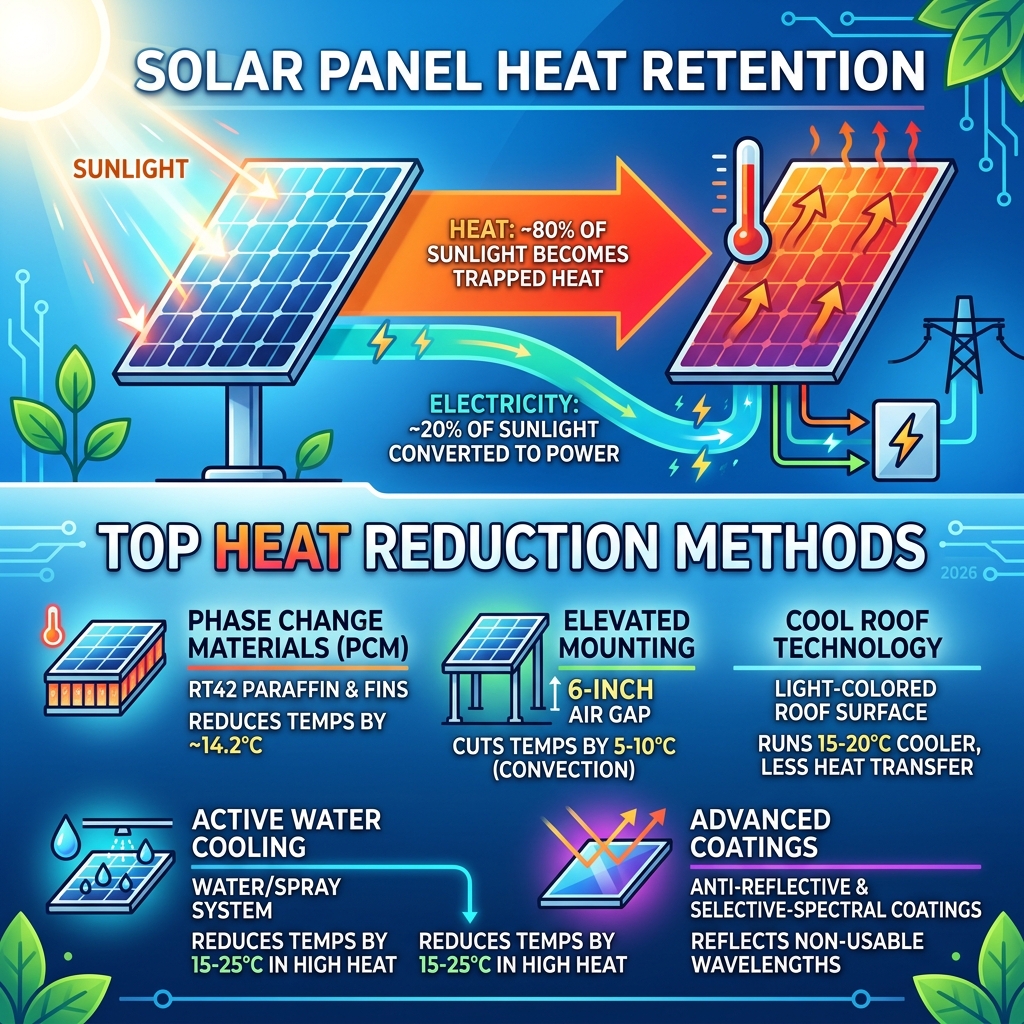
Top heat retention systems for solar panels:
- Phase Change Materials (PCM) – Passive thermal storage that absorbs excess heat; RT42 paraffin with triangular fins can reduce panel temps by 14.2°C
- Elevated mounting systems – A 6-inch air gap beneath panels cuts operating temps by 5-10°C through convection
- Cool roof technology – Light-colored roofing runs 15-20°C cooler than dark surfaces, reducing heat transfer to panels
- Active water/spray cooling – Reduces panel temperature by 15-25°C in high-heat environments
- Anti-reflective and selective-spectral coatings – Reflect non-usable wavelengths before they become heat
Most homeowners expect more sun to mean more power. The reality? It’s the opposite.
Solar panels are rated at 25°C (77°F) under lab conditions. On a typical summer day, your panels are running at 50-70°C — and losing efficiency every degree above that baseline.
Here’s the core problem: solar panels only convert about 16-20% of sunlight into electricity. The remaining 80-84% becomes heat. That heat stays trapped in the panel, slows electron flow, and quietly drains your system’s output.
For every degree Celsius above 25°C, a typical panel loses 0.30-0.50% of its rated power. On a hot afternoon at 65°C, that’s a 16% power loss — gone, just from heat.
For homeowners already battling high energy bills, that’s not a small number.
The good news: managing solar panel heat retention is a solvable problem. The right materials, mounting choices, and system design can recover much of that lost output — and protect your panels for decades longer.
The Physics of Solar Panel Heat Retention
To understand why your panels get so hot, we have to look at the science of what’s happening on your roof. When sunlight hits a solar cell, it’s not just “making power.” It’s a high-energy collision of photons.

In a perfect world, every photon would knock an electron loose and send it down the wire as electricity. In the real world, most of that energy just makes the silicon atoms vibrate like they’re at a rock concert. This vibration is what we feel as heat.
Standard Test Conditions (STC) assume a cell temperature of 25°C (77°F). However, panels typically operate 20-40°C above the ambient air temperature. This means if it’s a beautiful 30°C (86°F) day outside, your panels are likely sizzling at 50-70°C (122-158°F). If you’re new to this, our Solar Energy Guide for Beginners covers the basics of how these systems interact with the environment.
A major factor in this equation is radiative heat loss. Research into Radiative heat loss from PV systems shows that panels actually radiate 30% to 60% of their heat back to the sky during the day. However, traditional models often miss this, leading to surprises when modules actually become colder than the air at night because they are so efficient at “dumping” heat into the cold vacuum of space.
Optimal Operating Temperatures
While panels can survive extreme heat, they have a “happy place.” The optimal operating range for maximum efficiency is generally between 15°C and 35°C (59°F to 95°F). Once the cell temperature passes that 25°C STC mark, the internal resistance starts to climb. Think of it like trying to run a marathon in a sauna; you can do it, but you won’t be setting any personal records.
How Solar Panels Generate Internal Heat
The heat doesn’t just come from the sun’s warmth; it’s generated internally through several processes:
- Photon Absorption: Roughly 80-90% of incident radiation is absorbed by the panel, but only a fraction is converted to electricity.
- Resistance Losses: As electrons move through the silicon and the metal ribbons, they encounter resistance, which generates heat (just like a toaster filament).
- Recombination Processes: Sometimes an electron gets “excited” but then falls back into a hole without entering the circuit. This wasted energy is released as heat.
- Sub-bandgap Radiation: Some light wavelengths don’t have enough energy to create electricity but are still absorbed by the backsheet or frame, contributing significantly to solar panel heat retention.
Efficiency Killers: Temperature Coefficients and Power Loss
When we talk about solar panel heat retention, the “Temperature Coefficient of Pmax” is the most important number on your spec sheet. It tells us exactly how much power we lose for every degree the temperature rises.
As the temperature climbs, the voltage of the panel drops significantly. While the current (amperage) might actually increase slightly, the massive drop in voltage means the total Power (Watts = Volts x Amps) goes down. This is because heat causes silicon atoms to vibrate more violently, making it harder for electrons to flow in an orderly fashion. Understanding these metrics is key to calculating your Solar Panels Cost and Savings.
Calculating the Impact of Solar Panel Heat Retention
Let’s do some quick math. If you have a high-quality 400W panel with a temperature coefficient of -0.38%/°C:
- Standard Temp: 25°C (Output: 400W)
- Actual Operating Temp: 45°C (A 20°C difference)
- Calculation: 20°C x 0.38% = 7.6% loss.
- Real Output: 369.6W.
On a very hot day where the panel reaches 65°C (149°F), that loss jumps to 15.2%, meaning your 400W panel is only giving you 339W. This is why a Thermal analysis of solar panel with phase change material: experimental and numerical study is so vital for the industry; it proves that managing these temperatures isn’t just “neat science”—it’s a financial necessity.
Real-World Factors Increasing Panel Heat
Several environmental and installation factors can turn your roof into a griddle:
- Irradiance Intensity: More sun means more photons, which means more internal heat generation.
- Wind Speed: A gentle breeze of just 1 m/s can reduce panel temperatures by 5-11°C through convection.
- Roof Color: Dark asphalt shingles absorb heat and radiate it back into the underside of the panels.
- Mounting Height: Panels installed flush against a roof have nowhere to “breathe,” trapping heat in the narrow gap.
- Frame Color: Believe it or not, black frames can increase operating temperatures by 2-3°C compared to silver frames because they absorb more thermal energy.
Environmental Impacts: From Rooftop Cooling to the PVHI Effect
We often hear that solar panels are “hot,” but they can actually help keep your home cool. It sounds like a contradiction, but it’s all about where the heat goes.
When we install panels, they act as a giant sunshade for your roof. By absorbing the sunlight that would otherwise hit your shingles, they reduce the amount of heat that enters your attic. This shading effect can significantly lower your air conditioning needs during the day. If you’re planning an install, check out our Home Solar Panel Installation Guide to ensure you maximize this benefit.
The Photovoltaic Heat Island (PVHI) Effect
While panels cool the building underneath them, large-scale solar farms can create a “Photovoltaic Heat Island” (PVHI) effect. In these massive installations, the panels absorb so much energy and have such a low “albedo” (reflectivity) compared to natural desert or grass that they can warm the local air by about 1.3°C during the day.
However, unlike cities made of concrete and asphalt, solar farms tend to cool down rapidly at night. They don’t have the same “thermal mass” as a skyscraper, so the heat doesn’t stay trapped until morning.
How Panels Affect Building Thermals
It’s a bit of a double-edged sword:
- Summer Benefit: Panels provide shading, reducing daytime AC load.
- Winter Penalty: In cold climates, that same shading can prevent the sun from naturally warming your roof in the winter, slightly increasing heating costs.
- Nighttime Cooling: In some cases, panels can actually obstruct “radiative cooling”—the process where a roof dumps heat into the night sky—which might keep a house slightly warmer on summer nights.
Advanced Technologies to Mitigate Solar Panel Heat Retention
If you’re looking to buy a heat retention system (or rather, a heat reduction system), we are currently in a golden age of solar innovation. We aren’t just limited to “leaving a gap” anymore.
The most exciting development in solar panel heat retention management is the use of Phase Change Materials (PCM). These are substances—like specialized waxes—that absorb massive amounts of heat as they melt. Even for those looking for Renewable Energy Solutions for Apartments, understanding these thermal dynamics can help in choosing portable or balcony-mounted options that won’t overheat.
Passive Cooling Solutions for Solar Panel Heat Retention
A recent Thermal regulation of photovoltaic panels using PCM with multiple fins configuration study found that integrating RT42 paraffin wax with triangular aluminum fins on the back of a panel is incredibly effective.
- The Result: A temperature reduction of 14.2°C.
- The Benefit: This translates to a roughly 10-25% increase in electrical efficiency. The PCM acts like a thermal battery, soaking up the heat during the peak of the day and releasing it slowly at night when it doesn’t hurt your power production.
Installation Strategies for Better Airflow
You don’t always need high-tech wax to see results. Simple physics goes a long way:
- The 6-Inch Rule: Maintaining at least a 6-inch clearance beneath panels allows for natural “chimney effect” cooling.
- Elevated Mounting: Raising panels higher off the roof surface can reduce operating temperatures by 5-10°C.
- Anti-Reflective Coatings: These coatings help more light enter the cell rather than bouncing around and creating heat on the glass surface. For those going off the grid, these small gains are essential—see our Off-Grid Solar Panel Tips for more.
Longevity, Safety, and Future Innovations
Managing solar panel heat retention isn’t just about today’s power bill; it’s about making sure your system lasts for the next 25 years.
Most solar panels are designed to operate safely up to 85°C (185°F). Once you cross that threshold, things get dangerous. Excessive heat can lead to:
- Hot Spot Formation: Localized areas of intense heat that can actually melt the solder or crack the glass.
- Encapsulant Degradation: The “glue” that holds the panel together can turn yellow or brittle, blocking light and letting in moisture.
- Accelerated Degradation: While most panels lose about 0.5% efficiency per year, panels that constantly run hot can degrade at 0.8% to 1.2% per year, cutting years off their useful life. This is a critical factor when looking at The 2025 Guide to 5KW Solar Panel System Costs.
Future Materials for Managing Solar Panel Heat Retention
We are moving toward “cool photovoltaics.” Research into Heat-dissipation performance of photovoltaic panels with a phase-change-material fin structure is just the beginning.
- Selective-Spectral Cooling: Engineers are developing filters that reflect the “sub-bandgap” light (the stuff that can’t make electricity but can make heat) while letting the useful light through.
- Radiative Sky Cooling: New nanotechnology coatings can help panels “beam” their heat into space even while they are sitting in direct sunlight.
The Role of AI in Thermal Monitoring
In 2025 and beyond, we expect to see more systems integrated with AI-driven monitoring. These systems use real-time sensors to predict when a panel is reaching a critical temperature and can trigger active cooling or adjust the load to prevent damage. Proactive maintenance based on this data can extend a panel’s life from 25 years to over 30 years.
Frequently Asked Questions about Solar Heat
Do solar panels make my house warmer?
Actually, no! In most cases, they make your house cooler. Because the panels sit on racks above your roof, they create a shading effect. This prevents the sun from beating down directly on your shingles. Studies show that the air gap between the panel and the roof acts as a buffer, reducing the heat transfer into your attic and lowering your AC costs by up to 5-10%.
What is the maximum safe temperature for solar panels?
The industry standard for the maximum safe operating temperature is 85°C (185°F). If your panels hit 90°C (194°F), you are in the danger zone for critical failures like solder bond melting or “delamination,” where the layers of the panel start to peel apart. If you live in a desert climate, high-quality panels with low temperature coefficients are a must.
How does cold weather affect solar panel performance?
Solar panels love the cold. Because silicon is a semiconductor, electrons move much more efficiently when it’s chilly. You might see a 5-10% efficiency gain on a bright, freezing January day compared to a sweltering July afternoon. As long as the sun is shining and the panels aren’t covered in snow, winter can actually be your most productive season for “peak” efficiency.
Conclusion
At Financefyx, we believe that understanding the “hidden” physics of your energy system is the key to a better return on investment. Solar panel heat retention is a natural byproduct of turning sunlight into power, but it doesn’t have to be an efficiency killer.
By choosing panels with superior temperature coefficients, ensuring proper airflow during installation, and considering advanced cooling technologies like PCMs, you can protect your investment and keep your “solar kitchen” from overheating.
Ready to take the next step in your green energy journey? Explore more Renewable Energy Solutions on our site to find the perfect fit for your home.
