
Getting the Best R Value for Your Exterior Walls
Why the Best R-Value Walls Matter for Your Home’s Comfort and Energy Bills
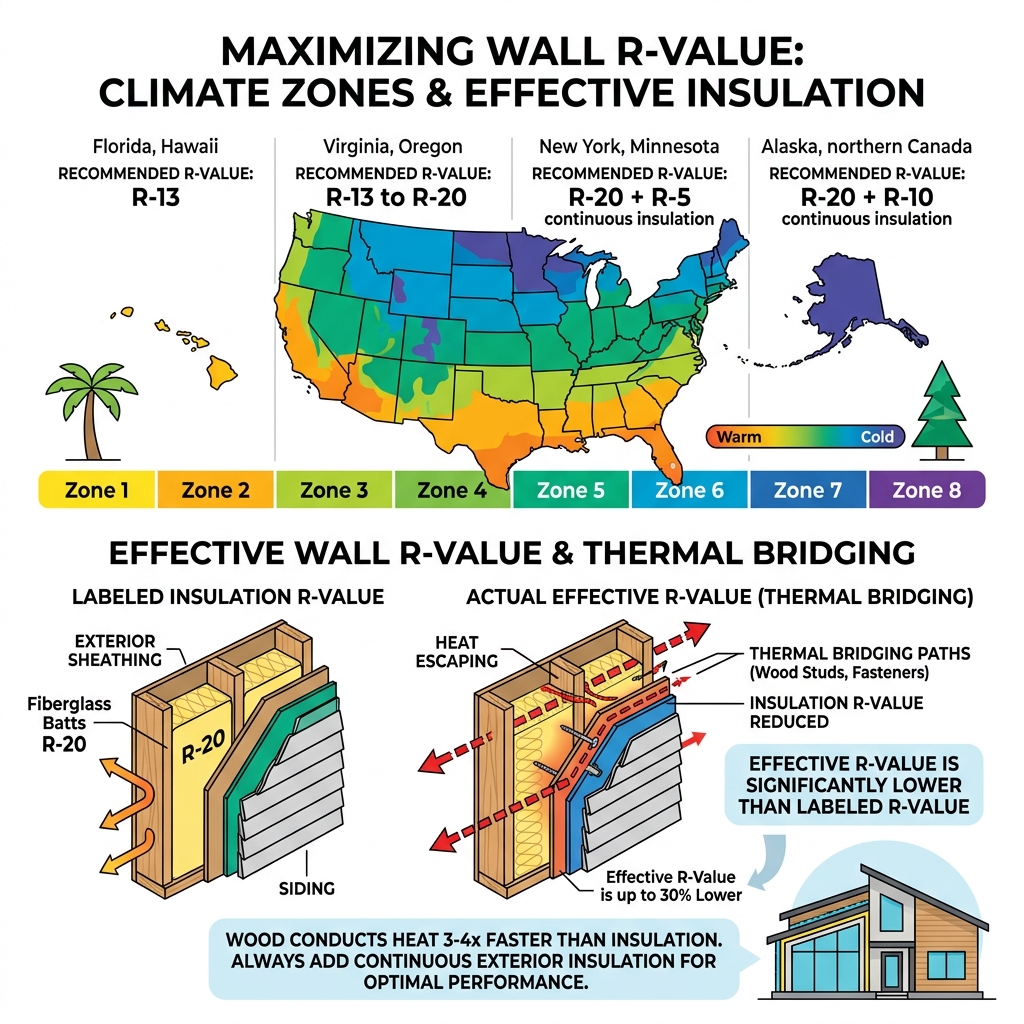
The best r value walls for your home depend on where you live. Here’s a quick answer:
| Climate Zone | Examples | Recommended Wall R-Value |
|---|---|---|
| Zones 1-2 | Florida, Hawaii | R-13 |
| Zones 3-4 | Virginia, Oregon | R-13 to R-20 |
| Zones 5-6 | New York, Minnesota | R-20 + R-5 continuous insulation |
| Zones 7-8 | Alaska, northern Canada | R-20 + R-10 continuous insulation |
Quick rule of thumb: The colder your winters, the higher the R-value you need. In most cold climates, aim for at least R-20 in your wall cavity plus continuous exterior insulation.
If your home feels drafty in winter — or your heating bills keep climbing — your exterior walls may be to blame.
Most homeowners focus on the attic. But walls cover far more surface area of your home’s envelope. A poorly insulated wall doesn’t just let heat escape. It creates cold spots, condensation, and uncomfortable rooms no matter how hard your furnace works.
R-value is the number that tells you how well a wall resists heat flow. The higher the R-value, the less heat escapes. Simple.
But here’s the catch: the R-value printed on an insulation package is almost never what your finished wall actually delivers. Wood studs, metal fasteners, and air gaps all act as shortcuts for heat to bypass your insulation — a problem called thermal bridging. According to building science research, wood framing alone accounts for roughly 23% of a wall assembly, and it conducts heat 3 to 4 times faster than insulation does.
That gap between labeled R-value and real-world wall performance is exactly what this guide is about.
Understanding R-Value and Thermal Bridging in Exterior Walls
To get the best r value walls, we first have to understand what we are fighting against: heat transfer. In building science, R-value stands for “resistance.” It measures how well a material prevents heat from traveling through it. The higher the number, the better the insulation. However, a wall isn’t just a solid block of insulation; it’s a complex sandwich of wood, nails, wires, and sheathing.
This brings us to the “invisible” enemy of energy efficiency: thermal bridging. Imagine you’re wearing a thick, high-tech winter parka, but it has metal zippers that run from your neck to your waist and down both arms. Even if the down filling is top-rated, those metal zippers will pull the heat right off your body.
In a house, your wood or steel studs are those zippers. Wood conducts heat about three to four times faster than the insulation sitting between the studs. In a standard home with studs spaced 16 inches apart, about 23% to 25% of your wall is actually solid lumber, not insulation. This means nearly a quarter of your wall is acting as a “bridge” for heat to escape.
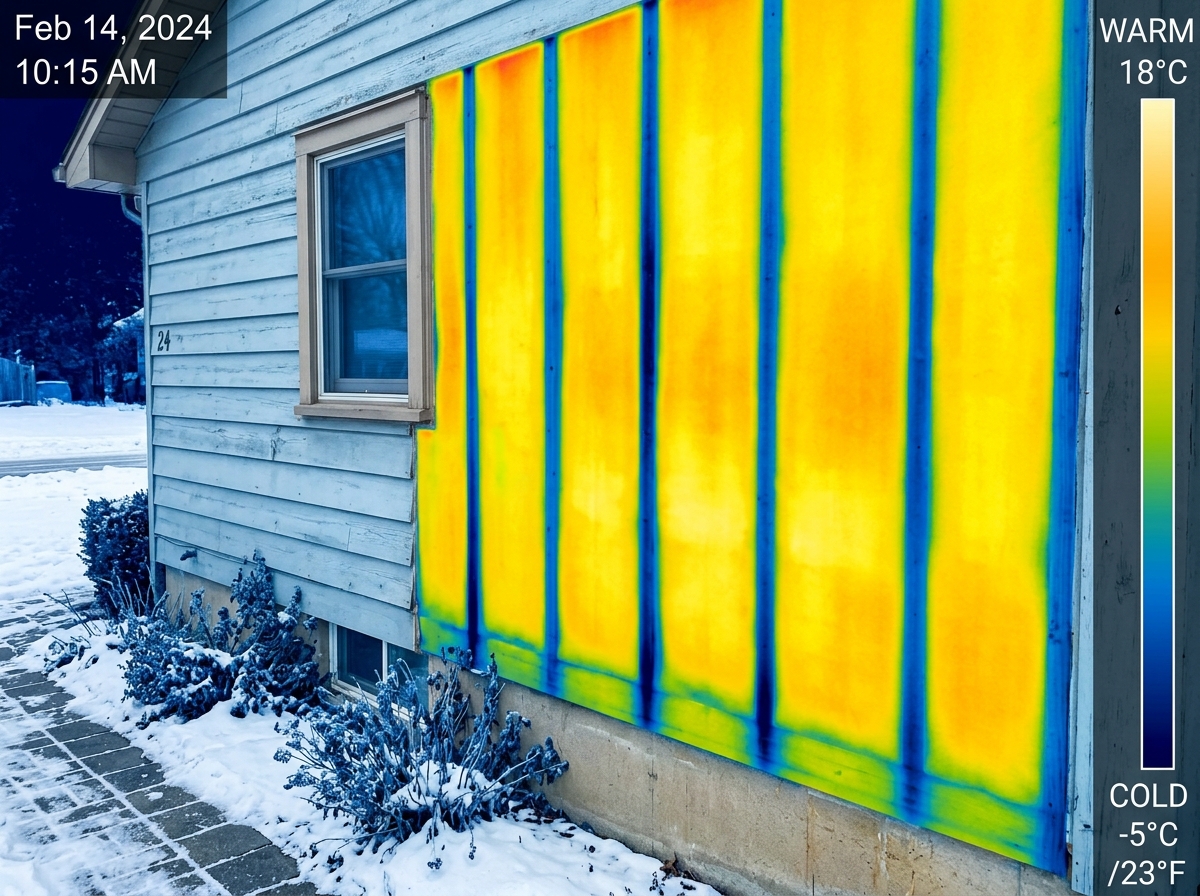
When we talk about the “effective” R-value, we are looking at the performance of the whole assembly, not just the pink fiberglass in the middle. If you have an R-20 batt in a wood-framed wall, your actual whole-wall performance might only be R-15 once you factor in all that wood. Understanding these nuances is a key part of insulating-your-home-for-energy-efficiency because it shifts the focus from buying “thick” insulation to building “smart” walls.
Recommended R-Values by Climate Zone and Building Code
Not all walls are created equal because not all climates are the same. A home in sunny Miami doesn’t need the same thermal armor as a cabin in the Yukon. To help homeowners and builders, the Department of Energy (DOE) and the International Energy Conservation Code (IECC) have broken the country down into climate zones, numbered 1 through 8.
The 2021 IECC standards brought about one of the biggest shifts in residential energy codes in a decade. For the first time, continuous insulation (ci) became a strict requirement for many colder regions. This is because the industry finally acknowledged that cavity insulation alone simply cannot overcome the thermal bridging problem in extreme cold.
To see how your current home stacks up, you can use the Home Energy Yardstick tool to compare your energy use against similar homes. In the meantime, here is a breakdown of what the modern codes generally require for wood-framed versus mass walls (like concrete or brick).
| Climate Zone | Wood-Framed Wall Requirement | Mass Wall Requirement |
|---|---|---|
| Zone 1 & 2 | R-13 | R-3 to R-4 |
| Zone 3 | R-20 or R-13 + R-5 ci | R-8 to R-13 |
| Zone 4 (except Marine) | R-20 or R-13 + R-5 ci | R-13 |
| Zone 5, 6, 7 & 8 | R-20 + R-5 ci or R-13 + R-10 ci | R-13 to R-20 |
Note: “ci” stands for continuous insulation, usually a layer of rigid foam on the outside of the studs.
Best R Value Walls: Comparing High-Performance Assemblies
When we set out to design the best r value walls, we usually look at two main components: cavity insulation (the stuff between the studs) and continuous insulation (the blanket on the outside).
For a standard 2×6 wall, simply stuffing it with a higher-density batt isn’t always the answer. Advanced framing techniques—like spacing studs 24 inches apart instead of 16—can help by reducing the amount of wood (and thus the thermal bridging) in the wall. However, the real “gold standard” for modern efficiency is the combination of cavity fill and an exterior “thermal break.”
By using these energy-saving-methods-for-home-insulation, we can push a standard wall from a mediocre R-15 effective rating to a high-performance R-25 or even R-30.
Achieving the Best R Value Walls with Continuous Insulation
Continuous insulation is exactly what it sounds like: a layer of insulation that covers the entire exterior of the building, including the studs. This acts like a cozy sweater for your house, stopping the “zipper” effect of thermal bridging.
Common materials for this layer include:
- Polyisocyanurate (Polyiso): Offers the highest R-value per inch (about R-6.0 to R-6.5), though its performance can dip slightly in extremely cold temperatures.
- Extruded Polystyrene (XPS): The classic “blue” or “pink” board, usually rated at R-5 per inch.
- Expanded Polystyrene (EPS): The most cost-effective option, often used in Latest research on high-R wall innovations. It’s vapor-permeable, which helps walls breathe.
- Mineral Wool Board: A favorite for many builders because it is fire-resistant, soundproof, and allows moisture to escape the wall easily.
Adding just one inch of R-5 continuous insulation to a 2×6 wall can improve its total thermal performance by over 20%. It also keeps the wood studs warmer, which prevents moisture from condensing inside your walls—a major win for durability.
Double-Stud vs. Single-Stud for the Best R Value Walls
If you want to go “Full Passive House” or achieve Net Zero status, you might look beyond the single-stud wall. The two heavyweights in high-performance building are the Double-Stud Wall and the Single-Stud with Thick Exterior Foam.
- Double-Stud Walls: These consist of two separate 2×4 walls with a gap between them. The entire “thick” cavity—sometimes 12 inches or more—is filled with dense-pack cellulose. This can achieve a staggering R-40 or higher. The main benefit is that there is no wood connecting the inside to the outside, virtually eliminating thermal bridging.
- Single-Stud + Thick Foam: This uses a standard 2×6 wall but adds 2 to 4 inches of rigid foam on the outside. It’s often easier for traditional crews to build, but the cost of long screws to attach siding through thick foam can add up.
While a double-stud wall might cost $15,000 to $20,000 more for a typical home, the catch-the-heat-insulation-tips-for-winter suggest that the comfort and resilience (staying warm during a power outage) are often worth the investment for those in Climate Zones 6 through 8.
Top Insulation Materials for Maximum Thermal Resistance
Choosing the right “stuffing” for your walls is the next step. Each material has its own “superpower,” whether it’s air sealing, fire resistance, or low cost.
- Closed-Cell Spray Foam (R-6.0 to R-7.0 per inch): This is the heavyweight champion of R-value. It expands to fill every tiny crack, providing an incredible air seal. However, it is the most expensive option and requires professional installation.
- Mineral Wool Batts (R-4.2 per inch): Unlike fiberglass, mineral wool is made from stone slag. It doesn’t sag over time, is completely fireproof, and is excellent at deadening sound. It’s our top recommendation for anyone who wants a “better than basic” wall.
- Dense-Pack Cellulose (R-3.6 to R-3.8 per inch): Made from recycled newspaper treated with borate for fire and pest resistance, this is a favorite for eco-conscious builders. It’s great for retrofits because it can be blown into existing cavities.
- Fiberglass Batts (R-3.0 to R-4.3 per inch): The most common and budget-friendly choice. To get the best r value walls with fiberglass, you must ensure it is installed perfectly—no gaps, no compression, and no folds.
For a deeper dive into these options, check out the-ultimate-guide-to-insulating-your-home.
Advanced Construction: ICFs and 2026 Cost-Effective Strategies
As we look toward 2026, many homeowners are moving away from wood altogether. Insulated Concrete Forms (ICFs) are essentially hollow Lego-like blocks made of EPS foam. They are stacked, reinforced with steel, and filled with concrete.
The result is a wall that is incredibly strong, air-tight, and offers a “whole-wall” R-value of R-22 or higher. Because there are no studs, there is zero thermal bridging. Furthermore, the “thermal mass” of the concrete helps regulate indoor temperatures, keeping the house cool in the summer and warm in the winter.
While the upfront cost of ICFs can be 5% to 10% higher than traditional framing, there are significant financial offsets:
- §45L Tax Credit: This federal credit provides thousands of dollars to builders of energy-efficient homes.
- §179D Deduction: For commercial buildings, this deduction helps offset the cost of high-performance envelopes.
- Lower HVAC Costs: Because ICF homes are so airtight, you can often install a smaller (and cheaper) furnace or AC unit.
Properly planning these upgrades can lead to massive long-term savings, much like following attic-insulation-tips-save-energy-and-money.
Frequently Asked Questions about Wall R-Values
What is the best R-value for a 2×6 wall in Climate Zone 6?
In cold regions like Minnesota or Northern New York, code usually requires a “split” insulation strategy. The most common target is R-20+5ci (R-20 in the cavity and R-5 continuous insulation on the outside) or R-13+10ci. This ensures the wall meets the thermal requirements while keeping the structural sheathing warm enough to prevent rot and mold.
Can I achieve high R-values without removing my existing drywall?
Yes! This is a common concern for retrofits. You have two main options:
- Drill-and-Fill: Small holes are drilled into the wall (usually from the outside), and dense-pack cellulose or injection foam is blown into the empty cavities.
- Exterior Wrap: If you are already planning to replace your siding, you can add a layer of rigid foam board directly over your old siding or sheathing before the new siding goes on. This is often the most cost-effective way to boost your R-value without a messy interior renovation.
Is continuous insulation really necessary for modern homes?
In Climate Zones 4 and higher, it is becoming the industry standard. Without it, you are essentially leaving 25% of your wall uninsulated due to thermal bridging. Continuous insulation doesn’t just save money on energy; it moves the “dew point” outside of your wall cavity, which protects your home from hidden moisture damage and mold.
Conclusion
Building or retrofitting for the best r value walls is one of the smartest investments a homeowner can make. While the R-value on the package matters, the way you assemble the wall—addressing thermal bridging and air leaks—is what will ultimately determine your comfort and your bank balance.
Whether you choose a classic 2×6 wall with exterior foam, a super-insulated double-stud assembly, or the rock-solid performance of ICFs, the goal remains the same: create a thermal barrier that keeps the weather outside and the comfort inside. At Financefyx, we believe that energy efficiency is the first step toward financial freedom. For more ways to take control of your home’s performance, check out More energy saving tips.
