
The Best Way to Insulate a Crawl Space
Why Getting Crawl Space Insulation Best Right Can Transform Your Home
Crawl space insulation best practices can cut your heating and cooling bills by 15–20% — and the right material makes all the difference.
Here’s a quick answer if you’re short on time:
| Insulation Type | Best For | R-Value Per Inch | Moisture Resistance |
|---|---|---|---|
| Closed-cell spray foam | Most crawl spaces | R-6 to R-7 | Excellent |
| Rigid foam board | DIY, wall insulation | R-4 to R-6 | Very good |
| Fiberglass batts | Avoid in crawl spaces | R-3.5 to R-4 | Poor |
Bottom line: Closed-cell spray foam is the top performer. Rigid foam board is a solid budget alternative. Fiberglass batts absorb moisture and should be avoided.
Picture this: it’s January, your furnace is running constantly, yet your floors still feel like ice. The culprit is often hiding below your feet.
An uninsulated or poorly insulated crawl space acts like a hole in your home’s thermal envelope. Cold air, moisture, and outside air seep in from below — raising your energy bills and making your living space uncomfortable.
It gets worse. Moisture from the ground and outside air doesn’t just cost you money. It can cause mold growth, wood rot, and even attract pests — all from a space most homeowners never think about.
The good news? Fixing it is straightforward when you know what works.
This guide walks you through every step — from choosing the right materials to moisture control and what the building codes require.
Understanding Your Crawl Space: Vented vs. Unvented Strategies
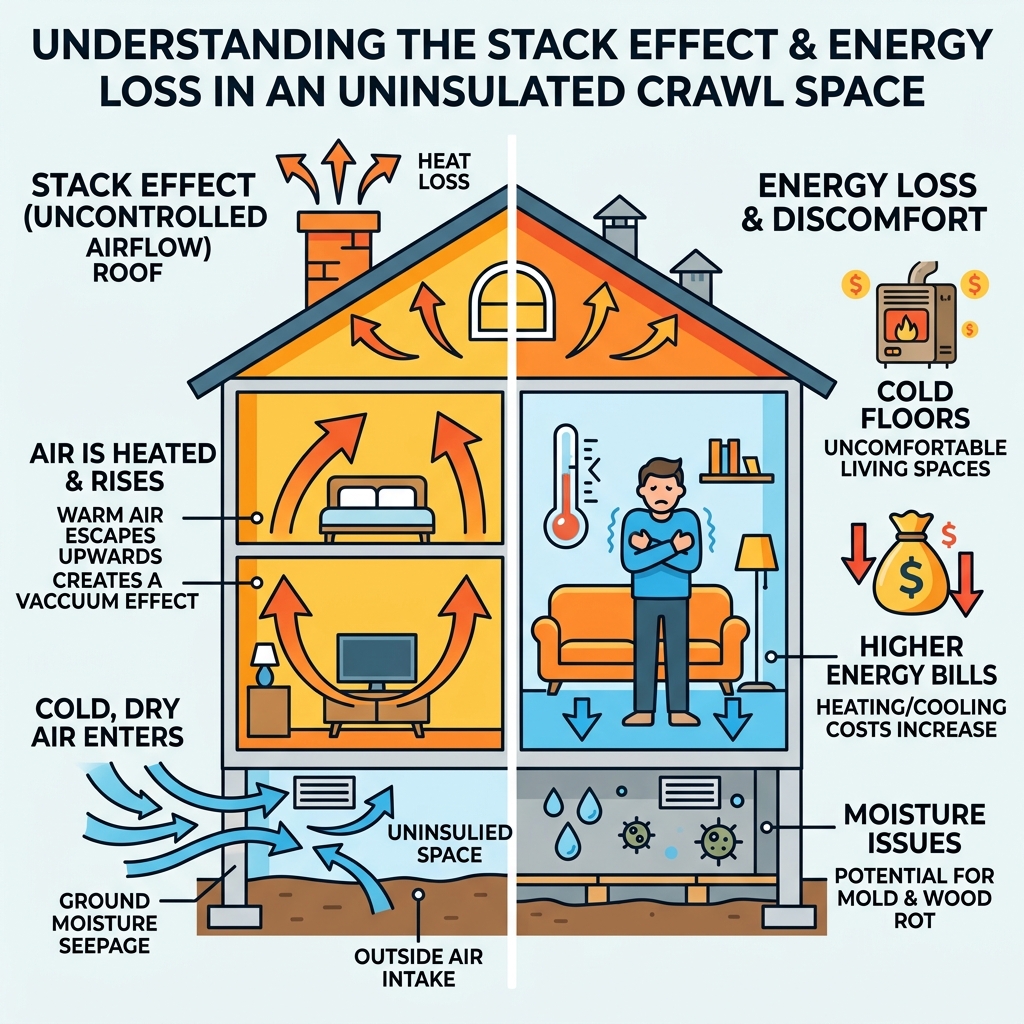
Before we dive into materials, we need to talk about how your crawl space is designed. Historically, building codes required crawl spaces to be vented to the outdoors. The logic was that airflow would “dry out” the space. However, modern building science has flipped this thinking on its head.
Vented Crawl Spaces
In a vented setup, outside air flows freely through wall vents. In the summer, warm, humid air enters the cool crawl space, hits the cold floor joists, and condenses into liquid water. This is a recipe for mold and rot. If you have a vented space, the traditional approach is to insulate the “ceiling” (the underside of your home’s floor). However, this often fails because the insulation gets damp and heavy, eventually falling to the dirt floor.
Unvented (Encapsulated) Crawl Spaces
Modern experts, including the Building Science Corporation, now recommend unvented or “conditioned” crawl spaces. In this strategy, we seal the vents and insulate the foundation walls instead of the floor joists. This brings the crawl space into the home’s “thermal envelope.”
By treating the crawl space like a mini-basement, you eliminate the “stack effect”—where cold air is sucked in at the bottom of the house and warm air escapes through the attic. For a deeper look at how this fits into your whole-house strategy, check out the-ultimate-guide-to-insulating-your-home.
Choosing the Crawl Space Insulation Best for Your Home
When searching for the crawl space insulation best suited for your specific climate and budget, you’ll encounter several options. The goal is to find a material that provides high thermal resistance (R-value) while standing up to the high humidity levels found underground.
R-Value Standards and Durability
R-value measures a material’s resistance to heat flow. The higher the number, the better it insulates. In a crawl space, durability is just as important as the R-value. Because these areas are prone to dampness, we need materials that are inorganic and water-resistant.
| Material | R-Value (per inch) | Moisture Sensitivity | Pest Resistance |
|---|---|---|---|
| Closed-Cell Spray Foam | 6.0 – 7.1 | Waterproof | High |
| Rigid Foam Board | 3.5 – 5.0 | High Resistance | Moderate (unless treated) |
| Mineral Wool | 3.0 – 3.3 | Breathable/Water Repellent | High |
| Fiberglass Batts | 2.8 – 3.9 | Very High (Absorbent) | Low (Rodent nesting) |
Why Closed-Cell Spray Foam is the Crawl Space Insulation Best Choice
If your budget allows, closed-cell spray foam is widely considered the gold standard. Unlike open-cell foam, closed-cell is dense and acts as both an air sealer and a vapor barrier.
According to the U.S. Department of Energy, adding or updating insulation can pay for itself in just a few years. Spray foam expands up to 100 times its size, filling every tiny crack in the rim joists and sill plates where air leaks are most common. It provides an impressive R-value of 6.0 to 7.0 per inch, effectively creating an “armor” against the elements.
Rigid Foam Board: The Crawl Space Insulation Best for DIY Projects
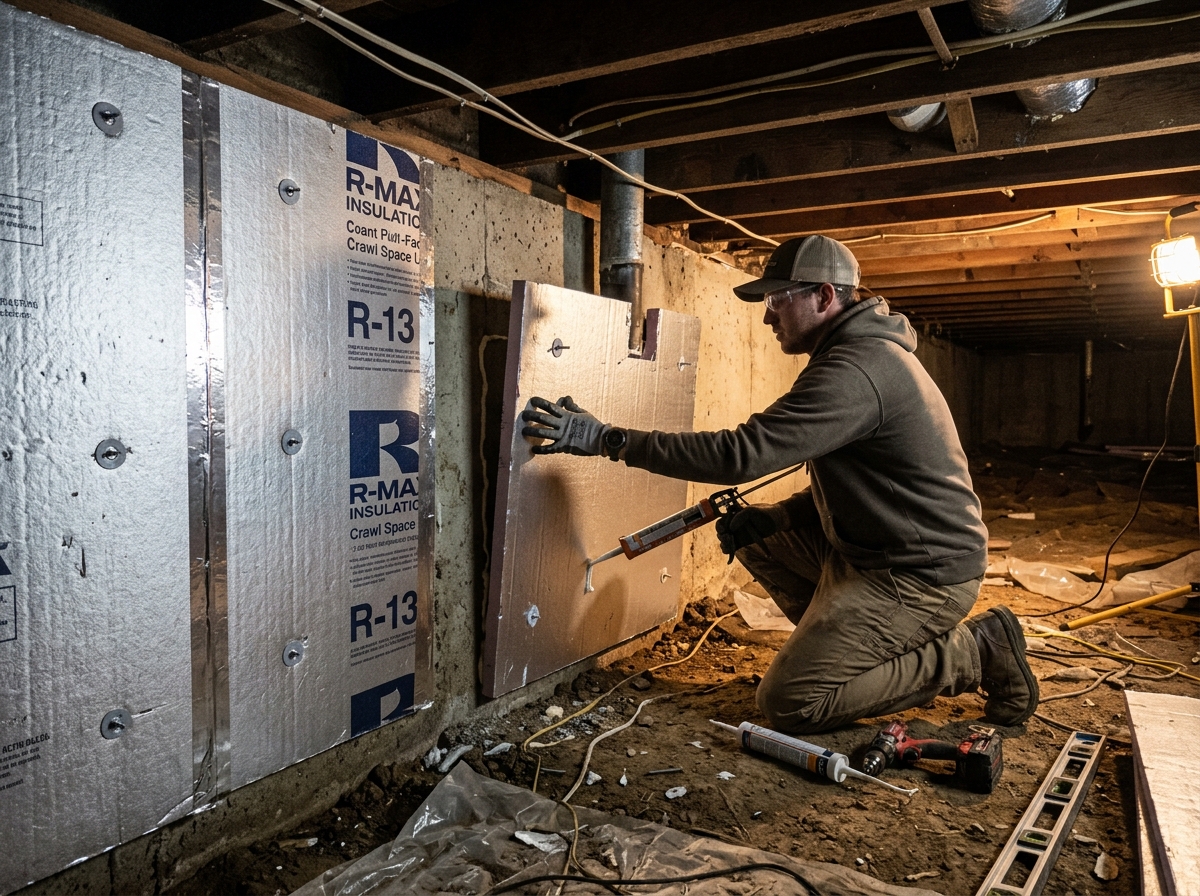
For the hands-on homeowner, rigid foam board (like Expanded Polystyrene or EPS) is the hero of the story. It’s reliable, easy to cut, and doesn’t require specialized spray equipment.
We often recommend graphite-infused foam boards because they can increase R-values by up to 24% over standard white foam. Many of these boards also feature a reflective surface that bounces radiant heat back into the crawl space, keeping the area even warmer. Learn more about choosing the right materials in our guide on insulating-your-home-for-energy-efficiency.
Why You Should Avoid Fiberglass Batts in Crawl Spaces
We’ll be blunt: fiberglass batts are usually a terrible idea for crawl spaces. While they are cheap and common, they act like a giant sponge.
- Moisture Absorption: Fiberglass traps condensation, which leads to sagging and a total loss of insulating power.
- Mold and Rot: Once wet, fiberglass holds moisture against your wooden floor joists, inviting wood rot and mold.
- Pest Condos: Rodents love fiberglass. They don’t just eat it; they move in, start families, and leave behind allergens.
If you currently have fiberglass in your crawl space that is damp or hanging, it’s time for a change. For more on why some materials fail, see our article on energy-saving-methods-for-home-insulation.
The Role of Encapsulation and Moisture Control
Insulation is only half the battle. If you put the world’s best insulation in a wet crawl space, you’re just masking a bigger problem. This is where encapsulation comes in.
Encapsulation involves covering the dirt floor and foundation walls with a heavy-duty, 6-mil to 20-mil polyethylene vapor barrier. We seal all the seams with specialized tape to ensure no moisture from the earth can evaporate into the space.
Essential Steps for Preparation:
- Remediate Groundwater: Fix any leaks, grading issues, or standing water before you insulate.
- Seal the Rim Joist: The rim joist (where the house frame meets the foundation) is a major source of energy loss. Use spray foam or rigid foam to seal this area tightly.
- Dehumidification: In many climates, a dedicated crawl space dehumidifier is necessary to keep humidity levels below 50%, preventing mold growth.
By combining insulation with a vapor barrier, you protect your home’s structural integrity. For winter-specific prep, don’t miss our catch-the-heat-insulation-tips-for-winter.
R-Values, Building Codes, and Installation Best Practices
Building codes vary significantly depending on where you live. Generally, the U.S. is divided into climate zones that dictate the required R-value for crawl space walls or floors.
- Warm Climates (Zones 1-2): Often require R-13.
- Moderate Climates (Zones 3-4): Typically require R-15 to R-19.
- Cold Climates (Zones 5-8): Can require R-25 to R-30.
Pro-Tips for Installation:
- Safety First: Always wear a respirator, eye protection, and knee pads. Crawl spaces are cramped and dusty.
- Fire Ratings: Ensure your foam insulation meets local fire codes. Many rigid foam boards require a thermal barrier (like drywall) unless they are specifically fire-rated for exposed use.
- Air Sealing: Insulation stops heat transfer, but it doesn’t always stop air. Use caulk or canned spray foam to seal gaps around pipes and electrical wires before installing your main insulation.
For more tips on navigating codes and maximizing efficiency, see our attic-insulation-tips-save-energy-and-money.
Long-Term ROI: Energy Savings and Home Value
Is the investment worth it? Absolutely. Properly insulating your crawl space typically delivers a 15-20% reduction in heating and cooling costs. With an average payback period of 5 to 10 years, it is one of the most effective home improvements you can make.
Beyond the monthly savings, you are also:
- Protecting Your Foundation: Preventing wood rot means avoiding five-figure structural repair bills down the road.
- Improving HVAC Longevity: Your system won’t have to work as hard to combat the drafts coming from below.
- Increasing Home Value: A dry, insulated, and encapsulated crawl space is a huge selling point for savvy home buyers.
Just as insulated window treatments save money in the living room, crawl space insulation protects the very “roots” of your home.
Frequently Asked Questions about Crawl Space Insulation Best
What is the best insulation for a crawl space with a dirt floor?
The best approach for a dirt floor is full encapsulation. This involves laying a thick vapor barrier over the dirt, sealing it to the walls, and then insulating the foundation walls with closed-cell spray foam or rigid foam board. This isolates the house from the damp earth entirely.
Do I need to remove old insulation before adding new material?
Yes, especially if the old insulation is fiberglass. If it’s wet, moldy, or compressed, it’s doing more harm than good. Removing the old debris allows you to inspect the wood for rot or pest damage before sealing everything up with new, high-performance materials.
Will insulating my crawl space stop cold floors?
Yes! Cold floors are usually caused by “thermal bridging” or air leaks in the crawl space. By insulating the walls (in an unvented space) or the joists (in a vented space), you create a thermal break. This keeps the heat inside your home rather than letting it soak into the cold ground below.
Conclusion
At Financefyx, we believe that a comfortable home starts from the ground up. Choosing the crawl space insulation best suited for your needs isn’t just about comfort—it’s about protecting your largest investment and keeping your hard-earned money from “leaking” out of your foundation.
Whether you choose the professional-grade performance of closed-cell spray foam or the DIY-friendly reliability of rigid foam board, the key is to address moisture first. A dry, insulated crawl space means lower bills, healthier air, and a home that stays cozy no matter what the thermometer says.
Ready to take the next step in home efficiency? Explore more energy-saving tips for your home and start your journey toward a more sustainable, comfortable living space today.
