
The Best Ways to Add a Battery to Your Solar System
Why Adding a Battery to Your Solar System Is Worth Considering in 2026
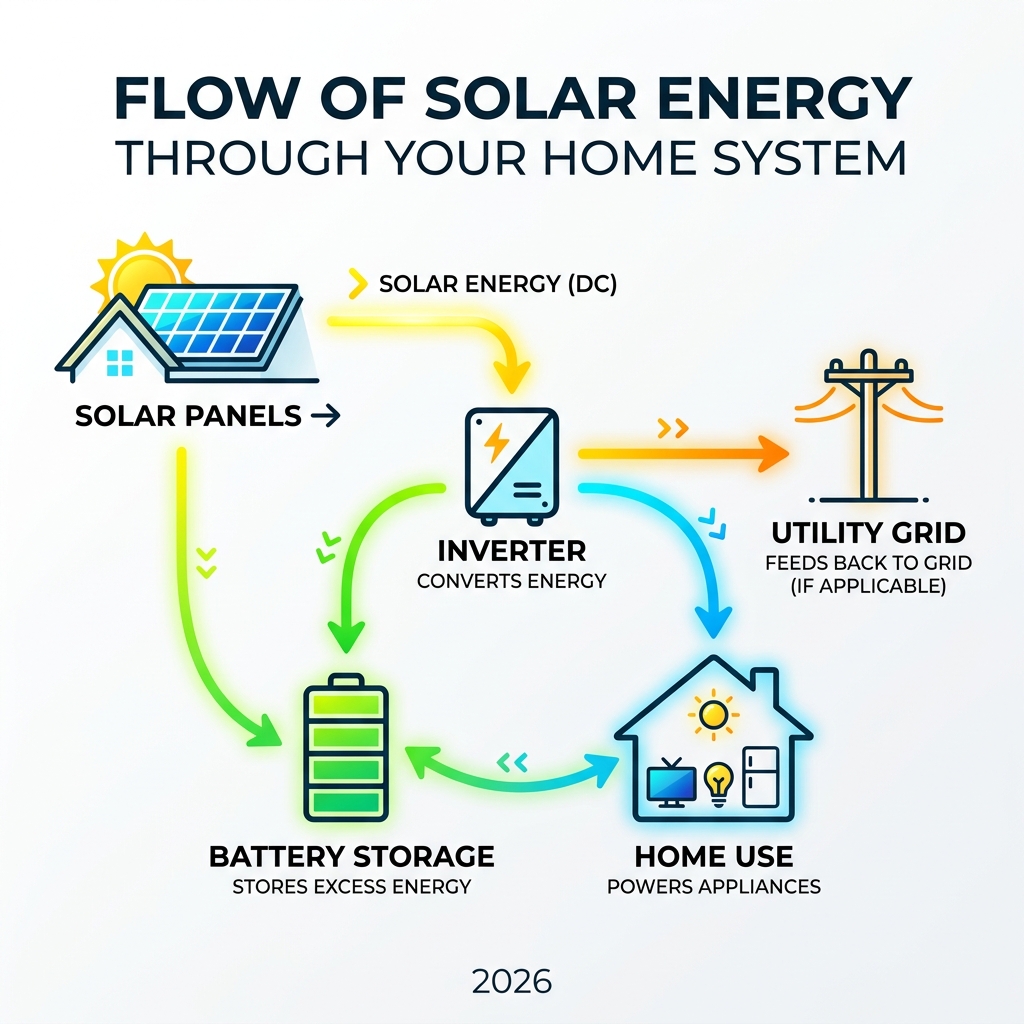
Adding a battery to your solar system lets you store the energy your panels produce during the day and use it at night, during outages, or when grid electricity is most expensive. Here’s a quick overview of the main ways to do it:
The 3 main methods for adding a battery:
- AC Coupling – Add a battery inverter alongside your existing inverter. Works with almost any system, including microinverters. Slightly less efficient due to extra energy conversion steps.
- DC Coupling – Replace your existing inverter with a hybrid inverter. More efficient, but requires more work and upfront cost.
- Storage-Ready Upgrade – If your inverter already supports battery storage, you simply connect a compatible battery pack. Easiest and cheapest option.
Not long ago, batteries were mostly for off-grid cabins and remote properties. The cost was high, the efficiency was low, and most homeowners with grid-tied solar didn’t bother.
That’s changed fast.
In 2020, only about 6% of new home solar installations included a battery. By early 2024, that number had jumped to 25%. Falling prices, better technology, and the reality of grid outages have pushed batteries into the mainstream.
Whether you want backup power when the grid goes down, or you want to stop selling cheap solar energy back to the utility during the day and buying expensive peak-rate power in the evening, a battery can do both.
The good news is that most existing solar systems can be retrofitted with battery storage — you don’t need to start from scratch. But the right approach depends on what kind of inverter you have, what your goals are, and where you live.
This guide walks you through everything you need to know.
Can You Add a Battery to an Existing Solar System?
The short answer is a resounding yes! Whether your system was installed last year or a decade ago, retrofitting storage is a common and increasingly popular project. According to Wood Mackenzie market research, the number of Americans adding batteries to their existing solar is expected to double by 2028.
However, the “how” depends on your current setup. Most solar panels are compatible with energy storage, but the ease of integration is all about your inverter. If your system was installed with a “storage-ready” or hybrid inverter, you’re in the best-case scenario. You can essentially “plug and play” a compatible battery.
If you have a standard string inverter or microinverters, you have two main paths: AC coupling (adding a second inverter for the battery) or DC coupling (replacing your existing inverter with a hybrid one).
Age is also a factor. A typical string inverter has a lifespan of about 10–15 years. If your inverter is nearing its tenth birthday, it might make more sense to swap it out for a modern hybrid model during the battery installation. For more details on the tech, check out our more info about home battery storage for solar.
AC Coupling vs. DC Coupling for Adding a Battery to Solar System
When we talk about “coupling,” we are describing how the battery connects to your solar panels and your home’s electrical system. This choice is the most important technical decision you’ll make.
| Feature | AC Coupling | DC Coupling |
|---|---|---|
| Best For | Existing systems, microinverters | New systems, older inverter replacements |
| Efficiency | Lower (multiple conversions) | Higher (direct DC charging) |
| Installation | Easier/Less disruptive | More complex/Requires rewiring |
| Equipment | Existing inverter + Battery inverter | Single Hybrid Inverter |
Efficiency and Standards
DC coupling is inherently more efficient because solar panels produce DC power, and batteries store DC power. In a DC-coupled system, the energy stays in DC form until you need to use it in your house.
In contrast, AC coupling involves converting DC solar power to AC (via your existing inverter), then converting it back to DC to store it in the battery, and finally back to AC to power your toaster. Each conversion loses about 1–3% of energy. However, AC coupling is often the go-to for retrofits because it doesn’t require messing with your existing solar array wiring.
Modern systems must also adhere to UL 1741 SA standards. This ensures the inverters can handle “frequency shifting”—a clever trick where the battery inverter tells the solar inverter to throttle down if the battery is full during a grid outage. Popular AC-coupled options like the Tesla Powerwall 3 come with their own internal inverter, making them a “one-box” solution for many retrofits.
Choosing the Right Method for Adding a Battery to Solar System
If you have microinverters (like Enphase units behind each panel), AC coupling is almost always the answer. You leave the roof alone and simply add the battery and its dedicated inverter near your main electrical panel.
If you have a string inverter that is getting old, we often recommend a hybrid inverter upgrade. This switches you to a DC-coupled setup, which is more efficient and simplifies your equipment into a single unit. Brands like the Panasonic EverVolt offer flexible versions that can work in either configuration. For a deeper dive into hardware, see our guide on the best home batteries for energy storage.
Sizing Your Battery for TOU and Backup
Don’t just buy the biggest battery you can afford; size it for your goals.
- Time-of-Use (TOU) Shifting: If your goal is to avoid high evening rates, look at your Time-of-use (TOU) rates and calculate how many kWh you use during those peak hours. A 10–13 kWh battery is usually enough for “peak shaving.”
- Backup Power: If you want to survive a multi-day outage, you’ll need to identify your “critical loads” (fridge, Wi-Fi, a few lights, medical devices). A critical load panel separates these from heavy hitters like your AC or clothes dryer.
- The Math: Consider the Depth of Discharge (DoD). Lithium batteries can usually be used up to 90–100%, while older lead-acid tech shouldn’t go below 50%. If you use 30 kWh a day and want two days of “autonomy” (independence from the grid), you’ll need a much larger stack.
Equipment and Compliance: MIDs, Inverters, and NEM 2.0

When adding a battery to solar system setups, especially in states like California, compliance is everything.
The Module Isolation Device (MID)
In an outage, your system must physically disconnect from the grid to prevent “backfeeding,” which could electrocute utility workers. This is handled by a Module Isolation Device (MID) or a system controller. This device acts as the brain, creating a “microgrid” for your home while the rest of the neighborhood is dark.
NEM 2.0 and Status Preservation
In California, many homeowners are on the NEM 2.0 (Net Energy Metering) plan. A major concern is whether adding a battery will kick you onto the less favorable NEM 3.0. The good news: Under PG&E and other major utility rules, you can typically add a battery without losing your NEM 2.0 status, provided you don’t increase your solar array size by more than 10% or 1 kW.
To keep the utility happy, your battery must be configured correctly. This often means a “no-grid-charge” setting, ensuring that the battery only stores solar energy, not cheap grid power. Equipment like Enphase IQ8 microinverters and the SolarEdge Home Hub are designed with these specific utility regulations in mind.
Costs, Incentives, and the Installation Process
Let’s talk numbers. Adding a battery to solar system configurations generally costs between $6,000 and $23,000. The average homeowner spends about $13,000 before incentives.
Incentives to Lower the Price
The most significant help comes from the Federal Investment Tax Credit (ITC). This allows you to deduct 30% of the total installation cost from your federal taxes. This credit is available for battery-only additions through 2032.
Additionally, many states offer rebates. California’s Self-Generation Incentive Program (SGIP) can provide thousands of dollars back, especially for those in high-fire-threat areas. You can find a full list of local perks on the DSIRE incentive database. For more context on how these costs balance out, read about solar panels cost and savings.
Steps for Adding a Battery to Solar System
The installation isn’t just about turning screws; it’s about paperwork.
- Site Assessment: A pro checks your main panel and solar inverter.
- Permitting: You need building permits from your local Authority Having Jurisdiction (AHJ).
- Utility Approval: You must submit an interconnection agreement to your utility (like PG&E).
- Fire Safety: Many regions now require batteries to be spaced 3 feet apart or have specific fire-rated barriers.
- Installation: The physical mounting and wiring. Some advanced DIYers use DIY installation videos for guidance, but we generally recommend a certified electrician for high-voltage work.
- Commissioning: Setting up the Tesla monitoring app or similar software to track your energy flow.
Frequently Asked Questions about Battery Retrofits
Will adding a battery affect my NEM 2.0 status?
Generally, no. As long as you aren’t significantly increasing the size of your solar panel array, adding storage is considered an “addition” rather than a “replacement” of your agreement. To be safe, ensure your installer uses “Power Control System” (PCS) certified equipment that prevents the battery from exporting to the grid in a way that looks like you’ve added more panels.
Can I perform a DIY battery installation?
You can, but it’s a steep mountain to climb. You’ll need to navigate complex electrical codes, fire department regulations, and utility inspections. If you make a mistake, you could void your battery’s 10-year warranty or, worse, create a fire hazard. For those determined to go it alone, check out our more info about DIY solar panel projects.
How do I check if my current inverter is compatible?
Look at the sticker on the side of your inverter for the model number, then find the spec sheet online. Look for terms like “Battery Ready,” “Hybrid,” or “DC-Coupled Storage Port.” If you see those, you’re in luck! If not, you’ll likely need an AC-coupled solution like the Powerwall or a full inverter replacement.
Conclusion
Adding a battery to your solar system is one of the smartest upgrades you can make in 2026. It transforms a passive energy-saving system into a personal power plant that works 24/7. While the technical choices between AC and DC coupling might seem daunting, the result—lower bills, grid independence, and peace of mind during blackouts—is well worth the effort.
At Financefyx, we believe energy independence should be accessible to everyone. By taking advantage of the 30% federal tax credit and choosing the right integration method for your home, you can lock in energy security for decades to come. Ready to take the next step? Explore renewable energy solutions with us and start your journey toward a more resilient home.
