
The Bright Side of Overcast Days for Solar Panels
The Real Answer: Do Solar Panels Work in Cloudy Weather?
Do solar panels work in cloudy weather? Yes — and better than most people expect.
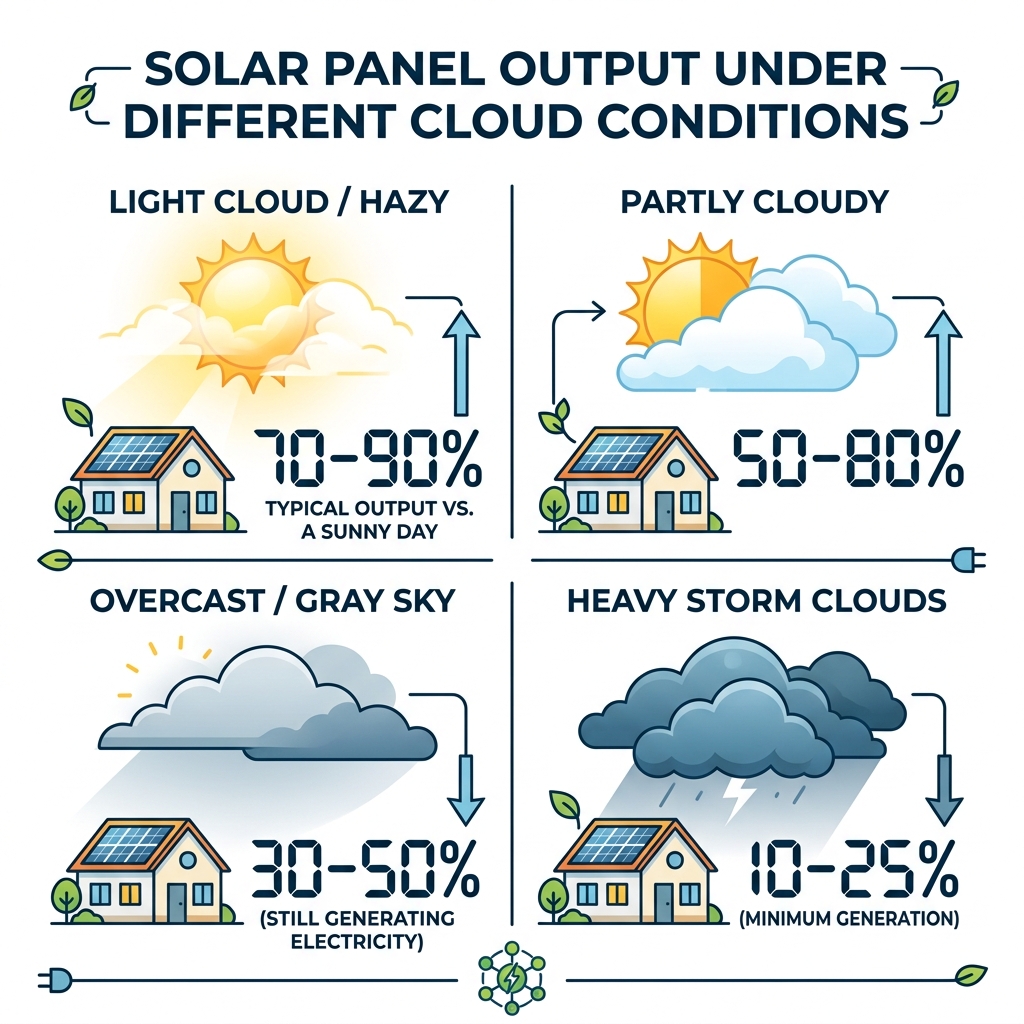
Clouds reduce output, but they don’t stop your panels from generating electricity. Here’s a quick breakdown of what to expect:
| Sky Condition | Typical Output vs. a Sunny Day |
|---|---|
| Light cloud / hazy | 70–90% |
| Partly cloudy | 50–80% |
| Overcast / gray sky | 30–50% |
| Heavy storm clouds | 10–25% |
Even on a fully overcast day, roughly 10–20% of the sun’s energy still reaches your panels. That’s enough to keep generating real electricity for your home.
The reason this works comes down to diffuse light. When sunlight hits clouds, it scatters — but it doesn’t disappear. Your solar panels absorb this scattered light and convert it into usable power, just like they do on a clear day, only at a lower rate.
This is exactly why cities like Seattle and Portland — two of the cloudiest in the US — have strong solar adoption rates. A typical 6kW system in Seattle can still produce around 6,621 kWh per year. That’s meaningful energy, even without year-round sunshine.
So if you’ve been putting off going solar because of cloudy winters or overcast skies, the weather is probably less of a barrier than you think.
Do Solar Panels Work in Cloudy Weather? The Science of Diffuse Light
To understand why your roof doesn’t just “turn off” when a cloud passes by, we need to look at the physics of light. Solar panels are made of photovoltaic (PV) cells, usually constructed from silicon. These cells don’t actually need the “heat” of the sun; they need photons.
Sunlight reaches our planet in two primary forms: direct and diffuse. Direct sunlight is the “beaming” light you feel on a clear summer afternoon. Diffuse light is sunlight that has been scattered by molecules and particles in the atmosphere—like clouds, dust, or haze.
When we ask, do solar panels work in cloudy weather, we are really asking if PV cells can catch these scattered photons. The answer is a resounding yes. Even when the sun is hidden, UV rays and visible light penetrate the cloud cover. These photons hit the silicon cells, knocking electrons loose and creating an electrical current. This is known as the photovoltaic effect.
Think of it like getting a sunburn on a cloudy day at the beach. You might not feel the direct heat, but those UV rays are still very much active. Your solar panels are essentially “sunburning” all day long, even if the sky is a dull gray. If you’re new to this technology, check out our solar energy guide for beginners to see how these cells form a complete home system.
Why solar panels work in cloudy weather even in the Pacific Northwest
It is a common misconception that solar only makes sense in the “Sun Belt” states like Arizona or Florida. However, some of the most successful solar markets in the world are in notoriously gray locations. Germany, for instance, was a global leader in solar capacity for years despite having a climate similar to Alaska.
In the United States, cities like Seattle and Portland are prime examples. While Seattle averages over 200 cloudy days a year, its solar systems are highly productive. This is because these regions often have cooler temperatures. Most solar panels actually run more efficiently when it’s cool; once the surface temperature of a panel rises above 77°F (25°C), its efficiency begins to drop.
The “lost” production from clouds in the Pacific Northwest is often partially offset by the “gained” efficiency from the temperate climate. If you live in a region known for its “liquid sunshine” (rain), our home solar panel installation guide can help you plan a system that accounts for local weather patterns.
Efficiency and Output: How Much Do Clouds Really Matter?
We won’t sugarcoat it: clouds do impact your bottom line. While panels work in the shade, they don’t work as well. On a heavily overcast day, you can expect your panels to produce between 10% and 25% of their peak capacity.
The thickness of the clouds is the biggest variable. High, thin cirrus clouds might only cause a 10-20% dip in production. Thick, dark storm clouds, however, can block up to 90% of incoming light. It’s important to remember that solar production is a “long game.” We don’t measure success by a single Tuesday in November; we measure it by the annual kilowatt-hours generated.
To help you visualize the impact, we’ve put together a comparison of how different sky conditions affect your potential solar panels cost and savings.
Solar Output by Cloud Density
| Cloud Type | Visual Description | Expected Output |
|---|---|---|
| None | Clear blue sky | 100% (Peak) |
| Light/Hazy | Sun is visible but muted | 70% – 90% |
| Partly Cloudy | Sun peeks in and out | 50% – 80% |
| Overcast | Solid gray “blanket” sky | 25% – 50% |
| Heavy Storm | Dark, thick rain clouds | 10% – 25% |
Choosing high-efficiency models so solar panels work in cloudy weather
If you live in a region where the sun is a rare visitor, the type of equipment you choose becomes critical. Not all panels handle low-light conditions the same way.
We generally recommend monocrystalline panels for cloudy climates. These are made from a single, high-purity silicon crystal. Because of this uniform structure, electrons have less “resistance” as they move, making these panels better at squeezing energy out of weak, diffuse light. While they might have a higher upfront cost, their ability to perform in the “gray” often leads to a better ROI over 25 years.
When looking at the 2025 guide to 5kw solar panel system costs, you’ll notice that high-efficiency models are becoming more affordable, making them a smart play for homeowners in the North or the Midwest.
Why Solar is a Worthwhile Investment in Cloudy Climates
You might be wondering: “If I’m only getting 25% power on some days, is the checkbook even worth opening?” The answer is almost always yes, thanks to two things: net metering and local electricity rates.
In many cloudy regions, electricity from the grid is expensive. Every kilowatt-hour your panels produce—even the “weak” ones on a Tuesday in March—saves you more money than a “cheap” kilowatt-hour would in a sunny desert state.
Furthermore, net metering acts as a giant “economic battery.” During the long, sunny days of summer, your system will likely produce more power than you can use. This excess flows back to the grid, and your utility provider gives you credits. In the winter, when production is lower and the clouds are thicker, you “spend” those credits to keep your lights on. This annual balancing act is why solar remains a fantastic investment in places like San Francisco, where the fog can be thick enough to hide the Golden Gate Bridge.
Debunking common myths about solar and weather
We hear a lot of tall tales about solar energy. Let’s set the record record straight on a few of the big ones:
- Myth: Solar only works in the desert.
- Fact: If this were true, Germany and the UK wouldn’t be solar powerhouses. Solar thrives anywhere there is daylight.
- Myth: Panels stop working in the winter.
- Fact: Cold weather actually improves conductivity. As long as there isn’t a foot of snow blocking the light, winter production is very real.
- Myth: Rain is bad for solar panels.
- Fact: Rain is actually a free cleaning service! It washes away dust, pollen, and bird droppings that can block light. Most homeowners see a slight efficiency boost after a good rain shower once the clouds clear.
- Myth: Solar panels are fragile.
- Fact: Most modern panels are rated to withstand 1-inch hail at 50 mph. They are built to protect your roof, not just sit on it.
Maximizing Your Energy Output When the Sun Isn’t Shining
If you want to ensure your home stays powered regardless of the forecast, you need to think about the “system” rather than just the panels. There are several hardware choices we recommend for those in variable climates.
First, consider microinverters. In a traditional “string” system, if one panel is shaded by a thick cloud or a nearby tree, the output of the entire string drops. Microinverters are small devices installed under each individual panel. This allows every panel to perform at its maximum potential independently. If one panel is under a heavy cloud, the others keep pumping out power at full capacity.
Second, look into bifacial panels. These panels have glass on both sides, allowing them to capture light that reflects off your roof or the ground. In cloudy weather, light is bouncing around everywhere; bifacial panels are designed to catch that “bounce.”
Finally, there is the “gold standard” of energy independence: battery storage. By pairing your panels with a home battery, you can store the “surplus” energy from a sunny morning and use it during a stormy afternoon. Check out our deep dive on home battery storage for solar to see how this works.
Managing performance during rain, snow, and cold
Winter weather brings its own set of quirks to solar production. One of the most interesting is the Albedo Effect. This happens when snow settles on the ground around your home. Snow is highly reflective; it can bounce extra sunlight up onto your panels, sometimes resulting in production spikes that exceed a normal sunny day!
As for the snow on the panels, most systems are installed at a tilt. Because panels are dark and smooth, they absorb heat and shed snow much faster than a standard shingle roof. Usually, the snow slides off within a few hours of the sun peeking out.
If you are planning to go “off the grid” in a snowy area, you’ll need a few more strategies. Our off-grid solar panel tips cover everything from panel angling to battery maintenance in extreme cold.
Frequently Asked Questions about Solar Performance
Do solar panels work at night?
Strictly speaking, no. Solar panels require photons from the sun to generate electricity. At night, they enter “sleep mode.” However, your home still runs on solar power if you have a battery backup. Alternatively, most homeowners stay connected to the utility grid, drawing power at night and “paying” for it with the credits they earned during the day. If you’re looking for the right hardware to bridge the nighttime gap, see our list of the best home batteries for energy storage.
Does rain damage solar panels?
Not at all. Solar panels are hermetically sealed and designed to live outdoors for 25+ years. Rain is actually beneficial because it performs “maintenance” for you. By washing away debris, rain ensures that when the sun does come out, your panels have a clear path to the light.
How much power is lost on a heavily overcast day?
On a day with thick, gray, “blanket” clouds, you will likely lose about 70% to 90% of your peak production. While that sounds like a lot, your system is sized based on your annual needs. Installers account for these “low” days when they design your array. Even with these dips, the aggregate power generated over the year is usually enough to offset the vast majority of a home’s energy bill.
Conclusion
So, do solar panels work in cloudy weather? They certainly do. While they might not reach their “peak” performance during a thunderstorm, they continue to provide a steady stream of clean, renewable energy by capturing diffuse light.
At Financefyx, we believe that sustainable living shouldn’t be reserved for people living in the desert. Whether you’re in foggy San Francisco, rainy Seattle, or snowy Boston, solar technology has advanced to the point where it is a reliable, money-saving investment. By choosing high-efficiency panels, considering battery storage, and taking advantage of net metering, you can make the “bright side” of overcast days work for your wallet.
Ready to take the next step in your energy transition? Explore more about renewable energy solutions and find out how you can build a weather-resilient home today.
