
The Ultimate Guide to Solar Panel Heat Insulation
Why Solar Panel Heat Insulation Matters for Your Home’s Energy Bills
Solar panel heat insulation refers to the combined thermal effect of rooftop solar panels and the insulation materials used beneath them to manage heat flow in and out of your home.
Quick answer — what you need to know:
| What It Does | Key Benefit |
|---|---|
| Solar panels shade your roof | Reduces roof surface temperature by up to 38% |
| Air gap under panels creates convection | Ceilings can run ~5°F cooler during the day |
| Proper insulation beneath panels | Prevents re-radiated heat from hot frames entering your home |
| Combined solar + insulation system | Cuts cooling load and reduces winter heat loss |
| Non-combustible insulation under panels | Reduces fire risk from electrical faults |
Most homeowners think of solar panels as simply a power source. But they also interact directly with your roof’s thermal performance — sometimes cooling it, and sometimes, if your setup isn’t right, adding heat load.
Here’s the thing: solar panels alone are not a substitute for real insulation. Panel frames and mounting rails can reach 60–75°C on a hot day, radiating heat back down onto your roof surface. Without proper insulation underneath, that heat finds its way into your living space — raising your cooling costs even as your panels generate electricity.
The good news is that when solar panels and quality roof insulation work together, the results are significant. Studies show the passive cooling effect alone can be worth the equivalent of a 5% price discount on your solar array over its lifetime, through reduced air conditioning use.
This guide walks you through exactly how to get that combination right — so your solar investment works with your insulation, not against it.
How Solar Panels Act as Natural Roof Insulation
When we think of insulation, we usually picture pink batts or spray foam tucked away in an attic. However, the physical presence of a solar array provides a massive “parasol” for your home. This is often referred to as the “shade fallacy” if misunderstood, but the data shows a very real cooling benefit when panels are installed correctly.
The Shading Effect and Surface Temperature
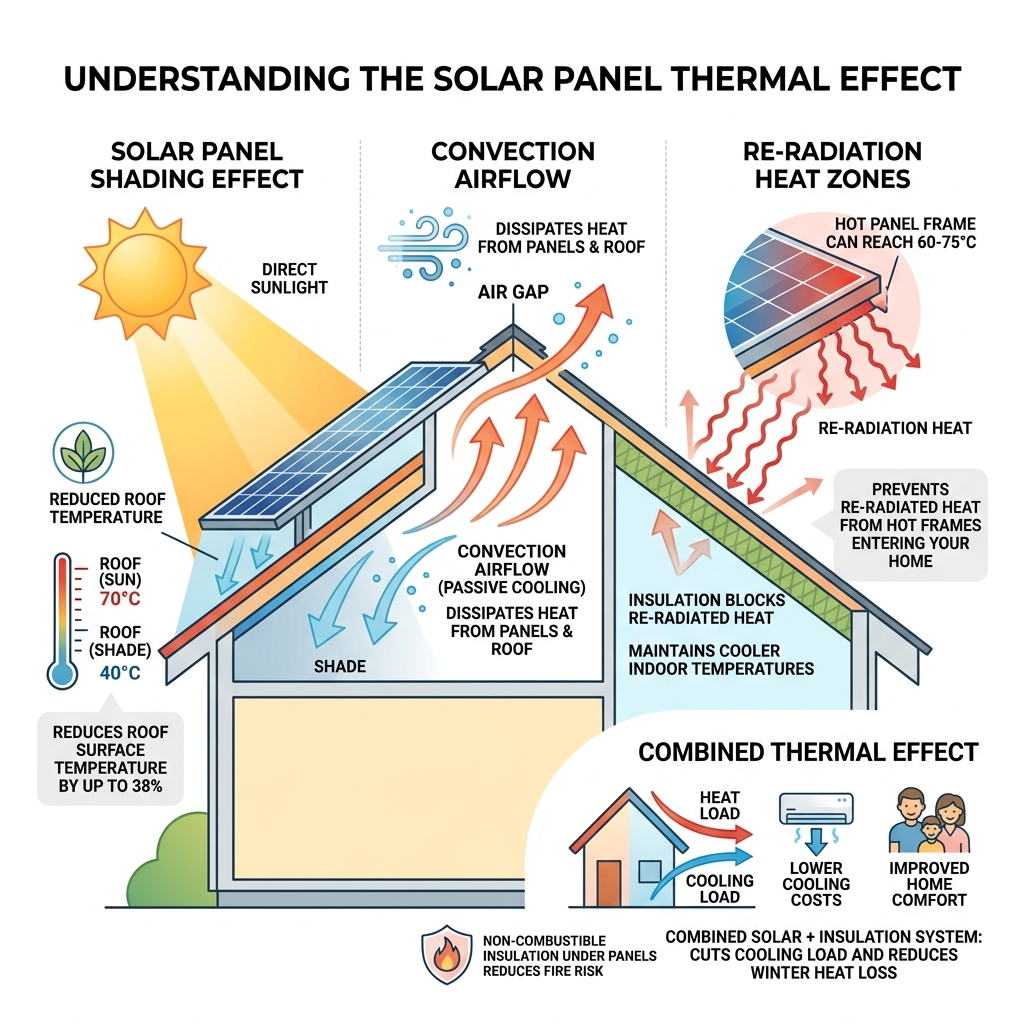
The most immediate benefit of solar panel heat insulation is simple: the panels take the hit so your roof doesn’t have to. Research, including a prominent study from UC San Diego, has shown that solar panels can reduce a roof’s surface temperature by up to 38%. By intercepting the sun’s rays before they strike the shingles or tiles, the panels prevent the roof deck from becoming a giant radiator that pumps heat into your home.
Convection Currents: Nature’s Air Conditioning
It isn’t just about the shade. Because most solar panels are mounted on a racking system that sits a few inches above the roof, an air gap is created. As the panels heat up, the air beneath them warms and rises, pulling in cooler air from the edges. This natural convection current acts as a buffer, whisking away heat that would otherwise soak into the building structure.
Measurements have shown that ceilings directly under solar panels can stay about 5°F cooler during peak daylight hours compared to bare roof sections. This passive cooling effect translates to real-world savings; modeling indicates a 38% reduction in annual cooling load through the roof section covered by PV. That is roughly equivalent to saving 5.9 kWh per square meter on cooling every year. To understand how these efficiency gains impact your wallet, check out our guide on solar-panels-cost-and-savings.
Winter Performance and Seasonal Shifts
While the cooling benefits are clear in the summer, what happens when the snow flies? In colder regions, the interaction between solar panels and heat becomes more complex. While panels can block some “passive solar gain” (the sun warming your roof in winter), they also act as an extra layer of thermal mass that can help retain some heat at night. Innovative research into an innovative method to control surface temperature of a rooftop photovoltaic system suggests that using controllable vents and insulation on the back of panels can even help with snow removal by trapping heat when needed.
The Science of Solar Panel Heat Insulation and Thermal Management
While we love the shading benefits, we have to be honest about the physics: solar panels get hot. Really hot. Because they are designed to absorb energy, the panels themselves can reach temperatures of 60°C to 75°C. If we don’t manage this heat, it can actually increase the thermal load on your home through a process called re-radiation.
The Re-radiation Challenge
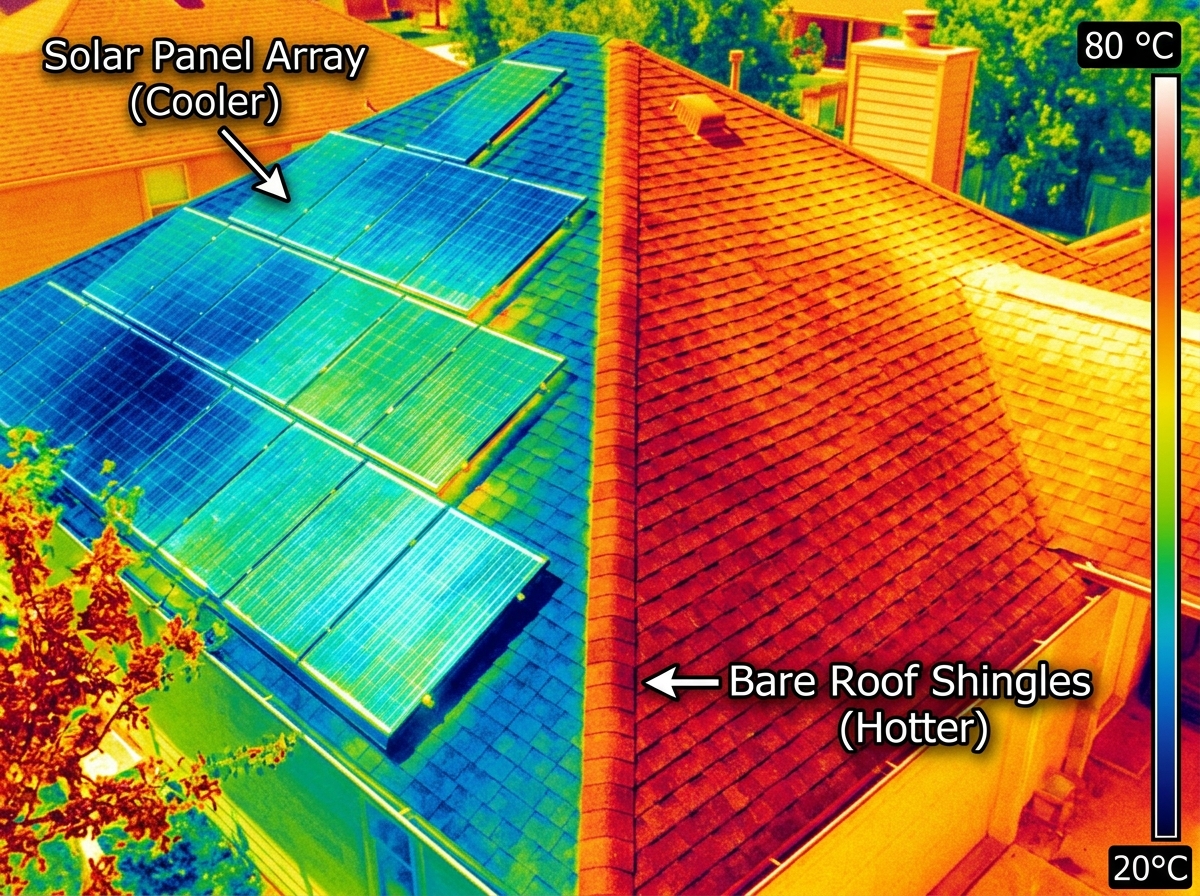
The aluminum frames and rails used in solar installations are excellent thermal conductors. They can act like “heat lamps,” absorbing solar radiation and then radiating longwave infrared heat directly back down onto the roof surface. In some cases, infrared scans have shown roof sections under solar panels having surface temperatures 20°C higher than adjacent open roof sections that have been treated with reflective coatings. This is why solar panel heat insulation strategies must look at the whole system, not just the panels themselves.
Innovative Thermal Solutions
To combat this, the industry is moving toward advanced materials that manage heat at the source:
- Thermal Conductive Back Sheets: Specialized back sheets, like those developed by AI Technology, Inc., use metal heat spreaders to reduce the operating temperature of the cells by 20-30°C. This doesn’t just protect your roof; it can improve solar panel efficiency by 5-10%.
- Spectrally Selective Shields: Scientists are developing a novel spectrally selective radiation shield for cooling a photovoltaic module. These shields are “smart”—they allow the light used for electricity (0.2–1μm) to pass through while reflecting the thermal infrared light (1μm–2.4μm) that causes overheating.
- Thermal Bridging Mitigation: By using non-conductive spacers or specific mounting strategies, we can reduce the amount of heat transferred from the hot metal frames into the roof structure.
Properly insulating-your-home-for-energy-efficiency is the final piece of the puzzle. If your attic is well-insulated, it provides the necessary barrier to stop any re-radiated heat from the panels from entering your living space.
Choosing the Best Insulation for Solar-Equipped Roofs
If you are planning a solar installation, you need to think about the “meat” in the sandwich—the insulation sitting between your ceiling and your roof deck. Not all insulation is created equal, especially when you add the weight and electrical components of a solar array into the mix.
Fire Safety: The Non-Negotiable Factor
Solar panels are electrical devices. While rare, malfunctions can lead to fires. When a fire occurs under a solar array, the panels can trap the heat and radiate it back down, intensifying the fire. This is why we strongly recommend non-combustible insulation materials like stone wool (mineral wool).
Leading insurance companies often advise that rooftop solar should only be installed on roofs with non-combustible materials. Stone wool doesn’t just resist fire; it can withstand temperatures over 1,000°C and won’t contribute to the spread of flames.
Comparing Insulation Types
When selecting insulation for a solar-ready home, consider the following factors:
| Material | R-Value (per inch) | Fire Rating | Best For |
|---|---|---|---|
| Stone Wool (Mineral Wool) | 3.0 – 3.3 | Non-combustible | Fire safety & sound dampening |
| Spray Foam (Closed-Cell) | 6.0 – 7.0 | Varies (often requires barrier) | Airtight sealing & moisture control |
| Fiberglass Batts | 2.9 – 3.8 | Naturally fire-resistant | Budget-friendly standard insulation |
| Reflective Barriers | N/A (reflects radiant heat) | High | Hot climates with high radiant load |
Moisture and Durability
Because solar panels can change the temperature profile of your roof, they can sometimes affect how moisture condenses in your attic. Choosing a moisture-resistant insulation, like closed-cell spray foam or treated mineral wool, is vital. Furthermore, if you have a flat roof where technicians will be walking to maintain the panels, you need a dimensionally stable insulation that can handle the mechanical load without compressing. For more specific tips on attic management, see our attic-insulation-tips-save-energy-and-money guide.
Maximizing Efficiency: Preparing Your Roof for Solar Installation
Preparation is the secret to a high-performing solar home. You don’t want to install a 25-year solar system on a roof that needs replacing in five years, nor do you want to miss out on the best solar panel heat insulation benefits because of poor mounting choices.
The Importance of the Air Gap
The “standoff” height—the distance between your roof and the panels—is critical. A flush-mounted system (where the panels are very close to the roof) provides less cooling benefit than a tilted system. A tilted array allows for better airflow, which enhances the convection cooling we discussed earlier. Even a small 3cm to 6cm venting channel can reduce energy losses due to heat by up to 50%.
Roof Color and Coatings
While the panels provide shade, the parts of the roof not covered by panels still soak up heat. Using a “cool roof” strategy—such as white shingles or reflective coatings—can work in tandem with your solar panels. Some homeowners even apply high-performance thermal coatings to the aluminum frames of the panels themselves to reduce re-radiation.
Structural Integrity and Racking
Before the first panel goes up, ensure your roof is structurally sound. Solar arrays add significant weight and wind load. Using high-quality racking that incorporates thermal breaks can prevent “thermal bridging,” where heat travels through the metal bolts directly into your home’s rafters. For a deep dive into the technical side of the setup, refer to our home-solar-panel-installation-guide.
Frequently Asked Questions about Solar Panel Heat Insulation
Does solar panel heat insulation replace traditional attic insulation?
No. Think of solar panels as a “first line of defense” that reduces the amount of heat reaching your roof. However, they do not provide a sealed thermal barrier. Traditional insulation is still required to maintain an R-value that keeps your home warm in the winter and cool in the summer. Solar panels enhance your insulation’s performance by reducing the temperature “delta” (the difference between outside and inside), but they don’t replace it. You can find more on this in the-ultimate-guide-to-insulating-your-home.
Can solar panels actually increase my roof’s heat load?
Yes, if not managed correctly. As mentioned, the aluminum frames and the dark surface of the panels can reach 75°C. If there is no air gap for ventilation, or if the roof lacks proper insulation, this heat can radiate directly into the building. This is known as the “re-radiation effect.” Proper mounting height and high-quality attic insulation are the best ways to prevent this.
What are the best materials for solar panel heat insulation?
For the panels themselves, look for modules with thermally conductive back sheets. For the roof structure beneath the panels, stone wool (mineral wool) is widely considered the best choice due to its combination of thermal resistance, moisture durability, and superior fire safety. If you are looking for other ways to save, explore various energy-saving-methods-for-home-insulation.
Conclusion
At Financefyx, we believe that true energy independence comes from a holistic approach to your home. Installing solar panels is a fantastic step toward sustainability, but to truly maximize your return on investment, you must consider solar panel heat insulation.
By combining the natural shading and convection cooling of solar panels with high-quality, non-combustible insulation, you create a home that is not only a power plant but a thermal fortress. You’ll see lower electricity bills, a smaller carbon footprint, and a more comfortable living environment year-round. Don’t let your solar panels work against your insulation—make them the perfect partners.
Start your renewable energy journey today and discover how the right combination of technology and insulation can transform your home’s efficiency.
