
Why Your Solar Setup Needs a 10kWh Battery Storage System
Why Every Solar Home Should Have a 10kWh Battery Storage System
10kWh battery storage is one of the most practical upgrades you can add to a home solar setup — and here’s what you need to know upfront:
Quick Answer: What Does a 10kWh Battery Do for Your Home?
| What You Need | What a 10kWh Battery Delivers |
|---|---|
| Backup power during outages | 8-14 hours of essential loads (lights, fridge, Wi-Fi) |
| Solar energy storage | Stores excess daytime solar for evening use |
| Reduce electricity bills | Shift energy use away from expensive peak-rate hours |
| Energy independence | Less reliance on the grid, even in winter |
| Cost after federal tax credit | ~$4,900-$12,600 (30% ITC available through 2032) |
Solar panels are excellent at generating clean energy. But they have one big problem: they stop working when the sun goes down — or when the grid goes down.
For homeowners already dealing with high energy bills, cold drafts in winter, and the anxiety of power outages, that’s a real gap in your home’s energy plan.
A 10kWh battery system fills that gap. It stores the energy your solar panels produce during the day and makes it available exactly when you need it most — at night, during peak billing hours, or when your neighborhood loses power.
The average US home uses around 30 kWh per day. A 10kWh battery won’t cover all of that, but it will comfortably power your essential appliances for 8 to 14 hours. That’s enough to keep your family warm, fed, and connected through most outages.
And with the 30% federal tax credit available through 2032, there’s never been a better time to act.

Understanding 10kWh Battery Storage: Capacity and Performance
When we talk about a 10kWh battery storage system, we are referring to its “energy capacity.” Think of it like a fuel tank for your house. A 10 kilowatt-hour (kWh) capacity means the battery can theoretically deliver 1,000 watts of power for 10 hours straight.
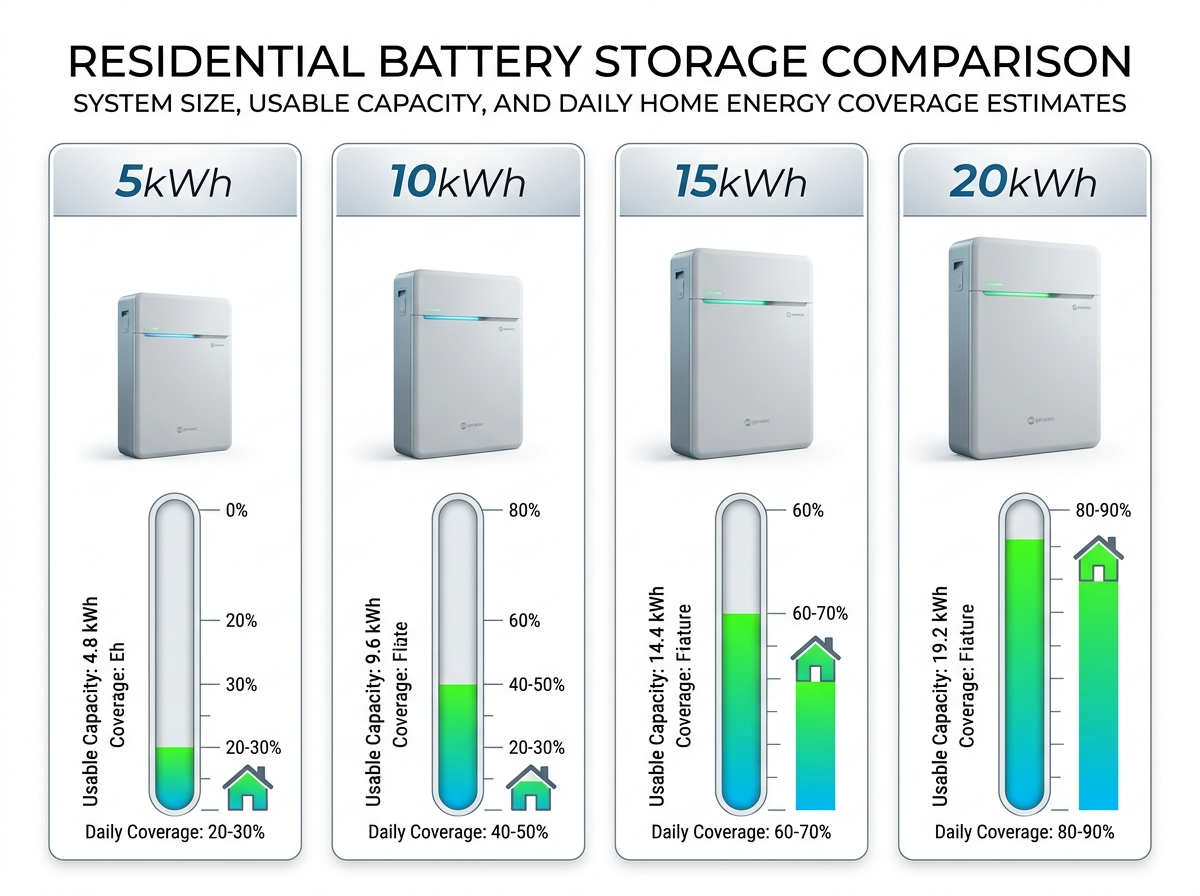
However, in the real world, “nominal capacity” and “usable capacity” are two different things. Most high-quality lithium batteries allow for a Depth of Discharge (DoD) of about 80% to 95%. This means if you have a 10.24kWh battery, you might have about 9.7kWh of actual energy to use before the battery needs to shut down to protect its internal chemistry.
The Numbers That Matter
To understand how this fits into your life, consider these statistics:
- Average Usage: The average US home consumes roughly 900 kWh per month, which breaks down to about 30 kWh per day.
- The 1/3 Rule: A 10kWh battery covers approximately one-third of your daily energy needs. This makes it the “sweet spot” for many households because it handles the expensive evening peak (usually 4 PM to 9 PM) without the massive price tag of a 30kWh system.
- Round-Trip Efficiency: This is how much energy you get back out compared to what you put in. Premium systems like the Enphase IQ Battery 10C boast a round-trip efficiency of about 96%, meaning very little energy is lost as heat during the charging process.
LiFePO4 vs. Lithium-Ion: Which 10kWh Battery Storage is Best?
If you’ve been shopping around, you’ve likely seen two main types of lithium batteries: Nickel Manganese Cobalt (NMC) and Lithium Iron Phosphate (LiFePO4 or LFP).
At Financefyx, we almost always point homeowners toward LiFePO4 for residential use. Why? Because while standard lithium-ion (NMC) is great for cell phones and EVs where weight matters, LFP is the king of home safety and longevity.
- Thermal Stability: LiFePO4 batteries are incredibly stable. They are significantly less likely to experience “thermal runaway” (a fancy term for catching fire) even if punctured or overheated.
- Cycle Life: A standard lithium-ion battery might give you 3,000 to 5,000 cycles. In contrast, a high-quality 10kWh battery storage unit using LFP cells, such as those from LINIOTECH or EG Solar, can provide 6,000 to 8,500 cycles. If you cycle your battery once a day, that’s a lifespan of over 20 years!
- Cobalt-Free: LFP doesn’t use cobalt, making it a more ethical and environmentally friendly choice.
- Certifications: Always look for UL1973 and UL9540 certifications. These ensure the battery and the integrated Battery Management System (BMS) meet the highest safety standards for residential installation.
Key Features to Look For in a 10kWh Battery Storage System
Not all 10kWh batteries are created equal. When comparing models, keep an eye on these technical “must-haves”:
- Smart Monitoring & App Control: You should be able to see exactly how much energy you’re storing and using from your smartphone. Modern apps allow you to change modes (e.g., “Backup Only” vs. “Self-Consumption”) on the fly.
- Continuous vs. Peak Power: Capacity (10kWh) is how much energy is in the tank. Output is how fast you can pull it out. A good system should offer at least 5kW of continuous output to run multiple appliances at once.
- Passive Cooling: Systems with no moving parts (fans) are quieter and have fewer points of failure.
- Weatherproofing: If you plan to install your battery outside, ensure it has an IP65 rating to protect against dust and rain.
- Expandability: Your needs might grow. Some systems, like the DELONG dPOWER 10, allow you to stack modules to go from 10kWh up to 50kWh without replacing your existing equipment.
For a deeper dive into specific brands, check out our guide on the best home batteries for energy storage.
Financial Breakdown: Costs, Incentives, and ROI in 2026
Let’s talk about the elephant in the room: the price tag. In 2026, the cost of a 10kWh battery storage system has stabilized, but it still requires a significant upfront investment.
| Tier | Estimated Battery Cost | Total Installed Cost | After 30% Tax Credit |
|---|---|---|---|
| Budget (DIY/Off-grid) | $3,000 – $5,000 | $5,000 – $7,000 | $3,500 – $4,900 |
| Mid-Range (Value Brands) | $6,000 – $9,000 | $8,500 – $12,000 | $5,950 – $8,400 |
| Premium (All-in-one) | $10,000 – $14,000 | $15,000 – $18,000 | $10,500 – $12,600 |
Hidden Costs to Watch For
The “sticker price” of the battery isn’t the whole story. You also need to budget for:
- Installation Labor: Typically $2,000 to $5,000 depending on complexity.
- Permitting & Inspection: $500 to $1,500.
- Electrical Panel Upgrades: If your home’s main panel is old, you might need a “Critical Load Sub-panel” to isolate the circuits you want to back up.
Incentives: The 30% Federal Tax Credit
The single biggest financial boost is the Federal Investment Tax Credit (ITC). Currently, you can deduct 30% of the total cost of your battery system (including installation!) from your federal taxes. This credit is available for standalone batteries (3kWh or larger) even if you don’t have solar panels. Under current legislation, this 30% rate is maintained through 2032, making 2026 an ideal time for installation.
ROI and Payback Periods
Is it worth it? For homeowners in states like California under NEM 3.0, the answer is a resounding yes. Since utility companies now pay very little for the solar energy you send back to the grid, “self-consumption” is the goal. By storing your own energy, you can save $1,200 to $1,800 annually. This leads to a payback period of 5 to 7 years.
In areas with flat electricity rates, the ROI is slower (10+ years), but the “value of backup” during a blackout is often what tips the scales for our readers. You can read more about the financial benefits in our article on home battery storage for solar.
Maximizing Backup Power and Energy Independence
One of the most satisfying moments of owning a battery is watching your lights stay on while your neighbor’s house goes dark. A 10kWh battery storage system provides a robust safety net.
Blackout Protection & Critical Loads
During an outage, your battery can operate in “backup mode.” Most installers will set up a Critical Load Panel. This ensures the battery doesn’t waste energy on “power hogs” like the clothes dryer or the hot tub, focusing instead on:
- The Refrigerator/Freezer (to prevent food spoilage)
- Wi-Fi Router and Home Office (to stay connected)
- Select LED Lighting
- Medical Devices (CPAP machines, etc.)
- Well Pumps or Sump Pumps
Time-of-Use (TOU) Optimization
Even when the grid is working perfectly, your battery is working for you. Many utilities charge “Peak Rates” in the evening. Your smart battery system can be programmed to:
- Charge during the day when solar is abundant (or at night when grid rates are lowest).
- Discharge during peak evening hours when electricity is most expensive. This “arbitrage” strategy can shave hundreds of dollars off your annual bill without you lifting a finger.
Sizing Your 10kWh Battery Storage for Whole-Home Backup
Can a single 10kWh battery run your entire home, including the central AC? Usually, no. A typical central AC unit can pull 3kW to 5kW of power just to keep running, and even more to start up. If you try to run the AC, the oven, and the dishwasher simultaneously, you will likely exceed the continuous power rating of a 10kWh system and trigger a shutdown.
How to Calculate Your Needs:
- Minimalist (500W-1kW load): A 10kWh battery lasts 10-20 hours. (Lights, fridge, phone charging).
- Essential (1kW-2kW load): A 10kWh battery lasts 5-10 hours. (Adds Wi-Fi, TV, and occasional microwave use).
- High Load (3kW-5kW load): A 10kWh battery lasts 2-3 hours. (Adds a small AC unit or space heater).
If you find that 10kWh isn’t enough, look for modular expansion options. Many modern systems, like the MyGrid 10kWh LiFePO4, allow you to add more battery “blocks” later. Some systems can scale up to 160kWh for massive off-grid estates!
Installation and Integration with Existing Solar Systems
One of the most common questions we get at Financefyx is: “Can I add a battery to the solar panels I already have?” The answer is almost always yes, but the how depends on your current setup.
AC vs. DC Coupling
- DC-Coupled Systems: These are generally more efficient (up to 5% higher efficiency) because the energy from your solar panels stays in DC form until it’s needed by your home. This is the standard for new installations.
- AC-Coupled Systems: This is the “Retrofit King.” If you already have solar panels and a string inverter, an AC-coupled battery (like the EcoFlow 10kWh LFP Battery) can be added easily. It connects to your home’s AC wiring, making the installation much simpler.
Inverter Compatibility
Your battery needs to “talk” to an inverter. If you have a Hybrid Inverter, it can handle both your solar panels and your battery. If you have microinverters (like Enphase), you’ll likely want an AC-coupled battery system that integrates with their specific monitoring software.
DIY vs. Professional Installation
While there are “plug-and-play” 10kWh units available for RVs or off-grid cabins, we strongly recommend professional installation for grid-tied home systems.
- Permits: Most jurisdictions require electrical permits and fire department sign-offs.
- Warranty: Many manufacturers will void your warranty if the system isn’t installed by a certified professional.
- Safety: Dealing with high-voltage DC and your main electrical panel is dangerous work.
For more on choosing the right setup for your specific home, see our comparison of best home batteries for energy storage (part 2).
Frequently Asked Questions about 10kWh Batteries
How long will a 10kWh battery power my house during a blackout?
For a typical home focusing on “essential loads” (refrigerator, LED lights, Wi-Fi, and phone charging), a 10kWh battery storage system will last between 8 and 14 hours. If you are very conservative with your energy use (dropping to 500W), you could stretch it to 20 hours. If you have solar panels, the battery will recharge during the day, potentially allowing you to stay powered indefinitely during a long-term grid failure.
What is the expected lifespan and warranty of a quality system?
A high-quality LiFePO4 (LFP) battery is generally rated for 6,000 to 10,000 cycles. Most manufacturers offer a 10-year limited warranty that guarantees the battery will still hold at least 70% to 80% of its original capacity after a decade. In real-world conditions, these batteries often last 15 to 20 years before the degradation becomes noticeable.
Is a 10kWh battery compatible with my existing solar panels?
Yes. If you have a standard solar setup, you can use an “AC-coupled” battery system. These systems use their own internal inverter to convert the AC power from your house back into DC for storage. Popular models use communication protocols like RS485 or CAN bus to sync with your existing solar monitoring. Always check with a technician to ensure your current electrical panel has the physical space for the additional breakers.
Conclusion
Investing in a 10kWh battery storage system is about more than just saving a few dollars on your utility bill — it’s about energy security and future-proofing your home. As the grid becomes less reliable and extreme weather events become more frequent, having your own personal “power plant” in the garage provides immense peace of mind.
With the 30% federal tax credit still in play for 2026, the “math” for solar storage has never looked better. Whether you want to achieve total energy independence or simply ensure your family stays comfortable during the next blackout, a 10kWh system is the most balanced, cost-effective way to get there.
Ready to take the next step toward a more sustainable home? Explore more renewable energy solutions on Financefyx to find the perfect fit for your lifestyle.
