
What the Agua Caliente Solar Power Plant Actually Does (and Why It Matters)
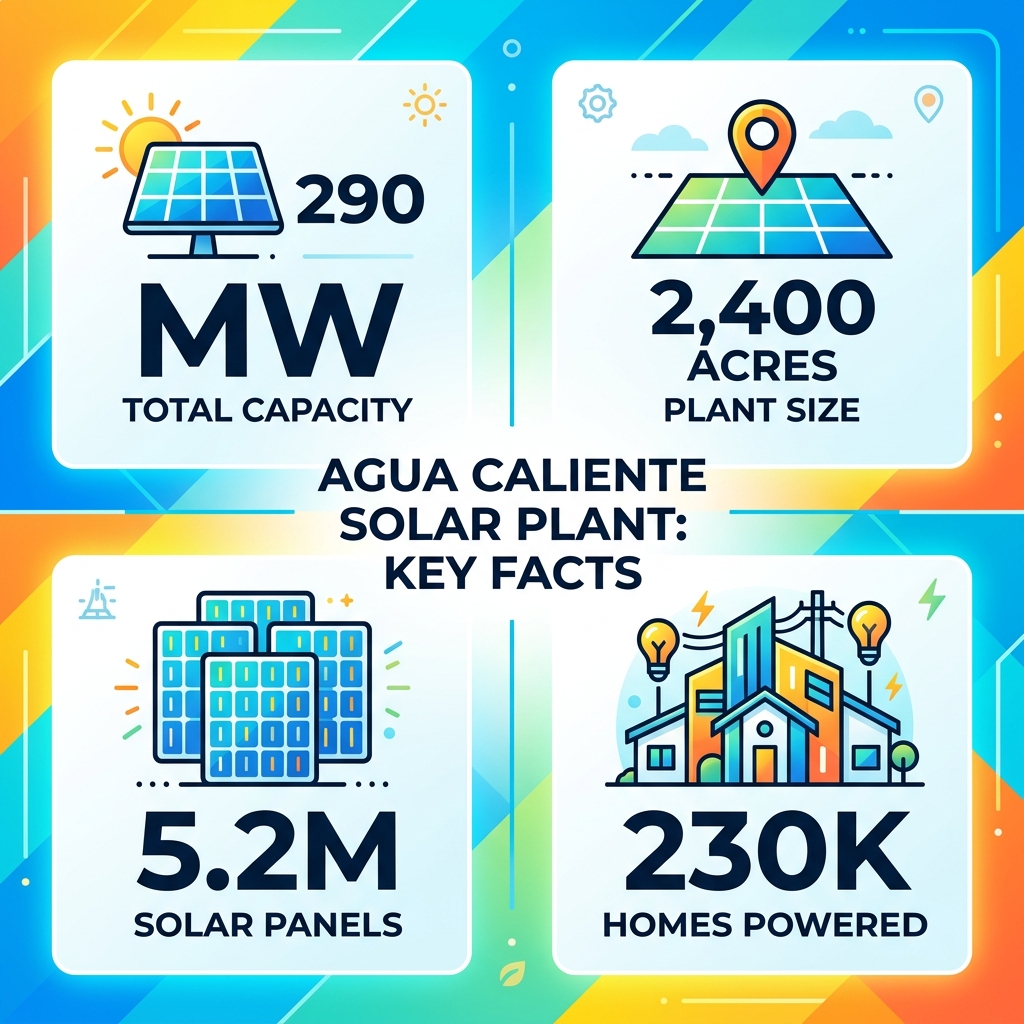
The agua caliente solar power plant is one of the most significant renewable energy projects ever built in the United States. Located in Yuma County, Arizona, this massive facility covers 2,400 acres of desert and generates enough clean electricity to power around 230,000 homes every year.
Here are the key facts at a glance:
| Feature | Detail |
|---|---|
| Capacity | 290 MW AC (410 MW DC) |
| Location | Yuma County, Arizona |
| Technology | Cadmium telluride (CdTe) thin-film PV |
| Annual Output | ~707 GWh (average 2012-2022) |
| CO2 Offset | ~220,000 tons per year |
| Homes Powered | ~230,000 households |
| Construction Cost | $1.8 billion |
| Completed | April 2014 |
| Historic Status | World’s largest operational solar PV plant at time of commissioning |
When it reached full operation in April 2014, it was the largest solar photovoltaic facility on the planet. That’s a remarkable milestone for a technology that was still proving itself at utility scale just a few years earlier.
But what actually makes this plant tick? How does a flat stretch of Arizona desert get turned into a powerhouse supplying electricity to hundreds of thousands of homes? And what can it teach us about the future of large-scale solar energy?
That’s exactly what this guide breaks down — in plain language, no engineering degree required.
Project Overview and Strategic Location
When we talk about the agua caliente solar power plant, we are talking about a project of massive proportions. Spanning roughly 2,400 acres in eastern Yuma County, Arizona, the site is roughly the size of 1,800 American football fields. This isn’t just a random patch of dirt; the location was selected with surgical precision.
The site sits near Dateland, about 65 miles northeast of Yuma. Why there? It comes down to three main factors: solar insolation, land history, and infrastructure. Yuma County boasts some of the highest solar insolation levels (the amount of solar radiation reaching the ground) in the United States. Basically, it’s one of the sunniest places on Earth. Furthermore, the land was previously used for agriculture, meaning it was already disturbed and lacked the dense, sensitive vegetation found in untouched desert tracts. Finally, its proximity to a major 500-kV transmission line meant we didn’t need to build hundreds of miles of new wires to get the power to the people who need it.
For those curious about the official documentation and the federal support that made this possible, you can check out the Official Agua Caliente Project Profile. If you are just starting your journey into how the sun turns into light switches flipping on, we have a great More info about solar energy basics guide to get you up to speed.
Development and Ownership
The “family tree” of the agua caliente solar power plant involves some of the biggest names in the energy sector. The project was originally developed by First Solar, a leader in thin-film technology. However, as is common with massive infrastructure projects, ownership shifted as the plant moved from a blueprint to a humming power station.
Today, the project is primarily owned by Clearway Energy (holding a 51% stake) and BHE Renewables (a division of Berkshire Hathaway Energy, holding 49%). NRG Energy was also a major player in the early ownership and development phases. These companies don’t just sit on the energy; they have a 25-year Power Purchase Agreement (PPA) with Pacific Gas & Electric (PG&E). This means the clean “green” energy generated in the Arizona desert is actually sold to help power homes and businesses in California, providing financial stability for the project for over two decades.
Construction Timeline and Milestones
Building a giant in the desert doesn’t happen overnight. Construction officially kicked off in the fall of 2010. By June 2011, the first of millions of solar modules were being secured into place. One of the most impressive things about this project was how quickly it scaled up.
In January 2012, the plant reached its first major milestone with 30 MW connected to the grid. By September of that same year, it had surged to 250 MW, briefly becoming the world’s largest operational PV plant during its ramp-up. The project reached its full 290 MW capacity ahead of schedule, officially crossing the finish line in April 2014.
The Technology Behind the Agua Caliente Solar Power Plant
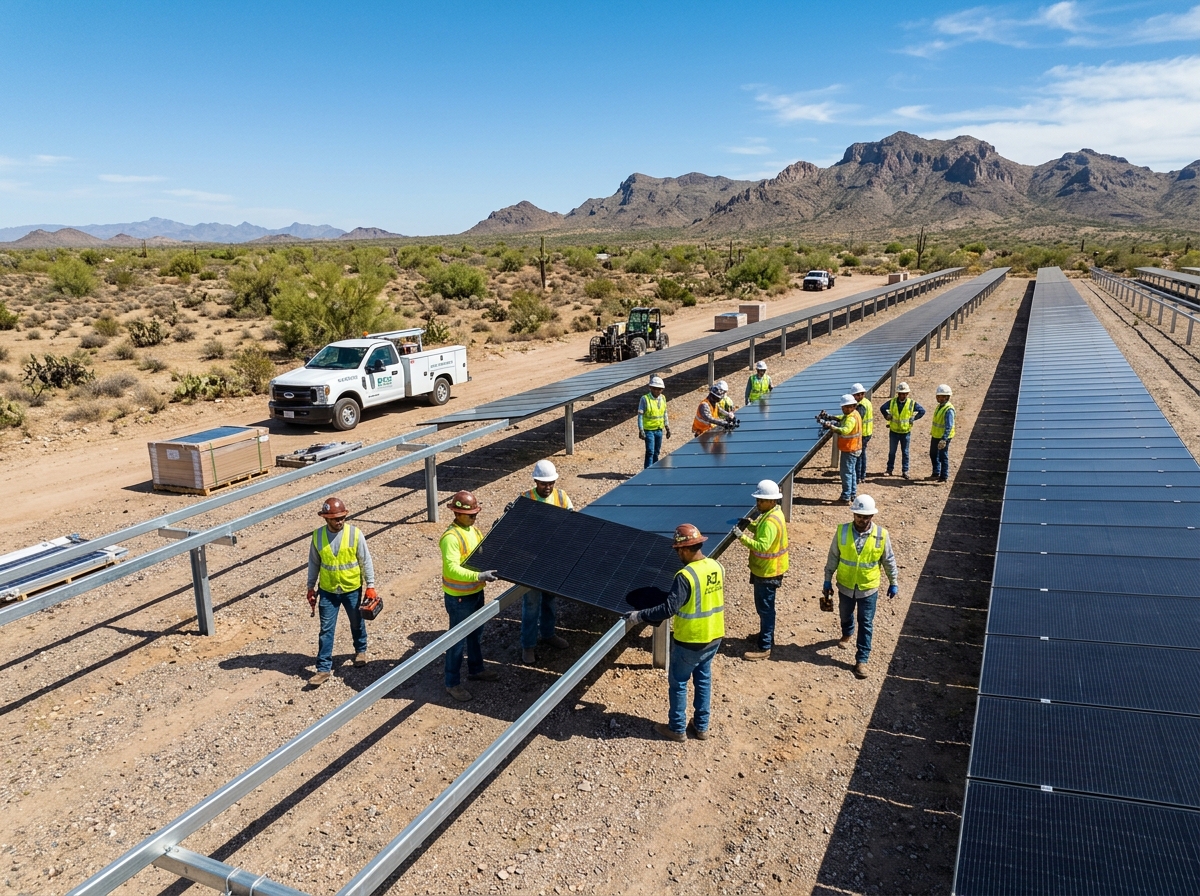
What makes the agua caliente solar power plant different from the solar panels you might see on a neighbor’s roof? It’s all about the “thin-film.” While most residential panels use crystalline silicon, Agua Caliente uses Cadmium Telluride (CdTe) technology.
The plant features an incredible 5.2 million modules. These aren’t on trackers that follow the sun; instead, they use a fixed-tilt mounting system. The panels are tilted at a specific angle (usually around 30 degrees) to capture the maximum amount of Arizona sun throughout the year without the need for complex moving parts that can break down in the harsh desert heat.
Innovative Modules at the Agua Caliente Solar Power Plant
The First Solar modules used at the plant are a marvel of engineering. Cadmium telluride thin-film modules are known for having the smallest carbon footprint and the fastest “energy payback time” of any solar technology on the market. In simple terms, the energy it takes to manufacture these panels is “paid back” by the clean energy they produce in less than a year.
These modules are also incredibly durable. They are designed to withstand high winds and the extreme temperature swings of the Yuma desert. If you’re wondering how this tech compares to what you might put on your own home, take a look at our guide to Learn about solar panel costs and savings.
| Feature | Thin-Film (CdTe) | Traditional Silicon |
|---|---|---|
| Thickness | Very thin layers (microns) | Thicker wafers |
| Efficiency in Heat | Excellent | Drops as temp rises |
| Carbon Footprint | Lowest | Moderate |
| Flexibility | High | Low/Rigid |
Grid Integration of the Agua Caliente Solar Power Plant
A challenge with solar power is “intermittency.” What happens when a cloud passes over? At a massive scale like 290 MW, a sudden drop in power could crash the local electrical grid. To prevent this, the agua caliente solar power plant was the first utility-scale plant in the U.S. to use advanced SMA inverters with “fault-ride-through” and dynamic voltage regulation.
These 500 SMA 630CP inverters act like the “brains” of the operation. They can sense changes in the grid and adjust the voltage output in milliseconds, ensuring that the power remains steady even if the weather gets dusty or cloudy. The inverters are housed in 200 Power Conversion System (PCS) vaults scattered across the 2,400-acre site.
Economic Impact and Federal Financing
You don’t build a world-class power plant with pocket change. The total construction cost for the agua caliente solar power plant was approximately $1.8 billion. To help bridge the gap and encourage large-scale renewable investment, the U.S. Department of Energy (DOE) provided a $967 million loan guarantee in August 2011 under the Title XVII program.
This federal backing was a huge vote of confidence in solar technology. For more on the industry milestones that paved the way for projects like this, you can read the SEIA report on Agua Caliente milestones.
Job Creation and Local Benefits
Beyond just generating electricity, the project was a massive shot in the arm for the Yuma County economy. During the peak of construction, the project created over 400 jobs, ranging from engineers to local laborers. Even now that it’s fully operational, it supports 10 to 16 permanent, high-paying roles for technicians and site managers who oversee the maintenance facilities.
The project also utilized approximately 39,000 metric tons of American steel for the mounting racks. This ripple effect helped support domestic manufacturing and proved that the “green economy” could create real-world industrial demand.
Environmental Performance and Sustainability
The environmental stats for the agua caliente solar power plant are nothing short of breathtaking. By replacing fossil fuel generation, the plant offsets approximately 220,000 tons of CO2 emissions every single year. That is the equivalent of taking about 40,000 cars off the road!
One of the most significant benefits for the desert environment is the plant’s water usage—or lack thereof. Unlike traditional coal or nuclear plants that require millions of gallons of water for cooling, this PV plant uses almost zero water for operation. While we often think of solar as “green,” the water savings in an arid state like Arizona are just as important as the carbon savings. If you’re interested in bringing some of these benefits to your own property, our Guide to home solar installation is a great place to start.
Comparison to Concentrated Solar Power
It is important to distinguish the agua caliente solar power plant (which uses Photovoltaics or PV) from other desert giants like Ivanpah or Solana, which use Concentrated Solar Power (CSP).
- Agua Caliente (PV): Uses panels to convert light directly into electricity. It’s simpler, uses less water, and has a very high capacity factor for a PV plant (around 28%).
- Solana/Ivanpah (CSP): Use mirrors to heat a fluid to create steam. While these can store energy in molten salt (like Solana does for 6 hours), they are often more complex and sometimes require natural gas “startup” boilers that emit some CO2.
Agua Caliente proved that PV could compete at a massive scale with simpler maintenance and lower environmental risks to local wildlife, such as the desert tortoise.
Frequently Asked Questions about Agua Caliente
What is the total capacity of the Agua Caliente Solar Project?
The plant has a nameplate capacity of 290 Megawatts (MW) AC. In DC terms (the raw power the panels produce before conversion), it is rated at 410 MW.
Who currently owns and operates the facility?
The facility is currently owned by a partnership between Clearway Energy and BHE Renewables. It is operated by the Agua Caliente Solar team, ensuring the 5.2 million modules are performing at peak efficiency.
How many homes does the Agua Caliente plant power annually?
On average, the plant generates enough electricity to power approximately 230,000 average American households. This varies slightly year-to-year based on weather conditions, but it has consistently met or exceeded its performance projections since 2014.
Conclusion
The agua caliente solar power plant is more than just a collection of glass and steel in the desert; it is a monument to what we can achieve when we commit to a clean energy future. By proving that utility-scale solar could be built quickly, financed responsibly, and integrated reliably into the grid, it paved the way for the solar boom we are seeing today.
At Financefyx, we believe that understanding these massive projects helps us make better decisions about our own energy use and investments. Whether you’re looking to install panels on your roof or just want to stay informed about the changing energy landscape, the legacy of Agua Caliente shows that the future is bright—and it’s powered by the sun.
