
Why Your Electricity Rate Is the Most Important Number in Solar
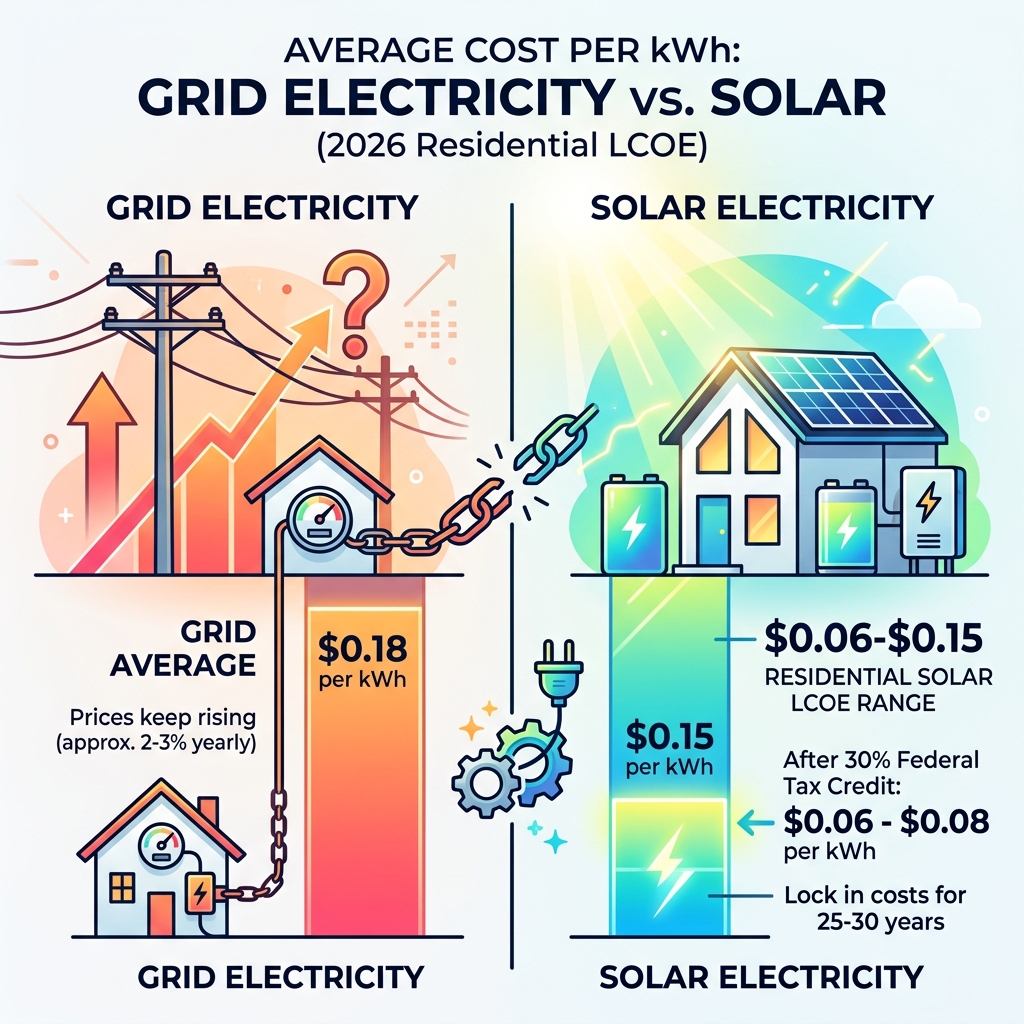
The average cost of solar per kWh ranges from $0.06 to $0.15 per kilowatt-hour for residential systems in 2025-2026, depending on your location, system size, and available incentives. Here’s a quick breakdown:
| Solar Sector | Average Cost per kWh |
|---|---|
| Utility-scale solar | $0.03 – $0.06 |
| Commercial solar | $0.08 – $0.11 |
| Residential solar | $0.06 – $0.16 |
| U.S. grid electricity (average) | ~$0.18 |
After the 30% federal tax credit, most homeowners buying through a reputable installer pay closer to $0.06 – $0.08 per kWh over the system’s lifetime.
Your utility company charges you roughly 18 cents per kWh today. That number has climbed from just 5 cents per kWh 45 years ago — and it keeps rising about 2-3% every year.
Meanwhile, solar energy can lock in your electricity cost at a fraction of that rate for the next 25-30 years.
That’s the core idea behind going solar. It’s not just about green energy. It’s about buying your electricity in bulk, upfront, before prices climb even higher.
But here’s where homeowners get confused: solar quotes throw around terms like kilowatts (kW), kilowatt-hours (kWh), cost per watt, and LCOE — often without explaining what any of it means. And if you can’t compare those numbers clearly, you risk overpaying or choosing the wrong system.
This guide cuts through the noise. We’ll explain exactly what the average cost of solar per kWh means, how it’s calculated, what drives it up or down, and how it stacks up against what you’re already paying your utility company.
Understanding the Basics: kW vs. kWh in Solar Energy
Before we dive into the dollars and cents, we need to clear up a common point of confusion. If you’ve started looking at quotes, you’ve likely seen two terms used constantly: kilowatts (kW) and kilowatt-hours (kWh). They sound similar, but they measure very different things.
Think of it like a car. A kilowatt (kW) is like horsepower—it measures the power capacity or the size of the engine. In solar terms, if we say a system is 7 kW, we are describing the maximum amount of power those panels can produce at any given moment under perfect sunlight.
A kilowatt-hour (kWh), on the other hand, is like the distance you travel. It measures energy consumption over time. If you run a 1,000-watt (1 kW) appliance for exactly one hour, you have used 1 kWh of energy. This is the unit your utility company uses to bill you every month.
Why does this distinction matter for your wallet?
- System Sizing: We use your annual kWh usage to determine how many kW of panels you need. If you use 10,000 kWh a year, we might design a 7.5 kW system to cover that.
- Production Ratios: Depending on where you live, 1 kW of solar capacity might produce 1.3 to 1.8 kWh of energy. A sunny roof in Arizona has a much higher “production ratio” than a shaded roof in Maine.
If you’re just starting your journey, checking out a solar energy guide for beginners can help you get a handle on these terms. Once you understand the “language” of solar, our home solar panel installation guide can walk you through the physical setup.
What is the Average Cost of Solar per kWh in 2025-2026?
When we talk about the average cost of solar per kWh, we are usually referring to the Levelized Cost of Energy (LCOE). This is a fancy way of saying: “If I take the total cost of the system over its entire life (30 years) and divide it by all the power it will ever produce, what is the price for each unit of energy?”
The solar industry has seen a massive shift thanks to initiatives like the Department of Energy’s SunShot Initiative. Launched in 2011, SunShot aimed to make solar competitive with fossil fuels. It hit its 2020 target of $0.06/kWh for utility-scale solar three years early. Now, the 2030 goal is a staggering $0.03/kWh.
For homeowners, the numbers look a little different because of “soft costs” (like labor and permits), but they are still incredibly competitive.
| Sector | 2011 Cost (per kWh) | 2017 Cost (per kWh) | 2025-2026 Est. (per kWh) |
|---|---|---|---|
| Residential | $0.52 | $0.16 | $0.06 – $0.15 |
| Commercial | $0.40 | $0.11 | $0.08 – $0.11 |
| Utility-Scale | $0.28 | $0.06 | $0.03 – $0.06 |
As you can see, the price has plummeted. In 2011, residential solar was a luxury at 52 cents per kWh. Today, it’s often the cheapest way to power your home.
Calculating Your Personal Average Cost of Solar per kWh
While national averages are a great starting point, your personal average cost of solar per kWh is unique to your roof. It isn’t a fixed number like a gallon of milk; it’s a calculation based on several subjective assumptions:
- Roof Orientation and Tilt: A south-facing roof with a 30-degree slope is the “gold standard.” If your panels face north or are completely flat, they will produce fewer kWh, which makes each kWh more expensive.
- Shading Analysis: That beautiful oak tree in the front yard might be great for shade, but if it blocks the sun for four hours a day, your system’s lifetime production drops, raising your cost per unit of energy.
- Climate Data: Solar installers use historical weather patterns to forecast production. Some use conservative data, while others might be more optimistic.
- System Lifespan: Are you calculating the cost over 20, 25, or 30 years? Most modern panels are warrantied for 25 years but can easily last 35. The longer the system lasts, the lower your average cost of solar per kWh becomes.
If you’re looking at a standard mid-sized system, the 2025 guide to 5kW solar panel system costs provides a deeper dive into the specific hardware and labor pricing you might encounter.
How Technology Impacts the Average Cost of Solar per kWh
Solar technology isn’t standing still. The panels we install today are significantly more efficient than those from even five years ago.
- Monocrystalline Efficiency: Most residential installs now use monocrystalline panels, which offer 15% to 22% efficiency. They produce more power in a smaller footprint.
- N-type TopCon and HJT: These are newer cell technologies that perform better in high heat and have lower degradation rates.
- Degradation Rates: All solar panels lose a tiny bit of “juice” every year. Standard panels might degrade at 0.5% to 0.7% annually. Premium panels (like N-type) might only degrade at 0.25%. Over 30 years, that difference adds up to thousands of extra kWh, lowering your lifetime cost.
Factors Influencing Your Solar Investment and ROI
When you receive a quote for $20,000 or $30,000, it’s easy to get sticker shock. But where is that money actually going? Understanding the breakdown helps us see why the average cost of solar per kWh varies so much between neighbors.
The Hardware vs. The “Soft Costs”
Surprisingly, the solar panels themselves usually account for less than 20% of your total bill. Here is a typical breakdown of a residential project:
- Hardware (40-50%): This includes the panels, the racking that holds them to your roof, and the inverters that turn DC power into AC power for your home.
- Labor and Installation (25-35%): Paying the experts who climb on your roof and wire the system into your main electrical panel.
- Soft Costs (20-30%): This is the “invisible” stuff—permitting fees, inspections, sales, marketing, and installer profit.
The Battery Factor
Adding energy storage is becoming the new standard, especially in states like California. While a battery increases your upfront cost, it can drastically improve your ROI by allowing you to use your own solar power at night instead of buying expensive grid power. Check out our reviews on the best home batteries for energy storage and learn more about home battery storage for solar to see if it fits your budget.
The Federal Tax Credit (ITC)
The single biggest factor in lowering your average cost of solar per kWh is the Federal Investment Tax Credit. Currently, you can deduct 30% of the total cost of your solar (and battery) system from your federal taxes. This incentive is locked in at 30% through 2032. If your system costs $20,000, the government essentially gives you back $6,000, bringing your net cost down to $14,000. You can explore other renewable energy incentives for homeowners to find state-specific rebates or property tax exemptions.
Solar vs. Utility: Comparing Long-Term Energy Costs
To understand if solar is a good deal, we have to look at the alternative: staying on the grid.
The national average for grid electricity is roughly 18 cents per kWh. However, in places like California, Massachusetts, or Hawaii, that number can soar above 30 or 40 cents. When you compare that to a solar LCOE of 6 to 8 cents, the winner is clear.
Bulk Energy Purchasing
Going solar is like going to a big-box store. When you stay with the utility, you are “buying a cup of coffee” every single day at a premium price. When you install solar, you are “buying the whole pallet of coffee beans” upfront. It’s a large initial investment, but the “price per cup” (or per kWh) is significantly lower.
An Inflation Hedge
Utility rates aren’t just high; they are volatile. Historically, electricity prices rise by about 2.2% to 3% every year. Over 25 years, an 18-cent rate could easily become a 35-cent rate. Solar “locks in” your rate. Once the system is paid off, your average cost of solar per kWh for the remaining 15-20 years of the system’s life is essentially zero.
Net Metering
Most states offer some form of net metering. This allows you to send excess solar energy back to the grid during the day and receive credits on your bill. You can then use those credits at night. It’s like using the grid as a giant, free battery. For a detailed look at how this impacts your wallet, see our guide on solar panels cost and savings.
Frequently Asked Questions about Solar Costs
How long does it take for solar panels to pay for themselves?
For most American homeowners, the “payback period” is between 6 and 10 years. Since the systems are designed to last 25 to 30 years, you’re looking at 15 to 20 years of essentially free electricity. Factors that speed up this timeline include high local electricity rates, generous state incentives, and a roof that gets plenty of sun.
Are solar panels becoming more affordable over time?
Yes, dramatically. The cost of solar has dropped by about 70% to 90% over the last decade. While prices have stabilized recently due to supply chain shifts and labor costs, the technology continues to get more efficient. We are currently in what many experts call a “price floor”—equipment is at record lows, and while marginal gains are possible, waiting years for a tiny price drop usually costs you more in lost utility savings than you’d save on the system price.
Does solar increase my home’s property value?
Absolutely. Research from Zillow has shown that homes with solar panels sell for about 4.1% more than similar homes without them. Other studies from Lawrence Berkeley National Laboratory suggest that buyers are willing to pay a premium of about $15,000 for a home with an average-sized solar system. It’s one of the few home improvements that actually pays for itself both in monthly savings and in resale value.
Conclusion
At Financefyx, we believe that understanding the average cost of solar per kWh is the key to taking control of your financial future. The transition to sustainable energy isn’t just an environmental choice; it’s a savvy long-term financial plan. By locking in your energy rates today, you protect yourself against the “burn” of utility inflation and gain a level of energy autonomy that the traditional grid simply can’t offer.
Whether you’re looking to save $100 a month or you want to completely disconnect from the rising costs of your local utility, solar energy provides a clear, data-backed path to savings. Explore more renewable energy solutions on our site to find the perfect fit for your home and budget.
