
The Ultimate Guide to Buying a Dehumidifier for Lower Energy Bills
Does a Dehumidifier Actually Lower Your Heating Bills?
Does a dehumidifier reduce heating costs? Yes — but with an important nuance. A dehumidifier can make your home feel warmer at lower thermostat settings, which reduces how hard your heating system works. However, the dehumidifier itself uses electricity, so your net savings depend on your energy prices, home type, and how you use it.
Here’s a quick summary:
| Factor | What to Expect |
|---|---|
| Heating system workload | Can drop by 10-15% with optimal humidity |
| Perceived warmth | Drier air feels warmer, even at lower temperatures |
| Potential annual savings | Estimated £100-£325 per year in some cases |
| Running cost (dehumidifier) | Typically 4p-16p per hour depending on model |
| Net result | Savings likely in damp, humid homes; less certain in dry climates |
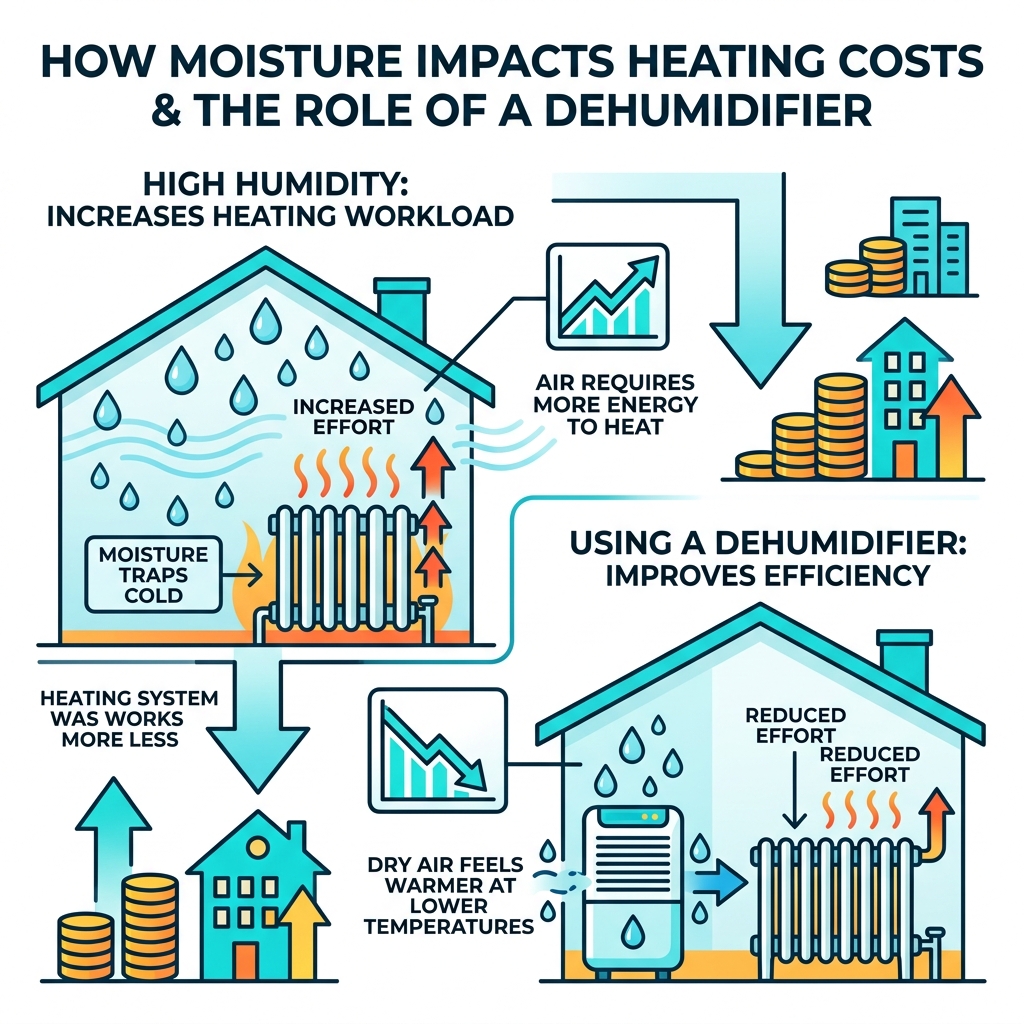
The core idea is simple: humid air takes more energy to heat than dry air. When your home holds excess moisture — from cooking, showering, or drying clothes indoors — your heating system has to work harder just to reach a comfortable temperature. Reducing that moisture with a dehumidifier can ease the burden on your boiler or radiators.
One real-world experiment found that running a dehumidifier for two weeks cut central heating usage from 46 hours down to just 22 hours. But the dehumidifier’s own electricity costs meant the total energy bill was still higher — at least at current UK energy prices.
So the honest answer is: it depends. This guide will walk you through exactly when a dehumidifier saves you money, when it doesn’t, and how to calculate what it means for your specific home.
Does a Dehumidifier Reduce Heating Costs? The Science of Thermal Efficiency
To understand if does a dehumidifier reduce heating costs, we have to look at the physics of the air inside our homes. Most of us think about temperature as a single number on a screen, but “thermal comfort” is actually a mix of temperature, air movement, and—most importantly—humidity.
Heat Capacity and Water Vapor
There is a scientific reason why damp homes feel like walk-in refrigerators. Water has a much higher heat capacity than air. This means that if your indoor air is saturated with water vapor, your heating system has to expend significantly more energy to raise the temperature of that “heavy” air. By removing the moisture, you are making the air “lighter” and easier to heat. Research suggests that a heating system can work 10-15% harder if the humidity is just 10-20% too high.
Perceived Warmth vs. Actual Temperature
Have you ever noticed how 65°F (18°C) feels cozy in a dry room but bone-chilling in a damp one? This is due to evaporative cooling. When the air is humid, moisture lingers on your skin, drawing heat away from your body. In drier air, your body can regulate its temperature more effectively. This allows you to turn your thermostat down by a few degrees without actually feeling colder. According to the Energy Saving Trust, lowering your thermostat by just 2°C can result in a 15% saving on your heating costs.

Understanding how a dehumidifier can help your heater work more efficiently is the first step toward a cheaper winter. However, even the best dehumidifier isn’t a magic wand; it works best when paired with other strategies, such as insulating your home for energy efficiency.
Why a dehumidifier reduces heating costs in damp environments
In a damp home, the savings aren’t just about the air temperature; they are about protecting the building itself. Damp walls are terrible insulators. If your walls are holding moisture—a phenomenon known as interstitial condensation—they will pull heat out of your rooms and dump it outside.
By keeping the relative humidity (RH) around 50%, a dehumidifier prevents this moisture from settling in your wallpaper, carpets, and structural timber. This is a crucial part of the ultimate guide to insulating your home, as dry materials simply hold heat better than wet ones. Furthermore, preventing mold growth saves you the massive indirect costs of professional remediation and health-related expenses.
How regional climate affects dehumidifier effectiveness
Your location plays a huge role in your potential savings. In regions with humid winters or coastal climates, the outdoor air is often saturated. Every time you open a door or window for ventilation, you’re letting in “wet” air.
While traditional advice suggests opening windows to ventilate, in a humid winter, this can actually make your home colder and damper. A dehumidifier allows you to manage indoor moisture without losing all your expensive heat to the outside. For more localized advice, check out these insulation tips for winter to see how to trap that warmth effectively.
How Dehumidifiers Generate Heat While Saving Energy
One of the best-kept secrets of these appliances is that they aren’t just moisture-sucking machines—they are also small heaters.
Compressor vs. Desiccant Models
All dehumidifiers produce some heat as a byproduct of their operation, but they do it differently:
- Compressor (Refrigerant) Models: These work like a fridge in reverse. They cool a coil to condense water and then reheat the air before blowing it back out. They release “latent heat” during the condensation process, usually raising the room temperature by 1-2 degrees.
- Desiccant Models: These use a chemical absorbent and an internal heating element to “regenerate” the material. Because of this heater, the air coming out of a desiccant model is often 10-12°C warmer than the air going in. In a small room, this can act as a very effective background heater.
When people ask, Does Using a Dehumidifier Save You Money on Your Electric Bill?, they often forget to factor in this “free” heat. If your dehumidifier is raising the room temperature, your primary heater doesn’t need to kick in as often. You can even pair this with smart thermostat reviews for energy saving to ensure your heating system recognizes the extra warmth and stays off.
Real-world examples of how a dehumidifier reduces heating costs
Let’s look at the numbers. Some users report that using a dehumidifier instead of keeping the heating on all day can save around £325 per year. In the UK, some manufacturers claim their units recover about 4,500 BTUs of heat over a full day—the equivalent of several hours of a small electric heater.
Another massive saving comes from the “Laundry Mode.” Drying clothes on a radiator or drying rack releases liters of water into the air, making the room feel freezing and encouraging mold. A dehumidifier can dry a load of laundry for about 5p to 30p, whereas a tumble dryer can cost over £1.50 per cycle. Over a year, this alone can save a household £50–£100. To maximize these gains, make sure you know how to seal air leaks to save energy, so you aren’t dehumidifying the entire neighborhood!
Calculating Your Potential Savings and Running Costs
To know if a dehumidifier is a good investment, you need to do a little math. While they are often described as “70% cheaper than heating,” that depends on your local electricity rates.
The Math: Running Costs vs. Space Heaters
A typical energy-efficient dehumidifier uses between 200W and 400W. A standard electric space heater uses 2,000W (2kW).
To calculate your cost: (Wattage / 1,000) x Hours of Use x Cost per kWh = Total Cost
If your electricity costs £0.27 per kWh and you run a 250W dehumidifier for 4 hours: (250 / 1,000) x 4 x 0.27 = £0.27 per day.
Compare this to a 2,000W heater running for just one hour: (2,000 / 1,000) x 1 x 0.27 = £0.54 per hour.
In this scenario, you could run the dehumidifier for 8 hours for the same cost as running a space heater for one hour. For more tips on managing these numbers, read our guide on reducing your home’s electricity bills.
Choosing the right model to ensure a dehumidifier reduces heating costs
Not all units are created equal. If you buy a model that is too small for your room, it will run 24/7 and never reach the target humidity, skyrocketing your bill.
- Energy Star Certification: These models are typically 13% more efficient than standard units.
- Extraction Efficiency (L/kWh): Look for how many liters of water the unit removes per kilowatt-hour of electricity used. Higher is better.
- Automatic Humidistats: This is a must-have. It allows the unit to turn off once the room reaches your desired humidity level (we recommend 50%).
Investing in energy saving smart devices like these is the future of home efficiency.
Best Practices to Maximize Efficiency and Lower Bills
Buying the machine is only half the battle; how you use it determines the savings.
- Set it to 45-50%: Setting it lower (to 30% or 35%) is unnecessary and incredibly expensive. Every 5% decrease below 50% can increase energy use by 10-15%.
- Placement Matters: Place the unit in a central location with plenty of airflow. Don’t push it against a wall or hide it behind a sofa, as the sensors won’t get an accurate reading.
- Clean the Filters: A clogged filter makes the motor work harder, using more power. Clean it once a month to maintain efficiency.
- Zoned Dehumidification: Instead of one giant unit for the whole house, sometimes a smaller unit in the dampest room (like the basement or laundry room) is more effective.
- Use Timers: If your electricity is cheaper at night (off-peak), use a timer to run the unit then.
Don’t forget that humidity often rises from the bottom up. Checking attic insulation tips to save energy can help you understand how moisture and heat move through your home’s “envelope.”
Frequently Asked Questions about Dehumidifiers and Heating
Can a dehumidifier replace a central heating system?
No. While a dehumidifier generates background warmth and makes the air feel warmer, it is not a primary heat source. It cannot replace a boiler or heat pump. Think of it as a “force multiplier”—it makes your existing heating system much more effective. Following these energy-efficient tips will help you use both systems in harmony.
Is it cheaper to run a dehumidifier or leave the heating on low?
It is almost always cheaper to run a dehumidifier to control moisture than to “cook” the moisture out with high heat. Leaving the heating on low reduces relative humidity, but it doesn’t remove the actual water from the air. That water eventually settles in your walls, causing damage. A home energy audit checklist can help you identify if your “heating on low” strategy is actually costing you more in the long run.
Do dehumidifiers work effectively in very cold rooms?
Standard compressor dehumidifiers struggle when temperatures drop below 15°C (60°F) because the internal coils can freeze. If you are trying to dry out an unheated garage or a very cold basement, you must use a desiccant dehumidifier or a compressor model with an automatic defrost function. This is a key part of choosing energy saving methods for home insulation and climate control.
Conclusion
At Financefyx, we believe that smart home management is the key to financial freedom. So, does a dehumidifier reduce heating costs? For the vast majority of homeowners dealing with damp winters, the answer is a resounding yes. By improving the thermal efficiency of your air, protecting your home’s structure, and providing a small amount of “free” heat, a dehumidifier pays for itself over time.
While the upfront cost and the slight increase in your electric bill can be intimidating, the reduction in your primary heating bill and the added benefits of mold prevention and faster laundry drying make it a savvy investment. Start saving on your home energy bills today by taking control of your indoor climate. Your wallet—and your lungs—will thank you!
