
Don’t Overpay for Solar: A Breakdown of 5kW Installed Prices
What Does a 5kW Solar System Actually Cost to Install in 2026?
The 5kw solar system installed price sits at around $13,550 on average before incentives in 2026 — but what you actually pay can vary a lot depending on where you live and how you install it.
Here’s a quick snapshot:
| Scenario | Cost |
|---|---|
| National average (before incentives) | $13,550 |
| Cost per watt | $2.71/W |
| After 30% federal tax credit | $9,485 |
| Lowest state price (Arizona) | $10,100 |
| Highest state price (Massachusetts) | $15,250 |
| DIY kit option | from $8,794 |
| Australia (after STC rebates) | $4,000–$8,500 |
Note: The 30% federal tax credit is currently available through 2032 for homeowner-owned systems.
Solar prices have hit historic lows in 2026. But many homeowners still end up overpaying — simply because they don’t know what a fair price looks like before they call an installer.
Think about it this way: you wouldn’t buy a car without knowing the sticker price first. Solar is no different — except the numbers are bigger and the incentives are a significant part of the ROI.
This guide breaks down every cost factor so you can compare quotes with confidence and avoid leaving thousands of dollars on the table.
Average 5kW Solar System Installed Price in 2026
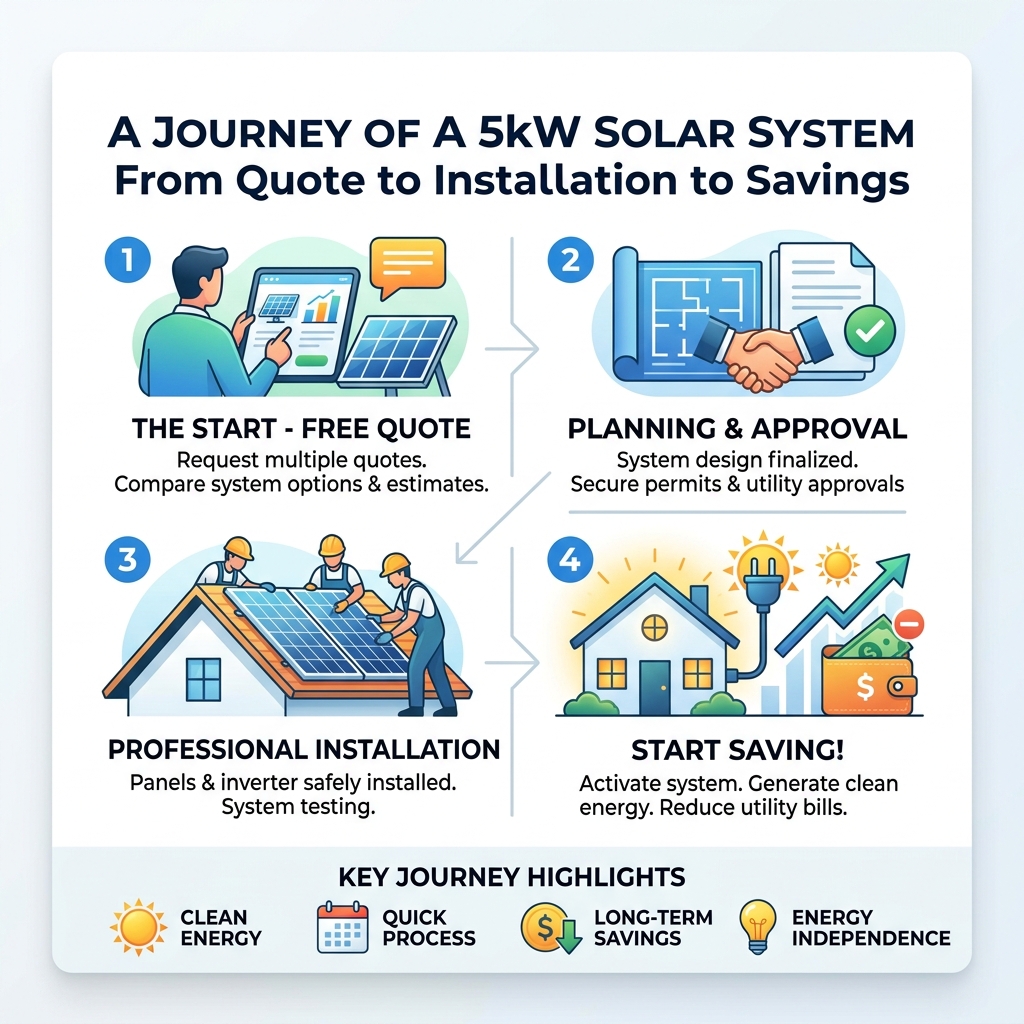
When we look at the national landscape, the 5kw solar system installed price has become more accessible than ever. As of 2026, the benchmark for a professional, turnkey installation is approximately $13,550. This breaks down to a cost per watt of roughly $2.71.
However, the “sticker price” isn’t what most homeowners actually pay. The Residential Clean Energy Credit provides a massive 30% federal tax credit for systems installed through 2032. This incentive alone slashes the national average price by $4,065, bringing your net investment down to just $9,485.
| Pricing Metric | National Average (2026) |
|---|---|
| Gross Installed Cost | $13,550 |
| Federal Tax Credit (30%) | -$4,065 |
| Net Cost to Homeowner | $9,485 |
It is important to note that this 30% credit is a stable, long-term incentive. Under current federal guidelines, this credit is scheduled to remain at 30% for homeowner-owned systems until the end of 2032. For those looking to maximize their solar panels cost and savings, timing your installation to lock in current hardware rates is key.
Key Components and Factors Affecting Price
A 5kW system isn’t just a stack of blue glass on your roof; it is a sophisticated power plant. Understanding what goes into that 5kw solar system installed price helps you spot a “padded” quote from a mile away.
The Hardware Breakdown
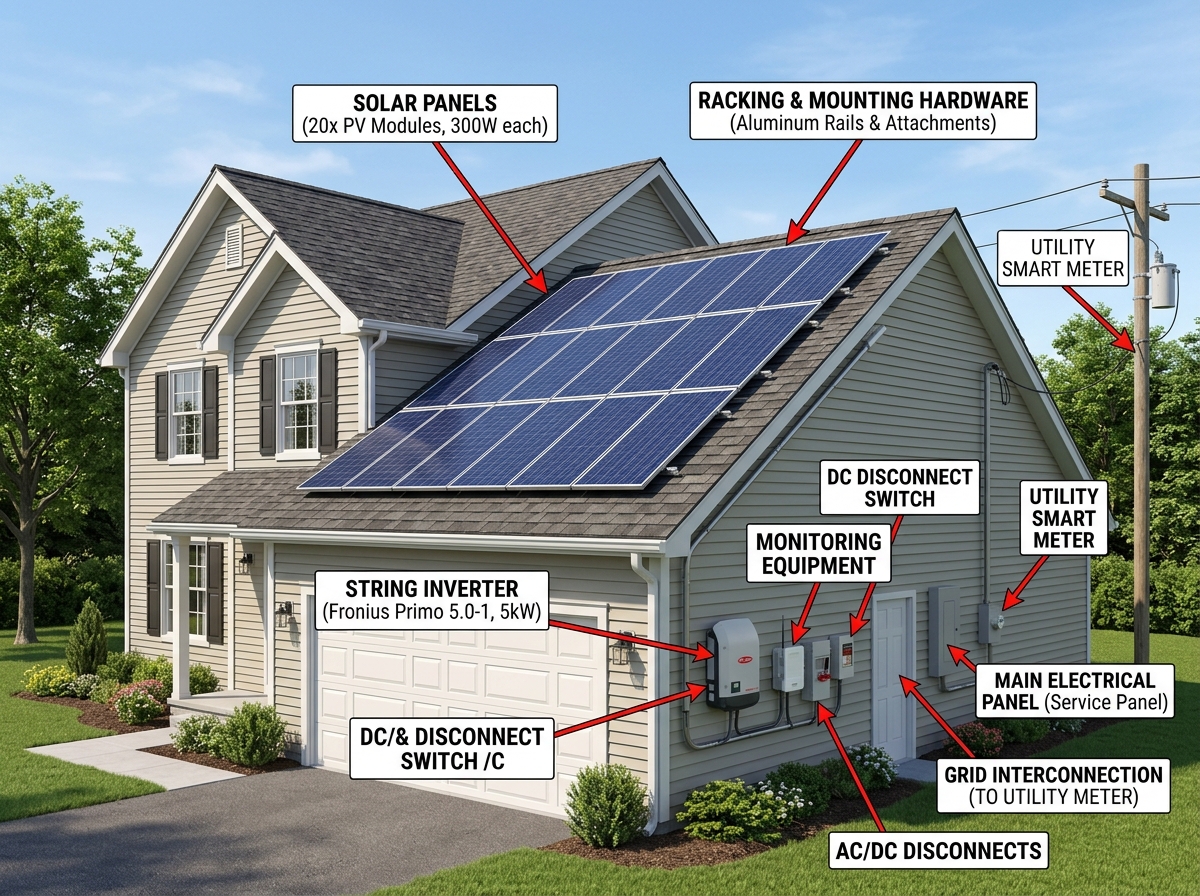
- Solar Panels: A typical 5kW system requires 12 to 15 panels, depending on the wattage of the modules (usually 400W to 450W). We always recommend Tier-1 monocrystalline panels. They are more efficient than older polycrystalline tech, meaning you need fewer of them to reach that 5kW mark—perfect if you have limited roof space.
- Inverters: These are the “brains” of the system, converting DC power from the panels into the AC power your home uses.
- Racking and Mounting: This is the hardware that secures the panels to your roof or the ground. Brands like IronRidge are industry standards for durability.
Factors Influencing Your 5kW Solar System Installed Price
Not every roof is created equal. If your home has a simple, south-facing asphalt shingle roof, your labor costs will be lower. However, several variables can push the price up:
- Inverter Choice: String inverters are the most cost-effective for unshaded roofs. However, microinverters or power optimizers (which allow panels to work independently) are better for roofs with partial shade but can add $1,000 to $2,000 to the total.
- Roof Complexity: Multiple roof planes, steep pitches, or materials like tile and slate require more specialized labor and safety equipment.
- Soft Costs: According to the NREL solar research division, “soft costs”—which include permitting, design, and customer acquisition—can make up a significant portion of your total bill.
For a deeper dive into the logistics, check out our home solar panel installation guide.
Regional Pricing Variations
Where you live dictates the local market competition and labor rates. In states like Arizona, high competition and streamlined permitting keep the 5kw solar system installed price around $10,100. Conversely, in Massachusetts, higher labor costs and complex local regulations can push that same system to $15,250.
Interestingly, our friends in Australia see some of the lowest prices globally, with 5kW systems ranging from $4,000 to $8,500 USD. This is largely due to the STC (Small-scale Technology Certificate) rebates that act as an upfront discount.
Energy Production and Household Suitability
Is a 5kW system actually enough to keep your lights on? On average, a 5kW system produces about 7,260 kWh annually, or roughly 20 kWh per day.
However, geography plays a huge role. A 5kW system in sun-drenched Phoenix might churn out 8,824 kWh a year, while the same system in cloudy Seattle might only produce 5,467 kWh. As noted by the Union of Concerned Scientists’ renewable energy resources, understanding your local “solar irradiance” is key to calculating your true ROI.
Is a 5kW System Enough for Your Home?
The average U.S. household consumes about 920 kWh per month. A 5kW system typically covers 70% to 85% of that usage.
- What it powers: It’s enough to run 5 refrigerators or roughly 132 TVs simultaneously!
- Who it’s for: It is the “sweet spot” for small to medium households (2-3 people) with modest energy needs.
- When to go bigger: If you have an electric vehicle (EV) or use electric heat pumps for your entire home, you might need to look at a 7kW or 10kW system instead.
Financial ROI, Incentives, and Payback Period
Investing in solar is one of the few home improvements that actually pays you back. Most homeowners see annual savings between $1,200 and $2,200 on their electricity bills.
Incentives Beyond the Tax Credit
- Net Metering: This allows you to “sell” excess energy back to the grid during the day and get credits to use at night.
- SRECs: In some states, you can earn Solar Renewable Energy Certificates for every megawatt-hour your system produces, which you can then sell for extra cash.
- Property Value: Studies show that owned solar systems can increase a home’s resale value by an average of 4%.
Calculating Your 5kW Solar System Installed Price Payback Period
The “break-even” point—where your energy savings equal the cost of the system—usually happens between 6 and 10 years. With a 25-year lifespan, that means you could enjoy 15+ years of essentially free electricity.
While the panels themselves are incredibly durable, we always advise budgeting for an inverter replacement around year 12 to 15, which typically costs between $1,000 and $2,000. Even with that maintenance, the average ROI for a residential solar investment stays strong at around 10%.
DIY vs. Professional Installation
If you are handy and have some electrical knowledge, a DIY 5kW ground mount solar panel kit can be purchased for as little as $8,794. This can save you 30% to 50% compared to a professional install.
However, “doing it yourself” isn’t for everyone. Here’s the reality check:
- Safety: You are dealing with high-voltage electricity and potentially climbing on your roof.
- Permits: You’ll still need to navigate local building permits and utility interconnection agreements. Some jurisdictions require structural engineering stamps that DIYers have to source independently.
- Warranties: Many premium panel manufacturers only honor their 25-year warranties if the system is installed by a licensed professional.
Using a NABCEP-certified installer ensures the job is done to code and maximizes your long-term ROI. For those interested in taking the reigns themselves, explore our DIY solar panel projects resources for more tips.
Frequently Asked Questions
How many panels are in a 5kW system?
Most modern 5kW systems use between 12 and 15 panels. If you use high-efficiency 450W modules, you’ll only need 12. This typically requires about 300 to 400 square feet of roof space.
Does the 30% federal tax credit expire?
Yes, but not for several years. To claim the full 30% credit, your system must be “placed in service” (installed and ready to operate). Current legislation under the Inflation Reduction Act keeps the credit at 30% through 2032, after which it will begin to step down. This provides a stable window for homeowners to invest in solar energy.
What maintenance does a 5kW system require?
Solar systems are remarkably low-maintenance because they have no moving parts. We recommend an annual cleaning to remove dust or pollen and checking your monitoring app once a month to ensure everything is producing as expected. Most panels come with a 25-year performance warranty, though the inverter will likely need a one-time replacement after 10-15 years.
Conclusion
At Financefyx, we believe that understanding the 5kw solar system installed price is the first step toward energy independence. By aiming for the $13,550 national average (before incentives) and acting while the 30% tax credit is at its peak, you can secure a net price under $10,000 in 2026.
Whether you choose a professional install for the peace of mind or a DIY kit to maximize savings, a 5kW system remains the “ideal entry point” for the average American home. Ready to learn more? Check out our full category on renewable energy to keep your home—and your wallet—powered for the future.
