
The Slippery Slope of Attic Insulation Upgrades
Why Your Sloped Roof Attic Is Costing You Money Right Now
Attic insulation for sloped roofs is one of the most effective upgrades you can make to cut heating bills and stop cold drafts in their tracks.
Here’s a quick summary of what you need to know:
- Best insulation types: Stone wool batts, fiberglass batts, blown-in cellulose, and spray foam
- Recommended R-value: R-49 to R-60 for cold climates like New England (15–19 inches of insulation)
- Two main system types: Vented (uses airflow to manage moisture) and unvented (fully sealed, often with spray foam)
- Biggest benefit: Cutting heating and cooling bills by up to 15%
- Key risk to avoid: Blocking soffit vents, which causes moisture buildup and ice dams
Sloped roofs look great. But they hide a costly problem.
Unlike a flat attic floor that’s easy to pile insulation on top of, a pitched roof has narrow rafter bays, awkward angles, and tight spaces. That makes insulating it much trickier — and most older homes simply don’t have enough.
The U.S. Department of Energy estimates that up to 40% of a home’s air leakage happens through the attic floor. In an uninsulated or under-insulated sloped roof, heat rises straight up and escapes — you’re essentially heating the outdoors.
A simple way to check: after a snowfall, look at your roof. If the snow melts faster than your neighbors’ roofs, your attic is leaking heat. That warmth you’re paying for is disappearing through your rafters.
This guide walks you through exactly how to fix that — the right materials, the right R-values, and the right installation steps for sloped roof attic spaces.

Why Attic Insulation for Sloped Roofs is a Game Changer
When we talk about upgrading a home, we often think of shiny new kitchens or hardwood floors. But if you want to see a real difference in your bank account and your daily comfort, the “game changer” is hidden right above your head.
Insulating a sloped roof attic isn’t just about stuffing some fluffy material between boards; it’s about creating a high-performance thermal envelope. In moderate and cold climates, a massive amount of heat is lost through the roof of an uninsulated home. By addressing the slope, we aren’t just slowing down heat loss; we’re reclaiming a space that might otherwise be a drafty, unusable “no-man’s-land.”
Thermal Resistance and Comfort
The primary goal is increasing thermal resistance, or R-value. When we use proper attic insulation for sloped roofs, we create a barrier that keeps heat where it belongs: inside during the winter and outside during the summer. This stabilizes indoor temperatures, meaning your HVAC system doesn’t have to work overtime. It’s one of the most effective energy saving methods for home insulation available today.
Noise Reduction and Fire Safety
Beyond the bills, there’s the peace and quiet. High-density materials like stone wool are incredible at noise absorption. If you live near a highway or under a flight path, insulating your sloped roof can turn a noisy attic into a silent sanctuary. Furthermore, materials like stone wool are non-combustible and can withstand temperatures over 2,000°F, providing a critical layer of fire safety for your family.
Preventing the Dreaded Ice Dam
If you’ve ever seen giant icicles hanging off a roof like jagged teeth, you’re looking at a symptom of poor insulation. Ice dams occur when heat escapes through the roof deck, melts the snow above, and then that water refreezes at the cold eaves. This can back up under shingles and cause massive water damage. Proper insulation keeps the roof deck cool, preventing this cycle entirely.
| Material Type | R-Value per Inch | Best For | Fire Resistance |
|---|---|---|---|
| Stone Wool | ~3.0 – 3.3 | Soundproofing & Fire Safety | Excellent |
| Fiberglass Batts | ~2.2 – 2.7 | DIY Projects & Budget | Good |
| Closed-Cell Spray Foam | ~6.0 – 7.0 | Air Sealing & High R-Value | Variable |
| PIR Boards | ~6.0 – 6.5 | Loft Conversions | Moderate |
Choosing the Right Materials and R-Values
Choosing the right material for attic insulation for sloped roofs depends on your goals. Are you turning the attic into a bedroom? Or are you just trying to stop the drafts?
The Department of Energy guidelines provide a roadmap for how much insulation you need based on where you live. For those in colder regions like New England, the target is often between R-49 and R-60.
- Stone Wool: This is a favorite for pitched roofs. It’s made from volcanic rock and recycled materials (often between 27% and 52% recycled content). It doesn’t sag over time, which is vital when you’re fighting gravity on a slope.
- Fiberglass Batts: These are the classic “pink” rolls. They are affordable and easy to handle, though they require precise cutting to avoid gaps.
- PIR (Polyisocyanurate) Boards: These rigid foam boards offer a very high R-value in a thin profile. They are excellent when space is limited, such as in a loft conversion where you don’t want to lose ceiling height.
For a deeper dive into the basics, check out the ultimate guide to insulating your home.
Determining R-Value for Attic Insulation for Sloped Roofs
R-value is simply a measure of how well a material resists heat flow. The higher the number, the better the insulation. To find out what you need, you first have to check the R-value guidelines for your specific climate zone.
If you are renovating an existing home in a cold climate, aiming for 15 to 19 inches of total insulation thickness is standard. However, because rafters are usually only 6 to 10 inches deep, we often have to combine methods. This might mean putting insulation between the rafters and then adding another layer below them to reach the target R-value without thermal bridging (where heat escapes through the wooden rafters themselves).
Vented vs. Unvented: Navigating Sloped Roof Systems
This is where many homeowners get confused. Do you want your roof to “breathe,” or do you want it sealed tight?
Vented Systems
A traditional vented system relies on airflow. Air comes in through the soffit vents (at the bottom of the roof), travels up a small gap between the insulation and the roof deck, and exits through a ridge vent at the top. This airflow carries away moisture and keeps the roof deck cool.
- Pros: Proven moisture management; keeps shingles cool.
- Cons: Harder to install correctly on a slope; requires baffles to prevent blocking the air path.
Unvented Systems
In an unvented (or “hot roof”) system, we seal the attic entirely. Usually, closed-cell spray foam is applied directly to the underside of the roof deck. This creates a continuous air and thermal barrier.
- Pros: Excellent air sealing; no need for vents; great for high-wind or hurricane-prone areas.
- Cons: More expensive; if the roof leaks, it can be harder to detect because the foam hides the water.
Properly managing these systems is a key part of how to seal air leaks to save energy.
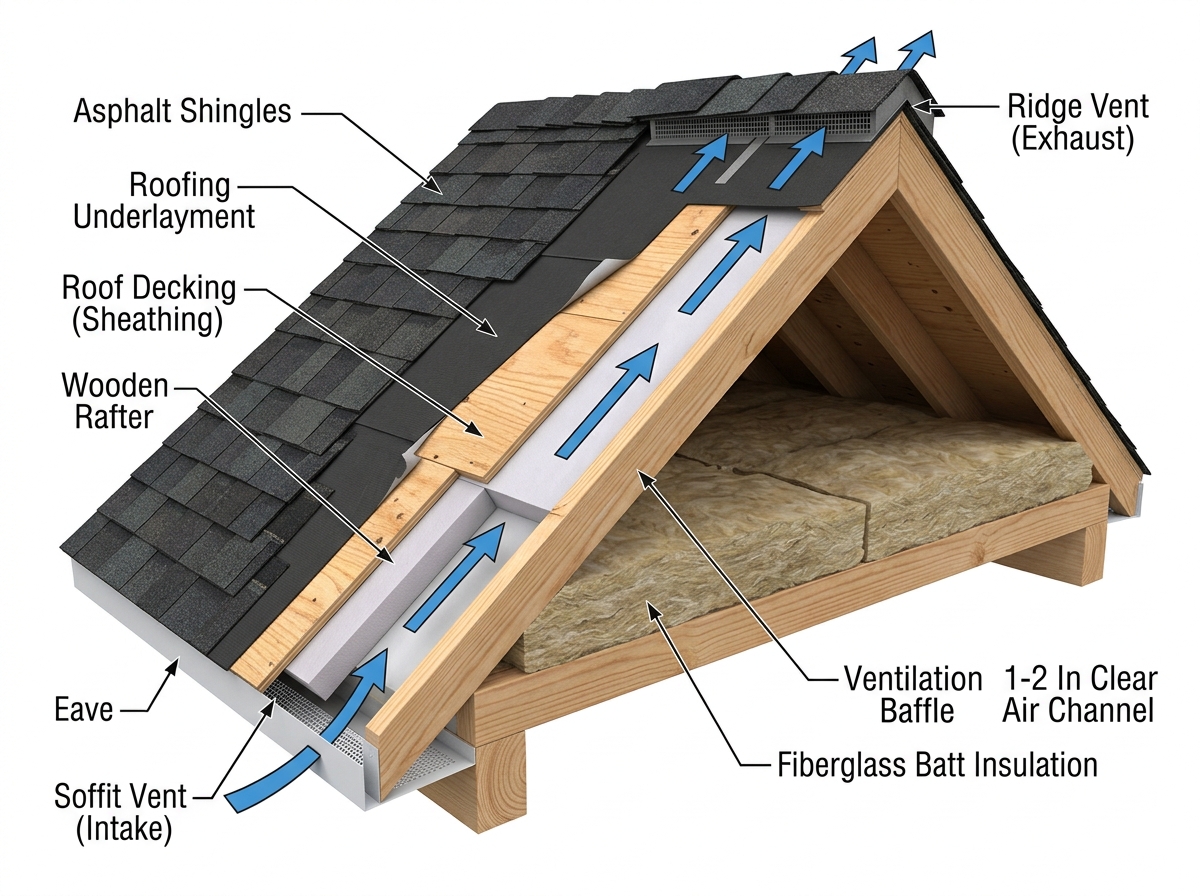
Installing Vented Attic Insulation for Sloped Roofs
If you go the vented route, baffles (also called rafter vents) are your best friends. These are plastic or foam channels that you staple directly to the roof sheathing between the rafters. They ensure that even if you pack in 12 inches of insulation, there is always a 1-to-2-inch clear path for air to flow from the eaves to the ridge.
Without these, your insulation will press against the roof deck, trapping moisture and leading to rot. We always recommend using a breathable membrane on the outside and a vapor control layer on the “warm” side (the side facing your living space) to keep the system dry and efficient. For more seasonal advice, see our catch the heat insulation tips for winter.
Step-by-Step Installation: From Rafters to Dwarf Walls
Ready to get your hands dirty? (Or at least dusty?) Here is how we approach the installation of attic insulation for sloped roofs.
1. Safety and Inspection First
Before you buy a single batt, inspect your joists and rafters. Are there signs of water leaks? If so, call a roofer first. Check your electrical cabling too. Old “knob and tube” wiring should never be covered with insulation as it can overheat.
2. Air Sealing
Insulation stops heat transfer, but it doesn’t always stop air. Use spray foam or caulk to seal gaps where wires, pipes, or chimneys go through the attic floor. Remember: up to 40% of air leakage happens here! This is one of the top attic insulation tips save energy and money.
3. Install Baffles (For Vented Systems)
Slide your baffles into the rafter bays starting at the soffit. Ensure they extend past the point where the insulation will be. Staple them securely.
4. Fitting the Insulation
Measure the space between your rafters. Most are 16 or 24 inches on center. Cut your insulation (stone wool or fiberglass) about half an inch wider than the space for a “friction fit.”
- Pro Tip: Don’t jam it in. If you compress insulation, you squeeze out the air pockets that do the actual insulating, which lowers the R-value.
5. Insulating Dwarf Walls and Gable Ends
In a loft conversion, you’ll often have “dwarf walls” (short vertical walls). These must be insulated just as carefully as the slope.
- Cut insulation to fit tightly between the studs of the dwarf wall.
- Ensure the insulation is continuous from the floor, up the dwarf wall, and into the sloped rafters.
- Use a vapor control layer (like a 1000-gauge polythene sheet or foil tape on PIR boards) to prevent condensation.
Frequently Asked Questions about Sloped Roof Insulation
Can I install insulation directly against the roof deck?
Yes, but only if you are creating an unvented system using specific materials like closed-cell spray foam. If you put fiberglass or stone wool directly against the wood without a ventilation gap, you are asking for moisture, mold, and rot. Always check your local building codes, as some regions have strict rules about “hot roof” assemblies.
How much does sloped roof insulation cost?
The cost varies wildly based on the material. Fiberglass is the most budget-friendly, while spray foam is the most expensive. However, you should look for incentives. Programs like the Mass Save Program or the Energy Wise rebates can often cover a significant portion of the costs. In some cases, these rebates make the difference between a “someday” project and a “right now” project.
What are the most common insulation mistakes?
- Blocking the Vents: This is the #1 mistake. If air can’t get from the soffit to the ridge, your roof will “sweat,” leading to mold.
- Gaps and Voids: Even a small 1-inch gap can reduce the overall effectiveness of your insulation by a huge percentage.
- Ignoring the Attic Hatch: We often spend thousands on the roof and forget the “hole” in the floor. Use an insulated attic stair cover to seal that final leak.
Conclusion
Upgrading your attic insulation for sloped roofs is a journey that pays for itself. Between the 15% savings on your energy bills and the massive boost in home comfort, it’s one of the smartest financial moves a homeowner can make.
Whether you choose the DIY route with stone wool batts or hire a professional for a full unvented spray foam system, the goal remains the same: a tighter, warmer, and safer home. Don’t forget that insulation is just one part of the puzzle; you can also save energy with insulated window treatments to keep that hard-earned heat from escaping elsewhere.
At Financefyx, we believe that financial health starts at home. By reducing your monthly overhead through smart energy upgrades, you’re freeing up capital for the things that really matter. Ready to learn more? Explore more energy saving tips and start your journey toward a more efficient home today.
