
Why Your Business Needs Commercial Photovoltaic Panels Right Now
Why Energy Costs Are Pushing Businesses Toward Commercial Photovoltaic Panels
Commercial photovoltaic panels are solar modules designed specifically for non-residential buildings — converting sunlight into usable electricity at a scale that can power everything from a small warehouse to a large industrial facility.
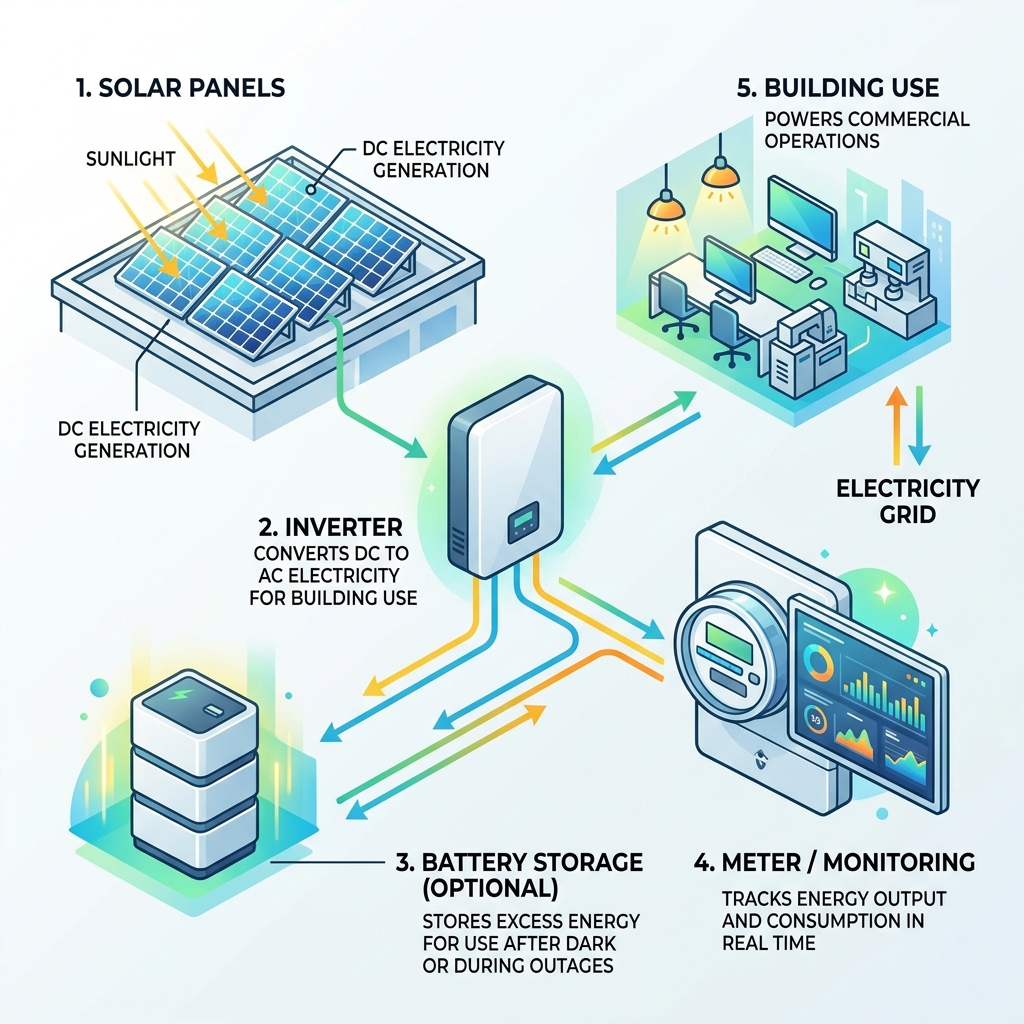
Here is a quick breakdown of what a commercial solar PV system includes:
| Component | What It Does |
|---|---|
| Solar panels | Convert sunlight into direct current (DC) electricity |
| Inverter | Converts DC to alternating current (AC) for building use |
| Mounting system | Secures panels to roof, ground, or carport structure |
| Meter / monitoring | Tracks energy output and consumption in real time |
| Battery storage (optional) | Stores excess energy for use after dark or during outages |
Systems typically range from 20kW to several hundred kilowatts, depending on your building size and energy needs.
Energy prices are not coming down anytime soon. Businesses across the UK and beyond are facing rising grid costs, tighter carbon reporting rules, and growing pressure from investors and customers to demonstrate real sustainability action.
Commercial solar is one of the most direct responses to all three pressures at once.
A leisure centre cuts its energy bills and carbon emissions. A calibration facility meets its sustainability targets. A business park generates enough power to save the equivalent of over 1,300 barrels of oil annually. These are not outliers — they are what happens when a building’s roof is put to work.
This guide walks you through everything you need to know: how these systems work, which panels perform best, what the real financial returns look like, and how to get your site ready.
The Strategic Advantage of Commercial Photovoltaic Panels
For most businesses, the decision to install commercial photovoltaic panels isn’t just an environmental one—it is a core strategic move. Unlike residential setups, commercial systems are built for scale, typically ranging from 20kW to several hundred kilowatts. This allows a company to generate a massive portion of its own power, shielding the bottom line from the volatility of the energy market.
One of the biggest advantages for businesses is the alignment of energy production and consumption. Most commercial entities operate during daylight hours, which is exactly when solar panels are at their peak production. By consuming “free” solar energy as it is generated, businesses can experience more than 25% savings from traditional electricity providers. This shift toward energy independence means you are no longer at the mercy of the grid.
If you are just starting to explore how the sun can power your operations, our solar energy guide for beginners offers a great foundation. In the commercial world, every square foot of unused roof space is essentially a wasted asset. By installing a solar PV system, you turn that roof into a mini-power plant that delivers electricity for roughly 9 cents per kWh, including operations and maintenance costs—significantly lower than standard commercial grid rates.

Selecting High-Efficiency Commercial Photovoltaic Panels
When we talk about “efficiency” in the commercial sector, we are looking at how much sunlight a panel can convert into electricity per square foot. Most commercial photovoltaic panels on the market today range from 19% to 22% efficiency, with premium models reaching as high as 23.2%.
In 2025, the technology landscape is dominated by a few key innovations:
- N-Type TOPCon: This technology is rapidly becoming the industry standard for commercial projects. Learn more about commercial TOPCon modules which offer conversion efficiencies as high as 28.7% in laboratory settings and over 22% in real-world applications.
- Heterojunction (HJT): These panels combine crystalline silicon with thin-film layers. They perform exceptionally well in low-light conditions and have a very low temperature coefficient, meaning they don’t lose as much power when the sun gets hot.
- Bifacial Modules: These panels have solar cells on both sides. While a monofacial panel only catches direct sunlight, a bifacial panel catches light reflecting off the roof or ground behind it.
| Feature | Monofacial Panels | Bifacial Panels |
|---|---|---|
| Light Capture | Front side only | Both sides (front & back) |
| Energy Yield | Standard | Up to 10-30% higher (site dependent) |
| Best Use Case | Standard flush-mount roofs | Flat roofs, ground mounts, carports |
| Durability | High | Very High (often dual-glass) |
Durability and Warranties for Commercial Photovoltaic Panels
A commercial solar installation is a 25-to-40-year investment. Therefore, the “paperwork” behind the panels is just as important as the silicon inside them. High-tier manufacturers now offer performance warranties that guarantee the panels will still produce 80-90% of their original power after 25 or 30 years.
For example, the Series 6 Family | First Solar utilizes CdTe thin-film technology. These modules are famous for their resilience in extreme environments and have a warranted annual degradation rate of just 0.3%. This is significantly lower than many conventional panels, meaning your energy yield stays higher for longer.
When reviewing specifications, look for these “gold standard” durability markers:
- PID Resistance: Ensures the panels don’t lose power due to stray electrical currents.
- Salt Mist & Ammonia Certification: Essential if your business is located near the coast or in an agricultural area.
- Hail Impact Durability: Some top-tier panels, like those from Trina Solar, are tested against hailstones up to 65mm in diameter.
- Temperature Coefficient: Look for -0.35% per degree C or lower. This ensures the panels keep working efficiently even during a heatwave.
Financial ROI, ESG Benefits, and Site Logistics
The financial case for commercial photovoltaic panels has never been stronger. Beyond the immediate 25% reduction in electricity bills, the Levelized Cost of Energy (LCOE) for solar is now roughly 9 cents per kWh. When you compare this to the rising costs of grid power, the “break-even” point for many businesses is now reached within 4 to 5 years.
To understand the broader financial picture, including upfront costs vs. long-term gains, check out our guide on solar-panels-cost-and-savings.
Beyond direct savings, there are significant regulatory and tax advantages:
- ESG and Compliance: Installations help businesses meet SECR (Streamlined Energy and Carbon Reporting) and ESOS (Energy Savings Opportunity Scheme) requirements.
- Capital Allowances: In many regions, the cost of the system can be deducted from taxable profits, providing an immediate “discount” on the investment.
- Smart Export Guarantee (SEG): If your system produces more power than you use (common during weekends for offices), you can sell that excess electricity back to the grid.
Optimizing Site Conditions for Maximum Yield
Not every roof is created equal. To maximize your return, we have to look at the physical realities of your site. Generally, you need about 100 square feet for every 1kW of solar capacity. If you have a 10,000-square-foot warehouse, you could potentially host a 100kW system.
Key factors for a successful installation include:
- Orientation and Tilt: In the Northern Hemisphere, south-facing roofs at a 35-40 degree angle are the “sweet spot.” However, east-west systems are becoming popular for businesses that need a steady “hump” of power throughout the entire day rather than one massive peak at noon.
- Roof Load Capacity: Commercial panels are heavy. While lightweight flexible panels exist for aging roofs, most standard installs require a structural assessment. For more on the physical installation process, see our home-solar-panel-installation-guide, which covers many of the same mounting principles.
- Flat Roof Mounting: Most commercial buildings have flat roofs. These use “ballasted” racking systems that hold the panels down with weights rather than drilling holes into your roof membrane.
- Agri-PV and Carports: If your roof isn’t suitable, consider your land. Agri-PV allows crops to grow under elevated panels, while solar carports turn your parking lot into a power generator while keeping employee cars cool.
Frequently Asked Questions about Commercial Solar
What is the typical payback period for a commercial system?
Most businesses see a full Return on Investment (ROI) within 4 to 6 years. Given that the systems are designed to last 25 to 30 years, this leaves you with over two decades of essentially free electricity. It is one of the most effective ways to “hedge” against future energy price hikes.
How do commercial panels perform in low-light or winter conditions?
Modern commercial photovoltaic panels are surprisingly efficient in the UK’s “grey” weather. They don’t just use direct sunlight; they also capture “diffuse” light (light filtered through clouds). In fact, solar panels actually perform better in cooler temperatures than in extreme heat, as high heat can reduce the efficiency of the electrical circuits.
What are the maintenance requirements for large-scale arrays?
Solar PV systems are incredibly low-maintenance because they have no moving parts. We recommend a routine professional cleaning once or twice a year to remove dust, bird droppings, or salt. Most commercial systems also include 24/7 digital monitoring, which will alert us if a specific string of panels isn’t performing as expected. Annual thermal imaging inspections can also identify “hot spots” before they become a problem.
Conclusion
The transition to commercial photovoltaic panels is no longer a “future” project—it is a present-day necessity for businesses looking to remain competitive. By locking in your energy costs for the next 25 years, you gain a level of financial predictability that the grid simply cannot offer.
Beyond the balance sheet, a solar-powered facility sends a powerful message to your clients, employees, and investors. It proves that your company is a leader in corporate sustainability and is actively contributing to the net-zero 2050 targets.
At Financefyx, we are dedicated to helping businesses navigate the complexities of the renewable transition. Whether you are looking at rooftop arrays, solar carports, or integrated battery storage, the time to act is now.
