
How Much Does a Massive 50kW Solar Array Cost in 2026?
Is a 20 kW Solar System Worth the Investment in 2026?
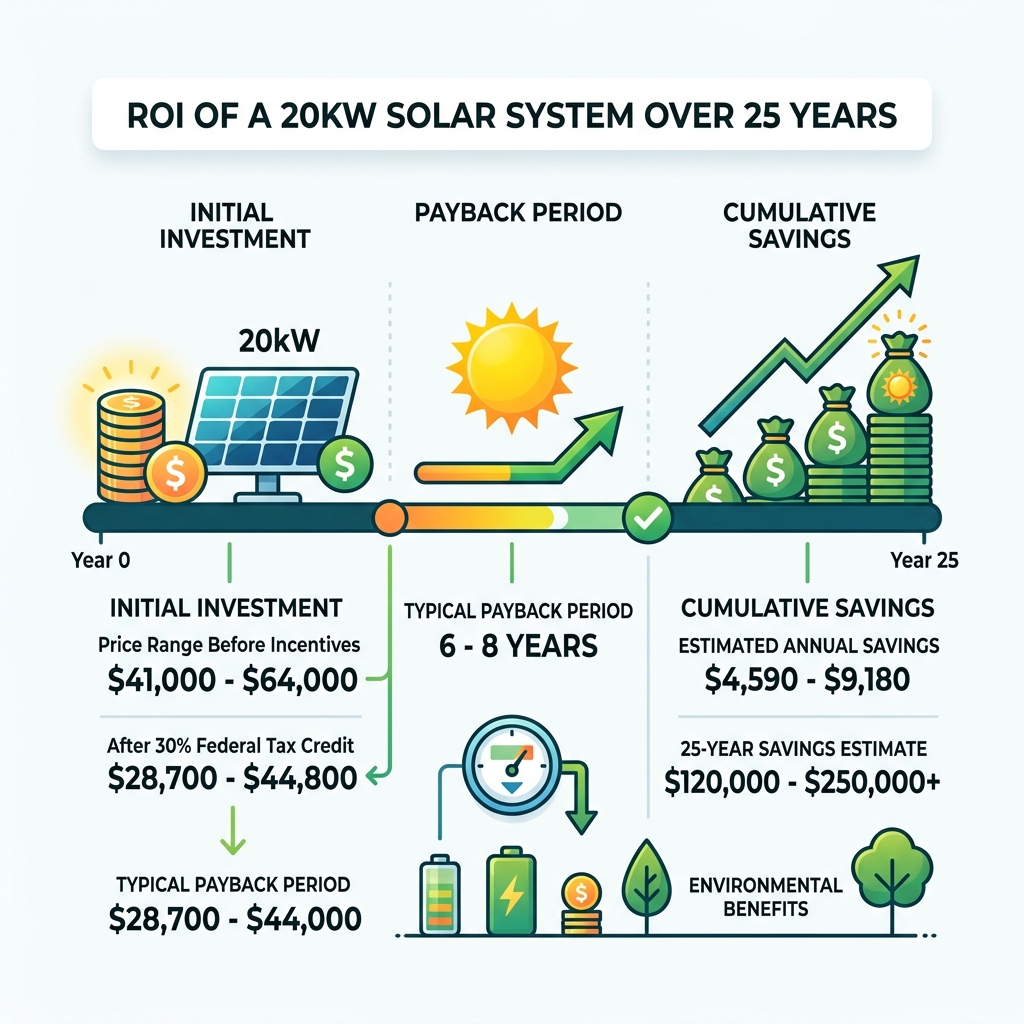
The 20 kw solar system price in 2026 ranges from $41,000 to $64,000 before incentives – dropping to roughly $28,700 to $44,800 after the 30% federal tax credit.
Here’s a quick snapshot of what you’re looking at:
| Cost Stage | Price Range |
|---|---|
| Before incentives (national average) | $41,000 – $64,000 |
| National average (2025 data) | ~$47,600 |
| After 30% federal tax credit | ~$28,700 – $44,800 |
| DIY equipment-only kits | $23,950 – $31,893 |
| Off-grid system (with batteries) | $60,000 – $120,000+ |
| Estimated annual savings | $4,590 – $9,180 |
| Typical payback period | 6 – 8 years |
| 25-year savings estimate | $120,000 – $250,000+ |
If you’ve been watching your energy bills climb every winter, you’re probably already doing the math. A 20 kW solar system is one of the largest residential and small commercial solar setups available – big enough to completely eliminate the average American household’s electricity bill, and then some.
But the upfront price tag stops a lot of people cold.
The good news? The true cost is significantly lower than the sticker price once you factor in tax credits, utility rebates, and long-term savings. Solar costs also hit an all-time low in 2025, making this one of the best windows to invest.
This guide breaks down every dollar – from panels and inverters to labor and permits – so you can make a confident, informed decision. For readers who want additional background on how solar pricing and policy work nationwide, the U.S. Department of Energy solar overview is a useful external reference.
20 kw solar system price basics:
Breaking Down the 20 kw solar system price in 2026
When we talk about a 20kW system, we are moving out of the “standard residential” neighborhood and into the “high-capacity” district. This is a system designed for large properties, luxury homes with heated pools, or medium-sized businesses. Because of the scale, the 20 kw solar system price benefits from economies of scale — you usually pay less per watt than someone installing a tiny 5kW system.
In 2026, the national average for a fully installed 20kW system sits between $41,000 and $64,000. While 2025 saw some of the lowest prices in history, we have to keep an eye on supply chain shifts and potential new tariffs that could nudge equipment prices slightly upward. However, the efficiency of newer N-Type and TopCon panels means you get more “bang for your buck” than ever before.
To understand where your money goes, we need to look at the solar-panels-cost-and-savings breakdown. It isn’t just about the glass on the roof; it’s about the engineering, the labor, and the legal red tape.
| Component | Estimated Cost Range (2026) |
|---|---|
| Solar Panels (48-60 units) | $19,000 – $25,000 |
| Inverters (String or Micro) | $4,500 – $8,500 |
| Mounting & Racking Hardware | $4,000 – $6,500 |
| Installation Labor | $9,000 – $14,000 |
| Permits, Engineering & Interconnection | $1,500 – $2,500 |
| Miscellaneous (Wiring, Conduit, Monitoring) | $2,500 – $4,800 |

State-by-State Variations in 20 kw solar system price
One of the most frustrating parts of solar shopping is that a system in Phoenix might cost $20,000 less than the exact same system in Boston. Why? It comes down to local labor rates, state-level incentives, and how much “solar-friendly” legislation exists in your area.
For example, the 20 kw solar system price in Arizona often hovers around $40,400 because the market is highly competitive and the installation process is streamlined. Meanwhile, in Massachusetts, you might see quotes closer to $61,000 due to higher labor costs and more complex permitting requirements.
California remains a unique beast. While market data shows an average price of $45,200 for a 20kW system, the ROI is often higher there because electricity rates are through the roof. Plus, programs like the Self-Generation Incentive Program (SGIP) can provide massive rebates if you add battery storage.
Texas is another hot spot (literally). With an average price of $42,400, many Texans are opting for high-capacity systems to combat the strain on the grid during summer heatwaves. If you want to see how these larger systems compare to standard sizes, check out our guide on how to dont-overpay-for-solar-a-breakdown-of-5kw-installed-prices.
Detailed Component Cost Breakdown
Let’s get into the weeds of what you’re actually buying. Not all panels are created equal!
- Tier 1 Panels: These are the gold standard. Brands like Silfab, Q.Cells, or Canadian Solar offer 25-to-30-year warranties. For a 20kW system, you’ll likely need between 48 and 60 panels, depending on whether you choose high-efficiency 450W modules or standard 370W modules.
- Inverters: This is the “brain” of your system. You have two main choices:
- String Inverters: Cheaper and simpler, but if one panel is shaded, the whole string’s performance can drop.
- Micro-inverters: These sit under each panel. They cost more upfront but maximize production if your roof has complex shading.
- Racking: Ironridge or Unirac systems are the industry favorites for keeping your panels attached to your roof during a hurricane.
- Permit Fees: Don’t forget the “soft costs.” Your local city council and utility company will want their cut for inspections and “interconnection” (the permission to hook your system to the grid).
For a deeper dive into the technical side, our home-solar-panel-installation-guide covers the step-by-step process.
Factors Influencing High-Capacity Solar Costs
Why does your neighbor’s quote look different from yours? It’s rarely just about the panels. The 20 kw solar system price is heavily influenced by the “degree of difficulty” of your specific property.
- Roof Complexity: If you have a simple, south-facing gable roof, your labor costs will be low. If you have a steep, multi-story roof with dormers and Spanish tiles, expect to pay a premium.
- Installation Type: Roof mounts are standard, but ground mounts are popular for 20kW systems because they require so much space. A 20kW ground mount solar panel installation might cost more in racking and trenching, but it allows for perfect orientation toward the sun.
- Equipment Efficiency: Premium “all-black” high-efficiency panels look great and produce more power in less space, but they can add $5,000+ to the total bill.
For those just starting their journey, we recommend reading our solar-energy-guide-for-beginners to get a handle on the terminology.
Residential vs. Commercial Requirements
A 20kW system sits right on the border between residential and commercial.
- Residential: Most homes in the U.S. use about 920 kWh per month. A 20kW system produces roughly three times that. This makes it ideal for “all-electric” homes that use heat pumps, EV chargers, and electric water heaters.
- Commercial: For a small office or a retail shop, a 20kW system can offset a massive chunk of operating costs. Businesses also get an extra financial perk: MACRS Depreciation, which allows them to write off the equipment cost much faster than a homeowner can.
Space is the biggest hurdle. You’ll need between 1,300 and 1,725 square feet of clear, unshaded space. If your roof isn’t big enough, you might need to look at smaller options, such as those found in the-2025-guide-to-5kw-solar-panel-system-costs.
Financial Incentives and ROI Analysis
This is where the “scary” upfront cost starts to look like a brilliant investment. The single biggest factor in reducing the 20 kw solar system price is the Federal Investment Tax Credit (ITC).
As of 2026, the Federal ITC remains at 30%. This isn’t just a deduction; it’s a dollar-for-dollar credit on your federal income tax. If your system costs $50,000, you get a $15,000 credit. Suddenly, your “real” cost is $35,000.
But wait, there’s more:
- Net Metering: Most states allow you to “sell” excess power back to the grid. During the day, your 20kW system will produce way more than you can use. Your meter literally spins backward, giving you credits you can use at night.
- SRECs: In some states, you earn “Solar Renewable Energy Certificates” for every megawatt-hour you produce, which you can sell for extra cash.
To avoid getting ripped off by high utility rates while waiting for your solar to kick in, read how to dont-get-burned-by-high-rates-average-cost-of-solar-per-kwh.
Calculating the 20 kw solar system price Payback Period
Most of our readers want to know one thing: “When does this pay for itself?”
On average, a 20kW system pays for itself in 6 to 8 years. In high-cost states like California or Massachusetts, that can drop to 4 to 6 years.
Think about it this way: After year 7, your electricity is essentially free for the next two decades. Over 25 years, a 20kW system can save you anywhere from $120,000 to over $250,000. That’s a better return than many stock market portfolios!
Annual production for a 20kW system averages about 29,033 kWh. However, geography plays a huge role. A system in Phoenix will produce about 35,291 kWh, while the same system in Seattle might only hit 21,873 kWh. Even in “cloudy” Seattle, the system still produces enough to wipe out a massive electric bill.
Environmental Impact and Carbon Offsets
Beyond the dollars and cents, a 20kW system is a powerhouse for the planet. Installing a system this size is the environmental equivalent of:
- Offsetting 23–30 metric tons of CO2 every year.
- Planting over 450 trees annually.
- Removing 6 to 7 gas-powered cars from the road.
- Saving over 3,000 gallons of gasoline every single year.
If your goal is a “net-zero” lifestyle, 20kW is the magic number that usually gets you there.
Grid-Tied vs. Off-Grid System Costs
There is a massive difference in the 20 kw solar system price depending on whether you want to stay connected to the utility company or cut the cord entirely.
- Grid-Tied: This is what 95% of people choose. You use the grid as your “battery.” It’s reliable, cheaper, and allows you to use net metering.
- Hybrid: This is a grid-tied system with a small battery backup. It gives you the best of both worlds — lower costs and protection during blackouts.
- Off-Grid: This is for the true pioneers. It requires a massive battery bank and a backup generator because there is no safety net.
For more on the off-grid lifestyle, check out our off-grid-solar-panel-tips.
The Cost of Adding Battery Storage
If you want energy security, you need batteries. The industry standard is now LiFePO4 (Lithium Iron Phosphate) technology. These batteries last longer and are safer than the old lead-acid versions.
Adding storage to a 20kW system isn’t cheap. A battery bank capable of supporting a 20kW array usually needs 60 to 100 kWh of capacity, which can cost between $24,000 and $60,000.
Why so much? Because a 20kW system can fill up a small battery in just a few hours of morning sun. To actually survive a three-day storm, you need a large “bucket” to store all that power. We’ve compared the options in our guides on home-battery-storage-for-solar and the best-home-batteries-for-energy-storage.
Off-Grid 20kW System Realities
We have to be honest here: true off-grid living is expensive. While a grid-tied 20 kw solar system price might be $47,000, an off-grid version can easily soar to $100,000 or $120,000.
As noted in industry research regarding high-capacity off-grid systems, the panels are actually the cheapest part of an off-grid setup. The real costs are the batteries, the heavy-duty off-grid inverters, and the mandatory backup generator.
In the winter, solar production can drop by 70-80%. Without the grid, you will need a propane or diesel generator to keep the lights on during a cloudy week in January. It’s a lifestyle of “energy budgeting” rather than “unlimited power.”
Frequently Asked Questions
How many solar panels are needed for a 20kW system?
Typically, you will need 48 to 60 panels. If you use high-efficiency 400W–450W modules, you can stay on the lower end (around 45-48 panels). If you use older or smaller 330W panels, you could need over 60. This requires a significant amount of roof space — at least 1,300 square feet.
How much electricity does a 20kW system produce annually?
On average, expect 26,500 to 33,000 kWh per year. The exact number depends on your “solar window.” If you live in Southern California or Arizona, you’ll hit the high end. If you’re in a rainy climate with lots of trees, you might be on the lower end. Orientation (facing South) and tilt angle are the two biggest factors you can control to maximize this output.
What are the maintenance costs for a 20kW solar array?
Solar systems are surprisingly low-maintenance because they have no moving parts. However, for a system this size, we recommend:
- Annual Cleaning: $150–$300 to remove dust and bird droppings (which can sap 10% of your power).
- Inverter Replacement: Most string inverters last 12–15 years. Budget about $3,000–$5,000 for a mid-life replacement.
- Monitoring: Most systems come with a free app, but some “pro” versions have a small monthly fee. Most Tier 1 panels come with a 25-year warranty, so if a panel fails, the manufacturer usually covers the hardware cost.
Conclusion
At Financefyx, we believe that understanding the 20 kw solar system price is the first step toward true energy independence. While $50,000 sounds like a lot of money, it is one of the few home improvements that actually pays you back every single month.
Whether you are looking to power a massive estate or protect your small business from rising utility rates, a 20kW system is a robust, sustainable, and financially savvy choice for 2026. By leveraging the 30% federal tax credit and local incentives, you can turn a massive utility liability into a long-term wealth-building asset.
Ready to dive deeper into green energy? Check out More info about renewable energy services to see how you can start your transition today. The sun is going to shine anyway — you might as well get paid for it!
