
How to Master the Attic Insulation Thickness Guide
Why Getting Your Attic Insulation R-Value Right Can Cut Your Energy Bills by 15% or More
The attic insulation r value guide you need starts with one simple truth: your attic is likely where your home loses the most energy — up to 25% of all heat escapes through an under-insulated attic every winter.
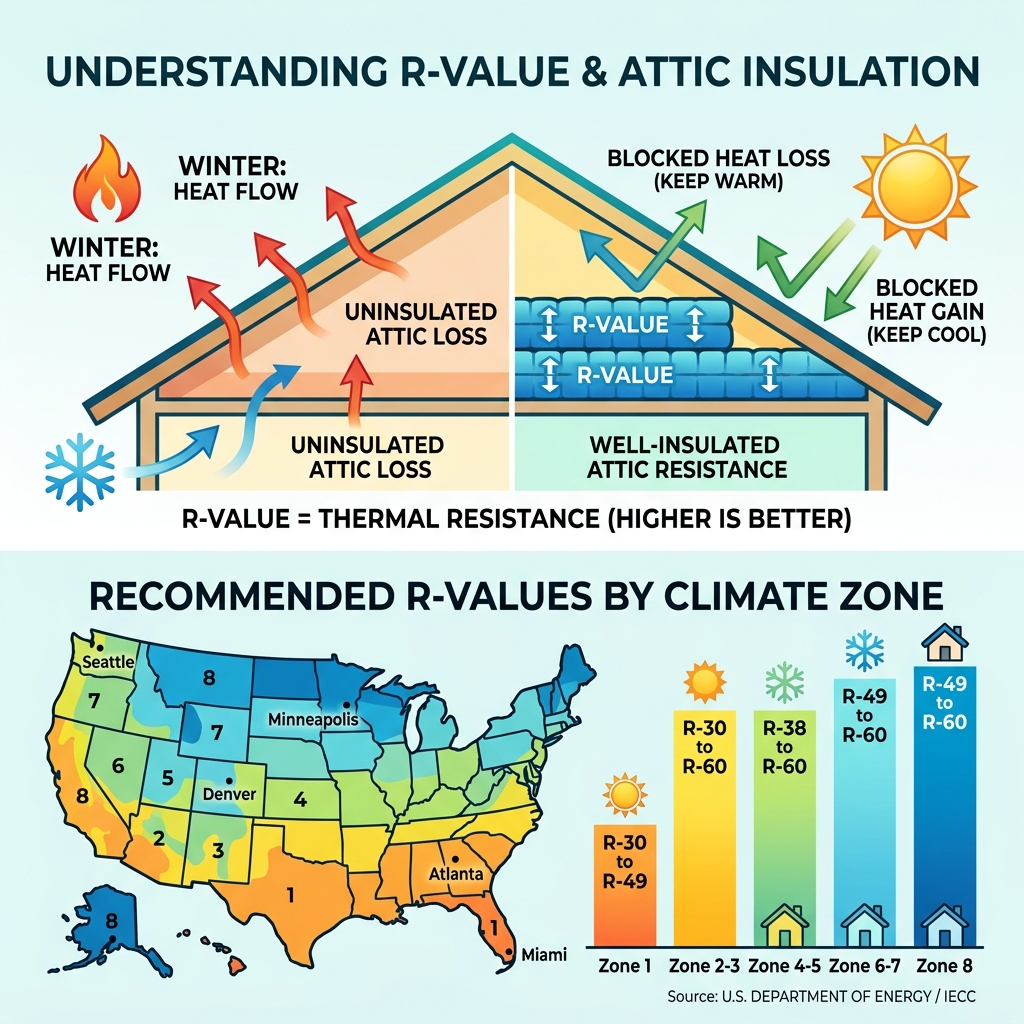
Here’s a quick-reference breakdown of recommended R-values by U.S. climate zone, so you can find your target right away:
| Climate Zone | Region Examples | Recommended Attic R-Value |
|---|---|---|
| Zone 1 | Miami, Honolulu | R-30 to R-49 |
| Zone 2-3 | Houston, Atlanta, Los Angeles | R-30 to R-60 |
| Zone 4-5 | Chicago, Denver, Seattle | R-38 to R-60 |
| Zone 6-7 | Minneapolis, Duluth | R-49 to R-60 |
| Zone 8 | Anchorage | R-49 to R-60 |
Source: U.S. Department of Energy / IECC 2021
R-value is simply a measure of how well insulation resists heat flow. The higher the number, the better it keeps heat where you want it — inside during winter, outside during summer.
The problem? Around 90% of U.S. homes are under-insulated, according to the Insulation Institute. Many homes — especially those built before 1980 — have little to no attic insulation meeting today’s standards. That means your heating system works harder, your bills climb higher, and your home stays uncomfortable no matter how high you set the thermostat.
The good news: fixing your attic insulation is one of the highest-ROI home upgrades you can make. The EPA’s ENERGY STAR program estimates homeowners can save 15% or more on heating and cooling costs just by getting their attic insulation to the right level.
This guide walks you through everything — from understanding R-values and finding your climate zone, to choosing the right material and knowing when to call a pro.
Understanding the Attic Insulation R Value Guide
When we talk about mastering your home’s efficiency, we have to start with the science of staying cozy. In home improvement, “R-Value” is the gold standard. It stands for thermal resistance. Think of it as a security guard standing at your ceiling, blocking heat from sneaking out in the winter and stopping solar heat from crashing your AC party in the summer.
Heat is a restless traveler. It moves in three ways:
- Conduction: Heat moving through solid materials (like your ceiling joists).
- Convection: Heat circulating through the air.
- Radiation: Heat traveling in straight lines, like the sun beating down on your roof.
Traditional insulation primarily fights conduction and convection. By understanding this attic insulation r value guide, you can choose materials that create a formidable barrier against these energy thieves. If you are just starting your research, you might want to check out the ultimate guide to insulating your home for a broader perspective on whole-house efficiency and modern standards.
Why R-Value Matters for Your Home
Why should you care about a technical rating? Because your wallet cares. According to the Department of Energy, an under-insulated home can waste about 20% of the energy used for heating and cooling. By hitting the right R-value, you aren’t just helping the planet; you’re essentially giving yourself a raise.
The EPA’s ENERGY STAR program notes that homeowners can save an average of 15% on heating and cooling costs (about 11% on total energy costs) by air sealing and adding insulation in key areas like attics and floors. Beyond the savings, proper R-values eliminate those annoying “hot spots” in the summer and keep your toes from freezing when the wind howls. We’ve explored various energy saving methods for home insulation that highlight how these small changes lead to massive long-term benefits.
How to Calculate Your Current Attic Insulation R Value Guide
Before you buy a single bag of cellulose, we need to know your starting point. You can’t reach your destination if you don’t know where you are! Put on a mask, grab a ruler and a flashlight, and head into the attic (carefully walking only on the joists!).
- Measure the Depth: Stick your ruler into the insulation until it hits the floor. Take measurements in 5-10 different spots and average them out.
- Identify the Material:
- Fiberglass (Loose): Looks like pink, white, or yellow fluff.
- Fiberglass (Batts): Large blankets of pink or yellow material.
- Cellulose: Gray, papery, recycled look.
- Rock Wool: Stone-gray or olive, wool-like texture.
- Use the Multiplier: Multiply your average depth by the material’s R-value per inch. For example, if you have 6 inches of loose fiberglass (R-2.5 per inch), your current R-value is R-15.
A quick visual rule of thumb: If you can see your floor joists, you definitely don’t have enough insulation. Most joists are only 6 to 10 inches deep, and modern standards usually require 13 to 20 inches of material. For more DIY inspection tricks, see our attic insulation tips to save energy and money.
Recommended R-Values by U.S. Climate Zone

The United States is a big place with wildly different weather. What works for a bungalow in sunny Florida would be a disaster for a cabin in the snowy Rockies. That’s why the Department of Energy (DOE) and the International Energy Conservation Code (IECC) have divided the country into eight distinct climate zones.
Each zone has a “target” R-value. These recommendations are based on cost-effectiveness—the point where the money you spend on insulation gives you the best return on your utility bills. Achieving a well-insulated and sealed attic | ENERGY STAR standard is the goal for any modern retrofit. If you’re curious about how this fits into your overall home plan, read more about insulating your home for energy efficiency.
Target R-Values for Your Specific Region
Let’s break down those zones with a bit more detail:
- Zones 1-3 (The Sun Belt): In places like Miami, Phoenix, and Atlanta, the goal is keeping the heat out. The DOE recommends R-30 to R-49 for uninsulated attics. If you already have some insulation (like R-19), you should aim to add enough to reach R-38 to R-49.
- Zone 4 (The Mixed Climate): Think New York City, St. Louis, and Kansas City. You deal with both humid summers and snowy winters. Aim for R-49 to R-60.
- Zones 5-8 (The Cold North): From Chicago up to Anchorage, the furnace is the MVP of the house. To keep that expensive heat inside, you need R-49 to R-60+. In the coldest regions, R-60 is the “no-brainer” choice for maximum comfort.
Winterizing is especially critical in these northern tiers. We’ve put together some essential catch the heat: insulation tips for winter to help you prepare before the first frost hits.
Comparing Materials and Thickness Requirements
Not all insulation is created equal. Some materials are “denser” energy blockers than others, meaning you need less thickness to reach your target R-value. Choosing the right one depends on your budget, your attic’s accessibility, and whether you’re doing it yourself.
| Insulation Material | R-Value Per Inch (Approx.) | Depth Needed for R-49 | Best For… |
|---|---|---|---|
| Blown-in Cellulose | R-3.2 to R-3.8 | 13 – 15 inches | Retrofitting existing attics; eco-friendly. |
| Fiberglass Batts | R-3.1 to R-3.4 | 15 – 16 inches | New construction; DIY-friendly. |
| Blown-in Fiberglass | R-2.2 to R-2.7 | 18 – 22 inches | Hard-to-reach corners; non-combustible. |
| Mineral Wool | R-3.0 to R-3.3 | 15 – 16 inches | Fire resistance and soundproofing. |
| Closed-Cell Spray Foam | R-6.0 to R-7.0 | 7 – 8 inches | Maximum R-value in tight spaces; air sealing. |
When selecting materials, don’t forget about moisture. For instance, if you’re working near bathrooms or kitchens, you should consider the best insulation to use between studs in your wet zones to prevent mold and R-value degradation.
Achieving the Right Attic Insulation R Value Guide Depth
Simply dumping insulation into an attic isn’t enough. To truly master the attic insulation r value guide, you have to account for the “real world” factors that can sap your R-value over time:
- Settling: Materials like cellulose can settle by 15% to 20% over several years. If you need R-49, it’s often smart to “over-blow” by a few inches to ensure you still have that rating five years from now.
- Compression: This is the arch-nemesis of fiberglass. Fiberglass works by trapping air. If you step on it or squash it under storage boxes, you’ve squeezed the air out—and the R-value along with it. A 6-inch batt squeezed into a 4-inch space loses about 30% of its effectiveness.
- Air Sealing: This is the secret sauce. Insulation is like a wool sweater; it keeps you warm, but if the wind blows through the knit, you still get cold. You must seal air leaks around plumbing stacks, recessed lights, and top plates with spray foam or caulk before adding new insulation.
- Thermal Bridging: Your wooden joists have a lower R-value than the insulation. To combat this, we recommend a “cross-layering” technique. If your first layer of batts is between the joists, lay the second layer perpendicular (across) the joists to cover the wood and break the thermal bridge.
Frequently Asked Questions about Attic Insulation
What are the signs my attic needs more insulation?
If your house feels like a roller coaster of temperatures, your attic is likely the culprit. Look for these “red flags”:
- Ice Dams: If you see thick ridges of ice on your eaves in winter, heat is escaping your attic, melting the snow on the roof, which then refreezes at the cold edge.
- Rising Bills: If your energy costs are creeping up despite no change in usage, your insulation may have settled or degraded.
- The “Touch Test”: In the winter, touch your ceilings. If they feel cold to the touch, heat is escaping through them.
- HVAC Overuse: If your AC runs 24/7 in the summer just to keep the house at 75 degrees, you are likely fighting “radiant gain” from a hot attic.
How much money can I save by insulating my attic?
Proper attic insulation often pays for itself within 3 to 7 years. Beyond the 15% savings on heating and cooling, you’re also extending the life of your HVAC system because it doesn’t have to work as hard. Additionally, energy-efficient homes can see a 2% to 5% bump in resale value. It’s one of the few home improvements that actually puts money back in your pocket every single month.
Should I DIY attic insulation or hire a professional?
This depends on the material and your “attic-phobia.”
- DIY: Adding fiberglass batts or renting a cellulose blowing machine from a big-box store is very beginner-friendly. It can save you 40% to 50% on labor costs. Just remember your PPE: gloves, goggles, and a high-quality N95 mask are non-negotiable.
- Professional: You should hire a pro if you need spray foam (which requires specialized chemical rigs), if you find mold or old “knob-and-tube” wiring, or if your attic is a cramped crawlspace that requires professional maneuvering. A certified contractor will also ensure that you don’t accidentally block your soffit vents, which is a common DIY mistake that leads to roof rot.
Conclusion
At Financefyx, we believe that smart financial moves start at home. Mastering the attic insulation r value guide is more than just a weekend project; it’s a strategic investment in your property’s value and your family’s comfort. With approximately 90% of U.S. homes currently under-insulated, taking action now puts you ahead of the curve.
Don’t forget the financial “cherry on top”: the 25C Federal Tax Credit. Under the Inflation Reduction Act, homeowners can claim a tax credit of 30% of the cost of insulation materials, up to $1,200 per year through 2032. Between the tax credit, the monthly utility savings, and the increased home value, there has never been a better time to “rule your attic.”
Ready to tackle the rest of your home? Explore more energy saving tips to keep your momentum going and your bills shrinking!
