
The Ultimate Guide to AC Coupled Solar Battery Storage
What Is AC Battery Storage — And Why It Matters for Your Home
AC battery storage is a system that stores electricity in a battery and connects to your home using standard AC (alternating current) wiring — the same type of power your appliances already use.
Here is a quick summary of what you need to know:
- What it does: Stores excess solar energy (or cheap grid power) for use later — at night, during peak-rate hours, or when the grid goes down
- How it connects: Works with your existing solar inverter — no rewiring needed
- Who it’s best for: Homeowners who already have solar panels and want to add battery backup
- Typical efficiency: 90–94% round-trip (meaning very little energy is lost in the process)
- Key benefit: Compatible with virtually any grid-tied solar system, regardless of brand
If you already have solar panels, adding a battery used to mean replacing your entire setup. That changed with AC-coupled systems.
AC-coupled batteries plug into your home’s existing electrical system like a second appliance. Your solar inverter keeps doing its job. The battery simply charges from the AC power already flowing through your home — and sends it back out the same way.
This is why AC-coupled systems now account for 60–70% of all battery retrofit installations. They are simply the path of least resistance for most homeowners.
And with energy bills climbing and grid outages becoming more common, more households are asking the same question: “Can I store my own power without starting from scratch?” With AC battery storage, the answer is almost always yes.
What is AC Battery Storage and How Does It Work?
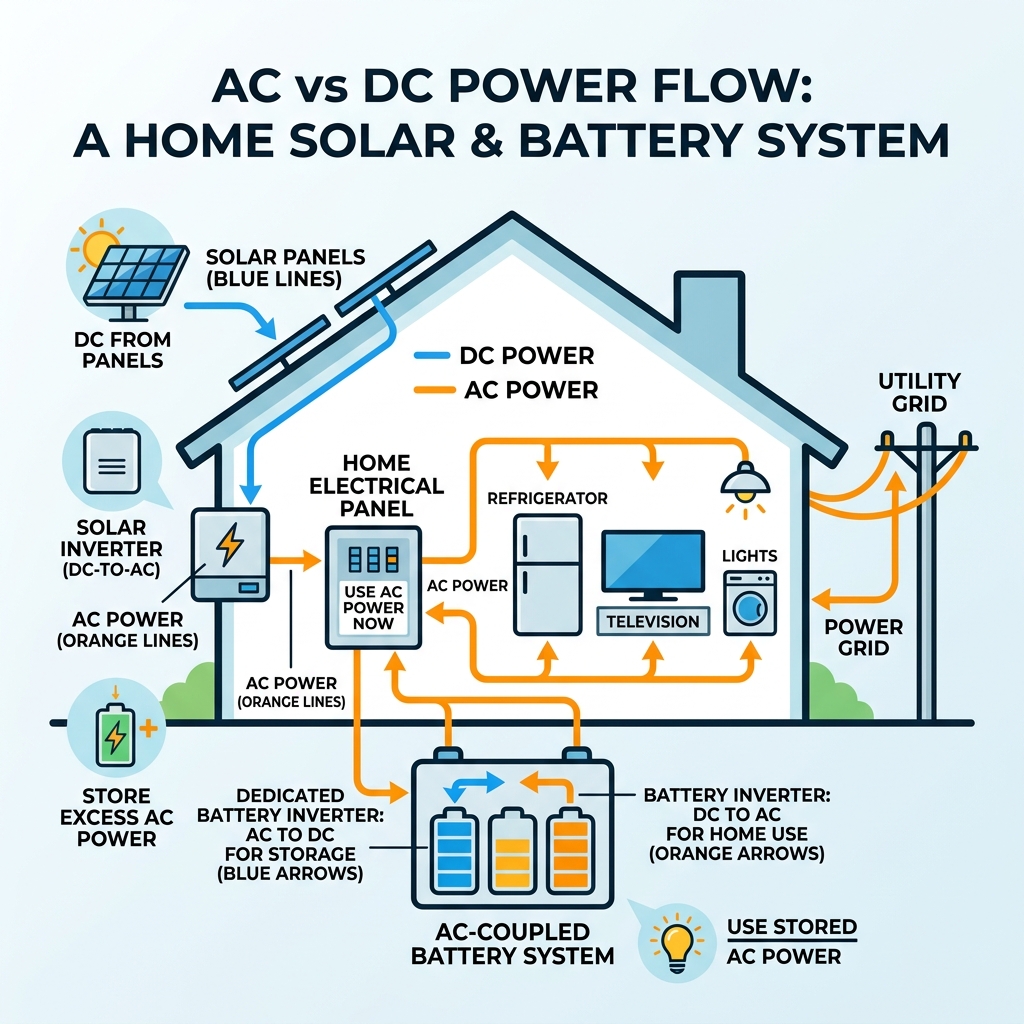
To understand ac battery storage, we first need to look at how electricity moves. Solar panels produce DC (Direct Current) electricity. However, our homes run on AC (Alternating Current). In a standard solar setup, a solar inverter turns that DC into AC immediately so you can use it to power your TV or fridge.
An AC-coupled system sits “after” that conversion. When your solar panels produce more power than you need, the excess AC power travels to the battery system. Inside the battery unit, a dedicated “battery inverter” converts that AC back into DC to store it in the cells. When you need that power later (like at 9:00 PM), the process reverses: the battery inverter turns the DC back into AC and sends it into your home’s electrical panel.
This bi-directional flow is the secret sauce. It allows the battery to act independently of the solar panels. Because the battery is communicating with the home’s AC bus, it doesn’t care what brand of solar inverter you have or how old your panels are. It simply watches the “traffic” of electricity and steps in to soak up the extra or fill the gaps.
Key Components of an AC Battery Storage System
A modern ac battery storage setup is more than just a box of chemicals. It is a sophisticated energy management suite. Here are the parts that make the magic happen:
- Solar Inverter: This is your original equipment that turns panel DC into home AC.
- Battery Inverter: Often built into the battery enclosure, this manages the charging and discharging of the battery.
- Energy Controller: The “brain” of the system. it monitors grid prices, solar production, and home demand to decide when to store or spend energy.
- LFP Cells: Most high-end AC batteries use Lithium Iron Phosphate (LFP) chemistry. These are prized for their safety, 15-year lifespans, and stability.
- Load Panels: These help prioritize which appliances get power during an outage (like the fridge and Wi-Fi) versus which stay off (like the hot tub).
For a deeper dive into how these parts interact, check out our guide on home-battery-storage-for-solar.
How AC Battery Storage Manages Power Conversions
You might wonder: “If we convert from DC to AC and back again, don’t we lose energy?” It’s a fair question! This is known as the rectification and inversion process.
Every time electricity changes form, a tiny bit is lost as heat. However, modern technology has made this incredibly efficient. Current ac battery storage systems typically achieve a round-trip efficiency of 90–94%.
Furthermore, AC systems handle voltage drop better than DC systems. Because AC power can travel longer distances over standard wiring without losing significant pressure (voltage), you have more flexibility in where you install the battery—whether that’s the garage, the basement, or an outside wall. Advanced thermal management systems, like those found in the latest LFP batteries, ensure the units stay cool during these conversions, protecting the hardware for the long haul.

AC-Coupled vs. DC-Coupled: Which is Right for You?
Choosing between AC and DC coupling is the “VHS vs. Betamax” of the solar world, except both versions are actually quite good!
| Feature | AC-Coupled System | DC-Coupled System |
|---|---|---|
| Best For | Retrofits (Existing Solar) | New Installations |
| Efficiency | 90–94% | 95–98% |
| Installation | Simple “Plug & Play” | Complex Rewiring |
| Compatibility | Works with any solar brand | Requires specific “Hybrid” inverter |
| Grid Charging | Yes, very easy | Possible, but less common |
While DC systems are slightly more efficient because they skip one conversion step, they are much harder to install on a home that already has solar. If you want to see which specific models we recommend, take a look at our list of the best-home-batteries-for-energy-storage.
Why AC Battery Storage is the King of Retrofits
If you already have a “grid-tied” solar system, ac battery storage is almost certainly your best bet. It captures 60-70% of the retrofit market for a reason.
With an AC-coupled setup, your solar installer doesn’t have to rip out your existing inverter or mess with the high-voltage DC wiring on your roof. This “brand agnostic” nature means you can pair a Tesla Powerwall or an Enphase AC battery with almost any solar setup. It also makes “modular expansion” easy—if you find you need more storage in two years, you can often just add another AC battery unit to the chain without redesigning the whole system.
For more on the top-rated units for this purpose, see our review of the best-home-batteries-for-energy-storage-2.
Cost Analysis and Installation Timelines
When we talk about the “cost” of a battery, we have to look past the sticker price. Installation labor is a huge factor. Because ac battery storage is simpler to wire, installation typically accounts for only 15-20% of the total project cost.
In contrast, a DC-coupled retrofit might require replacing your solar inverter, which adds thousands in equipment and labor. AC systems also tend to move through the permitting and interconnection process faster because they are seen by utilities as a separate, standard AC appliance. While the upfront CapEx (capital expenditure) for an AC battery might be slightly higher due to the built-in inverter, the ROI (Return on Investment) is often reached faster because of those lower installation hurdles.
Typical Applications and Use Cases for AC Systems
Why are people actually buying these things? It’s not just for the cool LEDs on the side of the box.
- Emergency Backup: This is the big one. When the grid goes down, a central energy controller can “isolate” your home from the grid. This prevents your solar power from leaking back into the lines (which is dangerous for repair workers) and keeps your lights on using the battery.
- Time-of-Use (TOU) Optimization: Many utilities charge more for electricity between 4:00 PM and 9:00 PM. An AC battery can charge up on cheap morning solar and discharge during those expensive evening hours, potentially saving you hundreds of dollars a year.
- Self-Consumption: If your utility doesn’t offer good “net metering” rates (where they pay you for extra solar), it makes more sense to store that energy yourself rather than selling it for pennies.
- Virtual Power Plants (VPP): Some programs allow you to “rent” your battery’s capacity to the grid during emergencies. In exchange, the utility pays you. AC systems are perfect for this because they can react quickly to grid signals.
- Arbitrage: This is the high-finance version of TOU. It involves charging the battery when grid prices are near zero (or even negative!) and selling it back when prices spike.
Advanced Features and Future Technologies
The world of ac battery storage is moving fast. We are seeing a shift toward “Inverterless” AC designs and AI-driven management.
Modern systems now feature AI-EMS (Artificial Intelligence Energy Management Systems). These systems don’t just follow a schedule; they check the weather forecast. If a storm is coming, the AI might decide to keep the battery at 100% capacity just in case the power goes out, even if that means missing out on a few cents of TOU savings.
We are also seeing the rise of Cobalt-free chemistry, specifically LFP. These batteries are not only safer (they don’t suffer from “thermal runaway” like older laptop-style batteries) but they also last much longer. Many now come with a 15-year lifespan or a guarantee of 6,000+ cycles.
Cloud diagnostics are another game-changer. Your installer can often “tunnel in” to your battery from their office to fix software bugs or check the health of individual cells, saving you a costly house call.
Frequently Asked Questions about AC Battery Storage
Can I add an AC-coupled battery to any existing solar system?
In nearly every case, yes! Because ac battery storage connects to the AC side of your home, it is “universal.” It doesn’t matter if your solar panels use microinverters or a string inverter. This plug-and-play compatibility is the primary reason AC coupling is the standard for home retrofits.
What is the typical round-trip efficiency of an AC system?
You can expect a round-trip efficiency of 90–94%. This means if you put 10 kWh of electricity into the battery, you’ll get about 9 kWh back out. While DC-coupled systems can be 1-3% more efficient, the flexibility and lower installation costs of AC systems usually outweigh this small difference for most homeowners.
Is AC-coupling better for backup power than DC-coupling?
Both can provide backup, but AC-coupled systems offer a unique advantage: redundancy. If your solar inverter fails, an AC battery can still charge from the grid to provide backup. If your battery fails, your solar inverter can still power your home during the day. They operate as two independent but cooperative systems, which many homeowners prefer for peace of mind.
Conclusion
At Financefyx, we believe that the energy transition should be accessible to everyone. AC battery storage represents the most user-friendly way to join that transition. Whether you are looking to save money on peak utility rates, protect your family during a blackout, or simply make the most of the sunshine hitting your roof, an AC-coupled system offers a smart, scalable, and safe investment.
The technology is no longer a “future” concept—it’s here, it’s efficient, and it’s ready to plug into your home today. By choosing a system with high-quality LFP cells and smart AI management, you aren’t just buying a battery; you’re buying energy independence.
Ready to take the next step? Explore more renewable energy solutions to find the perfect fit for your home.
