
Battle of the Batts: Mineral Wool vs Fiberglass Insulation
The Real Difference Between Mineral Wool vs Fiberglass — And Which One Wins for Your Home
Mineral wool vs fiberglass is one of the most common insulation decisions homeowners face — and the right choice can mean real savings on your heating bills.
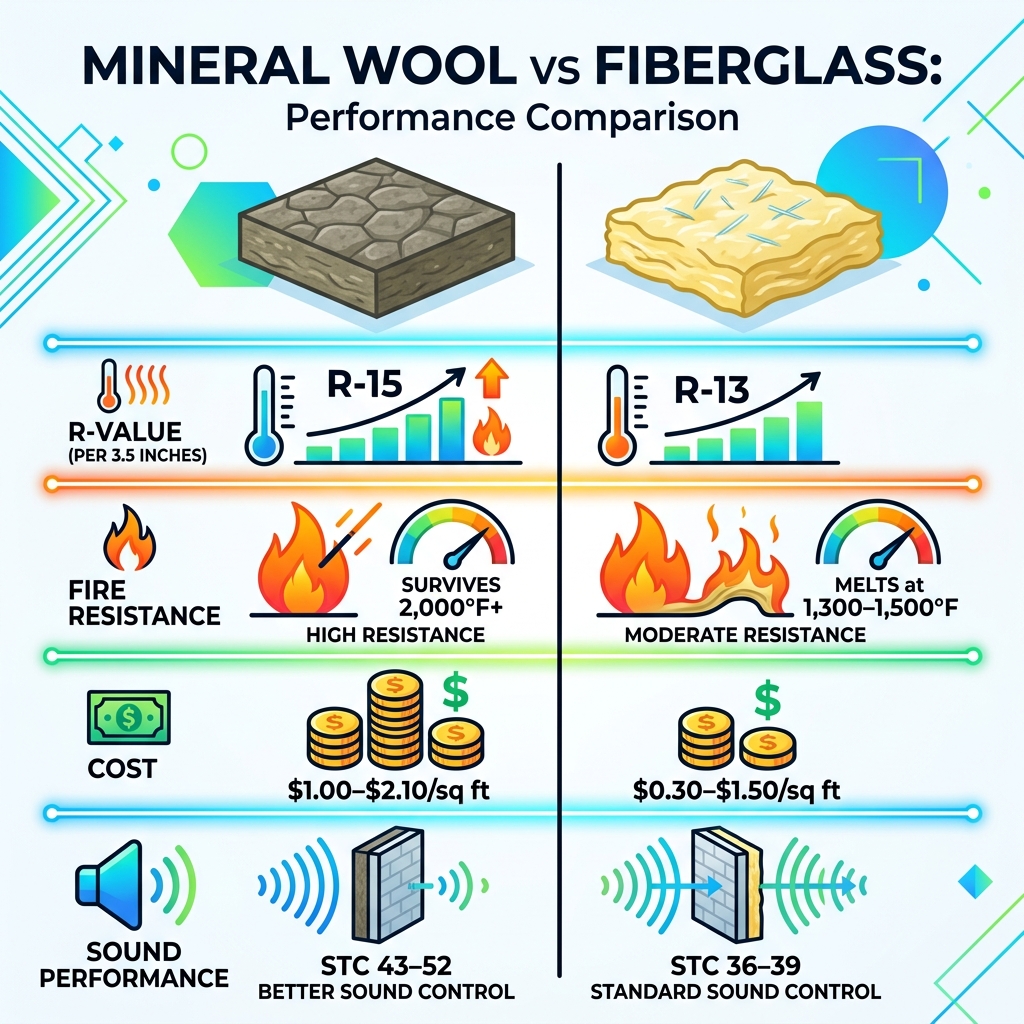
Quick answer: Mineral wool outperforms fiberglass in almost every category except price. Here’s how they stack up:
| Category | Mineral Wool | Fiberglass |
|---|---|---|
| R-value (3.5 inches) | R-15 | R-13 |
| Fire resistance | Survives 2,000°F+ | Melts at 1,300–1,500°F |
| Moisture resistance | Hydrophobic (repels water) | Absorbs water, loses R-value |
| Sound control (STC) | 43–52 | 36–39 |
| Installed cost | $1.00–$2.10/sq ft | $0.30–$1.50/sq ft |
| Recycled content | ~70% | 20–40% |
| Best for | Fire walls, basements, sound control | Attics, tight budgets, large-volume builds |
Bottom line: If budget is your main concern, fiberglass does the job. If you want better thermal performance, fire safety, and lasting durability, mineral wool is worth the premium.
Cold drafts creeping through your walls in winter are often a sign that your insulation isn’t working hard enough. Choosing the right material upfront can prevent years of high heating bills and discomfort.
Both materials are widely used batt insulations that fit standard wall cavities. They look somewhat similar on a shelf. But they behave very differently once installed.
Fiberglass has been the go-to choice in American homes for decades — it’s cheap, lightweight, and easy to find. Mineral wool is the fast-growing challenger, offering stronger performance across fire, sound, and moisture resistance.
The gap between them isn’t just marketing. Mineral wool carries 22–37% more R-value per inch than standard fiberglass. And in cold climates, that difference shows up directly on your energy bill.
The catch? Mineral wool typically costs 40–70% more than fiberglass. So the real question isn’t which material is “better” — it’s whether the upgrade is worth it for your specific project.
This guide breaks down every meaningful difference so you can decide with confidence.
Understanding the Materials: Mineral Wool vs Fiberglass
When we talk about mineral wool vs fiberglass, we’re really talking about two different ways of turning raw Earth materials into a fluffy, air-trapping blanket.
What is Mineral Wool?
Mineral wool (often called rock wool or stone wool) is made from volcanic rock—specifically basalt—and steel slag, which is a byproduct of the steel-making industry. To make it, manufacturers heat these minerals to about 3,000°F until they melt into a lava-like liquid. This liquid is then spun at high speeds, much like making cotton candy, to create fine fibers.
One of the standout features of mineral wool is its sustainability. It typically contains about 70% recycled material, making it a “greener” choice for those looking to reduce their environmental footprint. Because it’s made of stone, it is incredibly dense and heavy—about three times the density of fiberglass.
What is Fiberglass?
Fiberglass insulation is the classic pink or yellow “wool” most of us recognize. It was actually discovered by accident in the 1930s when a researcher tried to vacuum-seal a glass block and ended up with a mess of fine glass fibers. Today, it’s made by melting sand and recycled glass and spinning them into fibers.
While fiberglass is also a recycled product, it usually contains between 20% and 40% recycled content, which is significantly less than mineral wool. It is lightweight, flexible, and available in many forms, including batts, rolls, and loose-fill fiberglass.
If you are just starting your renovation journey, check out The Ultimate Guide to Insulating Your Home for a broader look at how these materials fit into your overall house plan.
Performance Showdown: R-Value and Thermal Efficiency
The primary job of insulation is to resist heat flow, measured by its R-value. The higher the R-value, the better the material is at keeping your expensive heated air inside during the winter and outside during the summer.
In the battle of mineral wool vs fiberglass, mineral wool takes the trophy for thermal resistance per inch.
| Wall Type | Mineral Wool R-Value | Fiberglass (Standard) | Fiberglass (High Density) |
|---|---|---|---|
| 2×4 Wall (3.5″) | R-15 | R-11 to R-13 | R-15 |
| 2×6 Wall (5.5″) | R-23 | R-19 | R-21 |
| 2×10 Joists | R-30 to R-38 | R-26 to R-30 | R-30+ |
As we can see, mineral wool provides a 21% to 37% R-value advantage in standard wall cavities. This is crucial for homeowners in colder climates who want to maximize their energy efficiency.
Thermal Performance of Mineral Wool vs Fiberglass
Why does mineral wool perform better? It comes down to density. Mineral wool has a density of about 8 lb/ft³, whereas standard fiberglass is much lighter, ranging from 0.5 to 1.8 lb/ft³.
This high density prevents “convective looping.” In cheaper, less dense insulation, air can actually circulate inside the insulation batt itself. This air movement carries heat away, effectively lowering the R-value. Because mineral wool is so packed with fibers, air stays trapped in tiny pockets where it belongs.
Furthermore, mineral wool is less prone to “thermal drift.” It maintains its R-value over decades, whereas fiberglass can settle or sag if not installed perfectly, creating gaps that let heat escape.
Safety and Durability: Fire, Moisture, and Sound
Performance isn’t just about the temperature on your thermostat; it’s about how the material protects your home during an emergency or against the elements.
Fire Resistance
This is where mineral wool truly shines. Because it is essentially made of rock, it is naturally non-combustible. Mineral wool can withstand temperatures upwards of 2,000°F without melting, smoking, or contributing to flame spread. In fact, it is often used as a “fire stop” in commercial buildings to prevent fire from moving between floors.
Fiberglass, while technically non-combustible because it is made of glass, has a much lower melting point—around 1,200°F to 1,300°F. In a typical house fire, temperatures can reach these levels quickly. While fiberglass won’t catch fire, it will melt and disappear, leaving the wooden studs exposed to the flames much sooner than mineral wool would.

Moisture Handling
We’ve all seen what happens to a wet sponge—it gets heavy, loses its shape, and stays damp for a long time. Fiberglass behaves much the same way. If a pipe leaks or condensation builds up in your walls, fiberglass absorbs the water. This causes it to sag, permanently losing its R-value, and creates a breeding ground for mold.
Mineral wool is hydrophobic. This means it naturally repels water. If you pour water on a batt of mineral wool, it will largely bead up and roll off. Even if it does get damp, it doesn’t soak it up like a sponge, and it maintains its structural integrity as it dries. This makes it the superior choice for basements, crawl spaces, and exterior walls where moisture is a constant threat.
Soundproofing with Mineral Wool vs Fiberglass
If you’ve ever lived in a house where you could hear a conversation in the next room as if there were no wall at all, you know the importance of acoustic dampening.
Mineral wool is the heavyweight champion of sound control. Its extreme density allows it to absorb sound waves across a broad frequency range.
- Mineral Wool NRC (Noise Reduction Coefficient): 1.00–1.05 (virtually 100% sound absorption)
- Fiberglass NRC: 0.85–0.95
In terms of STC (Sound Transmission Class) ratings, a standard interior wall with mineral wool usually hits an STC of 43 to 52, compared to 36 to 39 for fiberglass. For a home theater or a home office, this difference is the gap between “peace and quiet” and “constant distraction.” Using these energy-saving methods for soundproofing is one of the best upgrades you can make for your quality of life.
Practical Considerations: Installation and Cost
Now, let’s talk about the “real world”—the part where you actually have to put the stuff in your walls and pay the bill.
Installation Experience
If you are a DIYer, the mineral wool vs fiberglass debate gets personal very quickly.
Fiberglass is lightweight and flexible. This makes it easy to squeeze into odd-shaped cavities. However, it requires a lot of care. If you compress fiberglass to make it fit, you destroy its R-value. It also requires stapling to the studs to prevent it from sagging over time. And then there’s the “itch.” Fiberglass fibers are tiny shards of glass that irritate the skin, eyes, and lungs, requiring full PPE (long sleeves, gloves, goggles, and a mask).
Mineral wool is much stiffer. It doesn’t need to be stapled; it uses a “friction fit.” You simply cut the batt about half an inch wider than the stud cavity and press it in. It stays there by itself. Because it’s rigid, you can’t cut it with a utility knife—you’ll need a serrated bread knife or a specialized insulation saw. Most installers find it much easier to cut around electrical boxes and wires with precision compared to the “fluffiness” of fiberglass.
The Cost Factor
There is no sugarcoating it: mineral wool is more expensive.
- Fiberglass: $0.30 to $1.50 per square foot.
- Mineral Wool: $1.00 to $2.10 per square foot.
For a standard 1,500-square-foot home, upgrading from fiberglass to mineral wool can add anywhere from $1,500 to $3,000 to your total project cost.
Is it worth it? We often tell our readers that it depends on the location. If you’re insulating a garage or an attic floor where sound and fire aren’t major concerns, fiberglass is a smart way to save money. But for exterior walls, bathroom partitions, or attic insulation that needs to last 50 years, the durability and energy savings of mineral wool often pay for themselves over time.
Frequently Asked Questions about Insulation
Which is better for soundproofing: mineral wool or fiberglass?
Mineral wool is significantly better for soundproofing. Because it is three times denser than fiberglass, it is much more effective at stopping airborne noise (like voices or the TV) and reducing impact noise. While fiberglass is “adequate” for basic dampening, professionals almost always choose mineral wool for home theaters, recording studios, and shared walls in multi-family housing.
Does mineral wool lose R-value when wet?
No, mineral wool does not lose its R-value when wet in the same way fiberglass does. Because it is hydrophobic, it repels water and maintains its shape. Once it dries out, its thermal performance remains intact. Fiberglass, on the other hand, tends to mat down and clump when wet, which permanently destroys the air pockets required for insulation.
Is the extra cost of mineral wool worth it?
For most homeowners, the answer is “yes” for specific areas of the home. We recommend mineral wool for:
- Exterior walls: For maximum R-value and moisture protection.
- Bathroom walls: To block the sound of running water and resist mold.
- Mechanical rooms: For fire safety around furnaces and water heaters.
- Home offices/Bedrooms: For peace and quiet.
If you are on a strict budget for a large-scale build, using fiberglass in the “low-priority” areas and mineral wool in the “high-performance” areas is a great middle-ground strategy.
Conclusion
In the battle of mineral wool vs fiberglass, there isn’t a single “loser.” Fiberglass remains a reliable, cost-effective workhorse that has successfully insulated millions of homes. If you are looking for the most R-value for every dollar spent today, fiberglass is hard to beat.
However, if you view your home as a long-term investment, mineral wool offers a suite of benefits that fiberglass simply can’t match. Its superior fire resistance, hydrophobic nature, and incredible sound-dampening qualities make it the premium choice for modern construction.
As you prepare your home for the colder months, don’t forget to check out our Catch the Heat Insulation Tips for Winter to ensure your new insulation is doing its job.
Whether you choose the tried-and-true fiberglass or the high-performance mineral wool, the most important step is ensuring a proper, gap-free installation. For more ways to keep your home running efficiently, explore more energy-saving tips on our blog. Happy insulating!
