
Everything You Need to Know About DRICORE R Plus Panels
Why DRICORE R Plus Is a Smart Fix for Cold, Damp Basement Floors
DRICORE R plus is an insulated subfloor panel system designed to make basement floors warmer, drier, and more comfortable — without a complicated installation.
Quick answer: Is DRICORE R+ worth it?
- R-value: 2.7 (roughly double the standard DRICORE panel)
- Floor warming: Up to 10°C / 19°F warmer than bare concrete
- Panel size: 23.25″ x 23.25″ x 1″ — covers ~3.3 sq. ft. per panel
- Load capacity: Supports up to 3,153 lbs. per sq. ft.
- Installation speed: A 500 sq. ft. room can be done in an afternoon
- Warranty: 25-year limited
- Compatible flooring: LVP, laminate, engineered hardwood, tile, carpet
- Best for: Basements, workshops, garages, laundry rooms
If you’ve ever walked barefoot on a basement floor in January, you already know the problem. Concrete is cold, porous, and constantly pulling heat out of your home. Standard fixes — sleepers, vapor barriers, rigid insulation, plywood — can eat up 2 to 5 inches of headroom and take days to install.
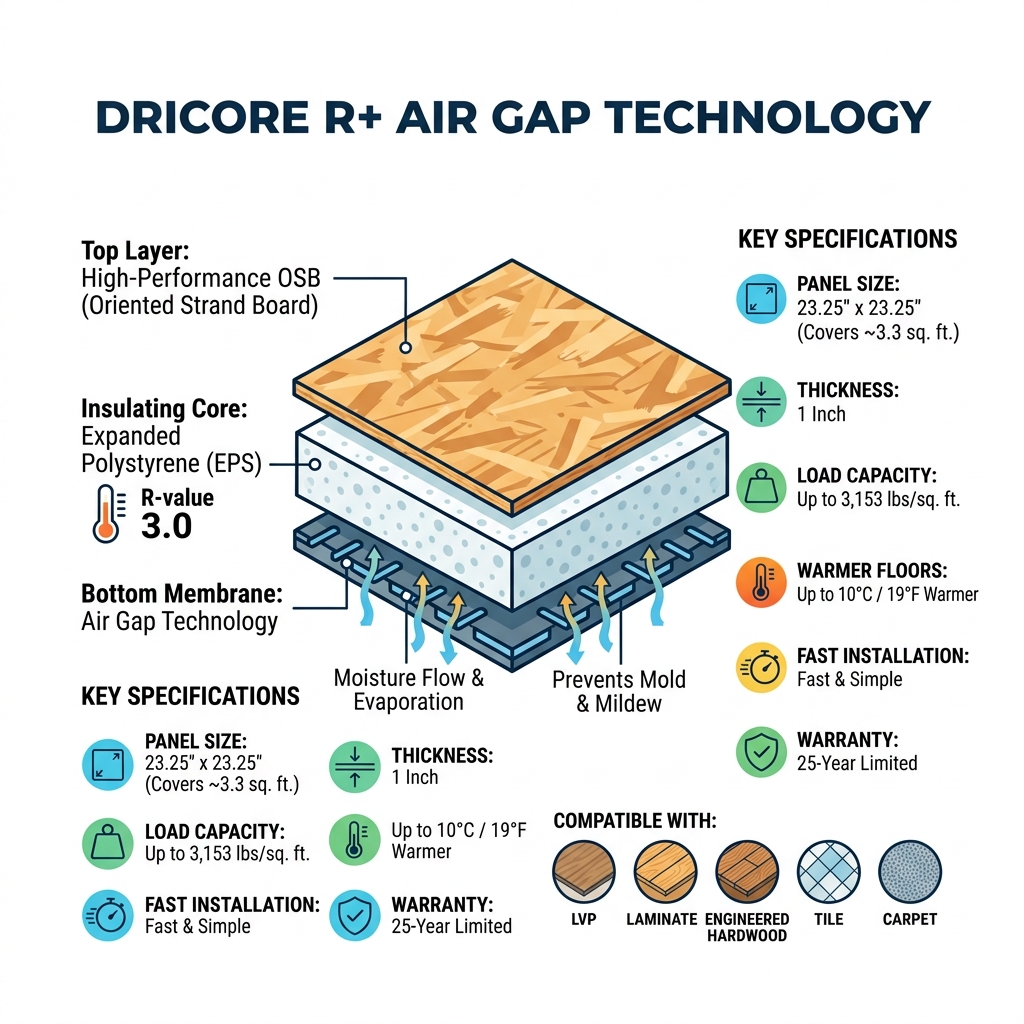
DRICORE R+ solves this with a single 1-inch panel that combines an air gap membrane on the bottom with expanded polystyrene (EPS) foam insulation and an OSB top layer. The air gap allows moisture from the concrete to evaporate instead of getting trapped, which helps prevent mold and mildew.
One contractor who tested it in his own 1,400 sq. ft. basement reported finishing the entire install in about three hours — and measured a 3°C rise in floor temperature afterward.
Key Features and Benefits of DRICORE R Plus
When we look at the dricore r plus system, we aren’t just looking at a piece of wood. We are looking at a highly engineered sandwich of materials designed specifically for the unique environment of a basement.
The Thermal Powerhouse: R-Value 3.0
The biggest selling point of the dricore r plus is its insulating capability. While the standard DRICORE panel offers an R-value of 1.4, the R+ version jumps up to an R-value of 3.0 (some technical specs list it at 2.7, but it is effectively double the standard). This is achieved through a layer of high-density closed-cell extruded foam.
Why does this matter? Because concrete is a thermal bridge. It sucks the heat right out of your feet. By adding this thermal break, we’ve seen reports that finished floors can feel up to 10°C (19°F) warmer. This is a massive win for anyone insulating-your-home-for-energy-efficiency and looking to lower their heating bills.
Strength and Load-Bearing Capacity
One common concern with foam-based subfloors is whether they can handle heavy furniture. Can you put a pool table on it? A piano? A home gym with a squat rack?
The answer is a resounding yes. dricore r plus panels are tested to support up to 3,153 lbs. per square foot. While this is lower than the standard panel’s 6,642 lbs. per square foot (due to the foam being slightly more compressible than the plastic cleats on the standard version), it is still more than enough for almost any residential application. Whether it’s a heavy sectional sofa or a treadmill, these panels are built to hold the weight without failing.
DRICORE R+ vs. Standard DRICORE: The Comparison
We often get asked which one is better. Here is how they stack up:
| Feature | Standard DRICORE | DRICORE R+ |
|---|---|---|
| Thickness | 0.75 inches | 1.0 inch |
| R-Value | 1.4 | 3.0 |
| Insulation Type | High-density plastic cleats | EPS Foam |
| Weight per Panel | 6.9 lbs | 5.2 lbs |
| Load Capacity | 6,642 lbs/sq. ft. | 3,153 lbs/sq. ft. |
| Main Benefit | Moisture protection | Warmth + Moisture protection |
As you can see, the R+ panel is actually lighter, making it easier to carry down those narrow basement stairs. If your goal is primarily energy-saving-methods-for-home-insulation, the R+ is the clear winner.
Step-by-Step Installation Guide
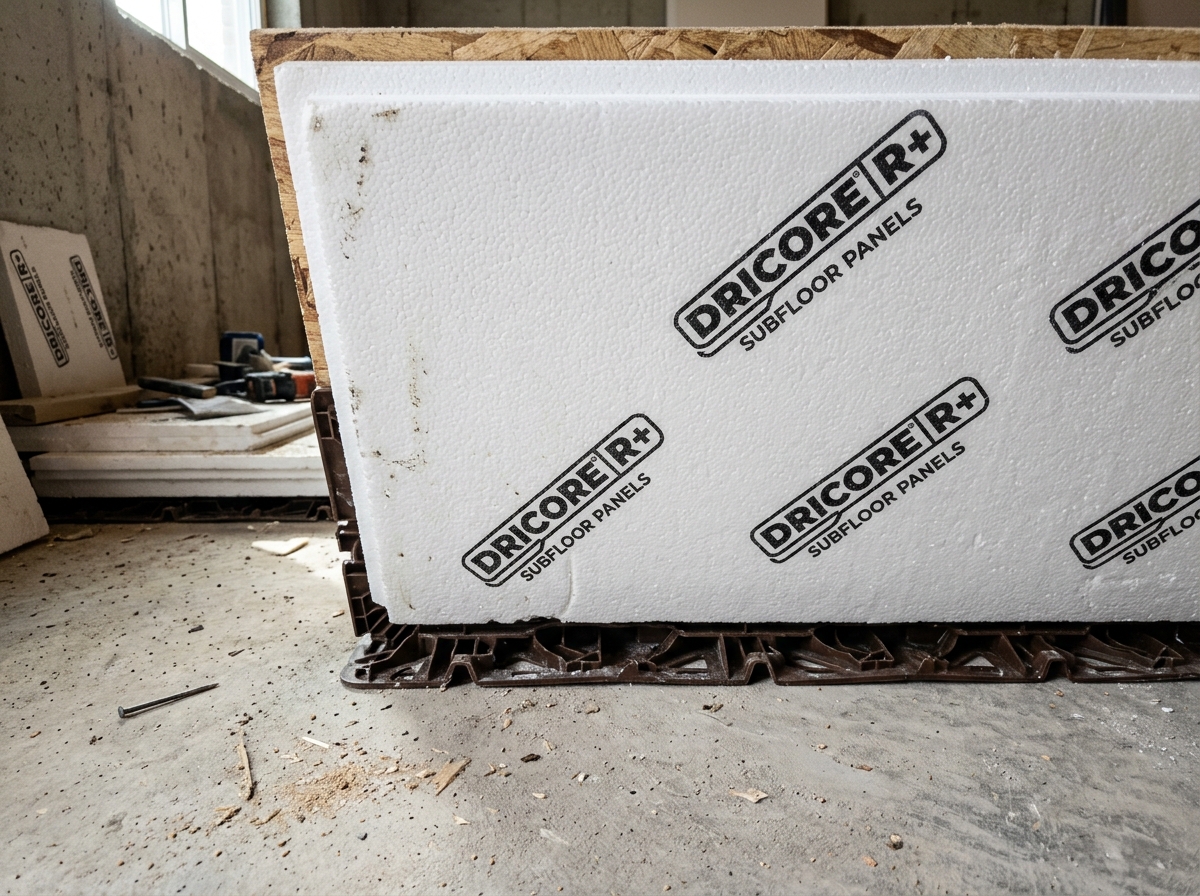
We love dricore r plus because it is essentially a giant Lego set for your floor. You don’t need to be a professional contractor to get a professional result. Here is how we recommend tackling the job.
1. Preparation and Tools
Before you start, make sure your concrete is relatively clean. You don’t need it to be sterile, but a good sweep or vacuum helps. You will need:
- A circular saw or table saw (with a standard wood blade)
- A rubber mallet
- A pull bar and tapping block
- 1/4 inch spacers (for the perimeter)
- A level (at least 4 feet long)
- DRICORE Leveling Shims
2. The Perimeter Gap
This is the golden rule of dricore r plus installation: leave a 1/4 inch gap around the entire perimeter of the room. This gap serves two purposes. First, it allows for the natural expansion and contraction of the OSB wood layer. Second, it allows for airflow. If you block this gap, you defeat the purpose of the air gap technology.
3. Tongue and Groove Alignment
Start in one corner of the room. Lay your first panel with the tongue sides facing the walls (after you’ve trimmed the tongues off the sides touching the wall to ensure a snug fit against your spacers).
When you lay the second panel, you simply slide the tongue into the groove. If it’s a tight fit, use your tapping block and rubber mallet. Never hit the panel directly with a hammer, or you’ll damage the edges.
4. Staggering the Seams
To ensure maximum floor strength, you must stagger your seams. When you reach the end of your first row, cut the last panel to fit (leaving that 1/4 inch gap). Use the leftover piece from that cut to start your second row. This naturally offsets the joints.
5. Leveling as You Go
Concrete is rarely perfectly flat. As you install, use your 4-foot level to check for wobbles. If a panel feels “springy” or uneven, slide a DRICORE leveling shim underneath the foam layer. These shims are designed to nestle perfectly into the panel’s underside. For variances larger than 1/4 inch, you might need a self-leveling patch compound before you start.
For those who prefer a visual walkthrough, we highly recommend checking out the instructional videos provided by the manufacturer. If you are planning a larger renovation, our the-ultimate-guide-to-insulating-your-home offers even more context on how subfloors fit into your overall home envelope.
Performance and Moisture Protection
Basements are notorious for “sweating.” Because concrete is porous, moisture from the ground can migrate through the slab. In a traditional basement setup, this moisture gets trapped under a carpet pad or wood flooring, leading to that “basement smell” (which is actually mold and mildew).
Air Gap Technology
The magic of dricore r plus lies in its “Air Gap Technology.” The foam layer isn’t flat; it has channels built into it. These channels allow air to circulate constantly under the floor. This circulation encourages any moisture to evaporate and be reabsorbed into the concrete or vented out through the perimeter gaps, rather than soaking into your finished flooring.
Thermal Comfort: The 19°F Difference
We’ve mentioned the R-value, but let’s talk about the real-world feel. In field tests, installing dricore r plus has been shown to raise the surface temperature of the finished floor by up to 10°C or 19°F.
Imagine it’s 20°F outside. Your concrete slab might be a chilly 50°F. Without a subfloor, your laminate or LVP is going to be 50°F. With dricore r plus, that surface temperature can jump into the high 60s. That is the difference between needing wool socks and being able to walk around in bare feet. This is a key part of our catch-the-heat-insulation-tips-for-winter strategy for homeowners.
Improving Air Quality
By preventing mold growth, you are also improving the indoor air quality of your home. Mold spores can travel through HVAC systems and affect the health of your family. A dry floor is a healthy floor. We always suggest that homeowners make-your-home-energy-efficient-with-these-tips to ensure a holistic approach to home health.
Frequently Asked Questions about DRICORE R Plus
Can DRICORE R Plus be used in bathrooms or laundry rooms?
Yes, but with a few extra steps. While the panels are moisture-resistant, they are not waterproof. If you are installing them in a bathroom or laundry room, we recommend sealing the perimeter gaps near tubs, showers, or floor drains with a high-quality flexible silicone caulk. This prevents large spills or leaks from getting under the panels.
Also, if you are planning on tiling over them in a bathroom, you must fasten the panels to the concrete using Tapcon fasteners to ensure there is zero movement, as movement will crack your grout lines. This is a common part of remodeling-your-home-for-energy-efficiency when turning a basement into a guest suite.
What types of finished flooring are compatible with DRICORE R Plus?
Almost anything!
- LVP (Luxury Vinyl Plank): This is the most popular choice. As long as the LVP is at least 4mm to 5mm thick, it can go right on top.
- Laminate: Works beautifully and stays very warm.
- Engineered Hardwood: A great choice for a high-end look.
- Carpet: Makes for the ultimate cozy basement.
- Tile: Requires the panels to be fastened to the concrete first.
You can find these panels at various retailers, including DRIcore R+ Insulated Panel | Michaels.ca, Menards, and Home Depot. Prices typically hover around $7.00 to $8.00 per panel, though buying in bulk can often save you money.
How does the system handle uneven concrete floors?
This is where the 4-foot level becomes your best friend. If your floor has a dip or a hump of more than 1/4 inch over a 4-foot span, you should use a self-patching concrete compound to level it out first.
For smaller variances (less than 1/4 inch), the DRICORE leveling kit is perfect. These are thin plastic shims that slide under the panel. We’ve found that taking the time to level the floor properly at this stage prevents “clicking” sounds in your finished laminate or LVP later on. It’s similar to how we suggest checking for air leaks when following attic-insulation-tips-save-energy-and-money — the prep work is what makes the final result successful.
Conclusion
At Financefyx, we are always looking for home improvement solutions that offer a high return on investment, both in terms of home value and daily comfort. DRICORE R plus hits that sweet spot. It’s a DIY-friendly project that can be completed in a single weekend but provides benefits that last for decades.
With a 25-year limited warranty, you can rest easy knowing your basement floor is protected against moisture and cold. Whether you are building a home theater, a playroom for the kids, or a quiet home office, starting with a solid, warm foundation is the most important step.
Not only does this system make your home more comfortable, but it also contributes to overall energy efficiency by providing a significant thermal break. For more ideas on how to improve your home’s footprint, check out our guide on eco-friendly-home-renovations-to-save-energy.
Learn more about sustainable home solutions and start your basement transformation today!
