
A Guide to Finding Energy Audit Companies That Don’t Shock You
Why Your Home’s Energy Bills Are Higher Than They Should Be
Energy audit companies are professional services that inspect your home or building to find where energy is being wasted — and show you exactly how to fix it.
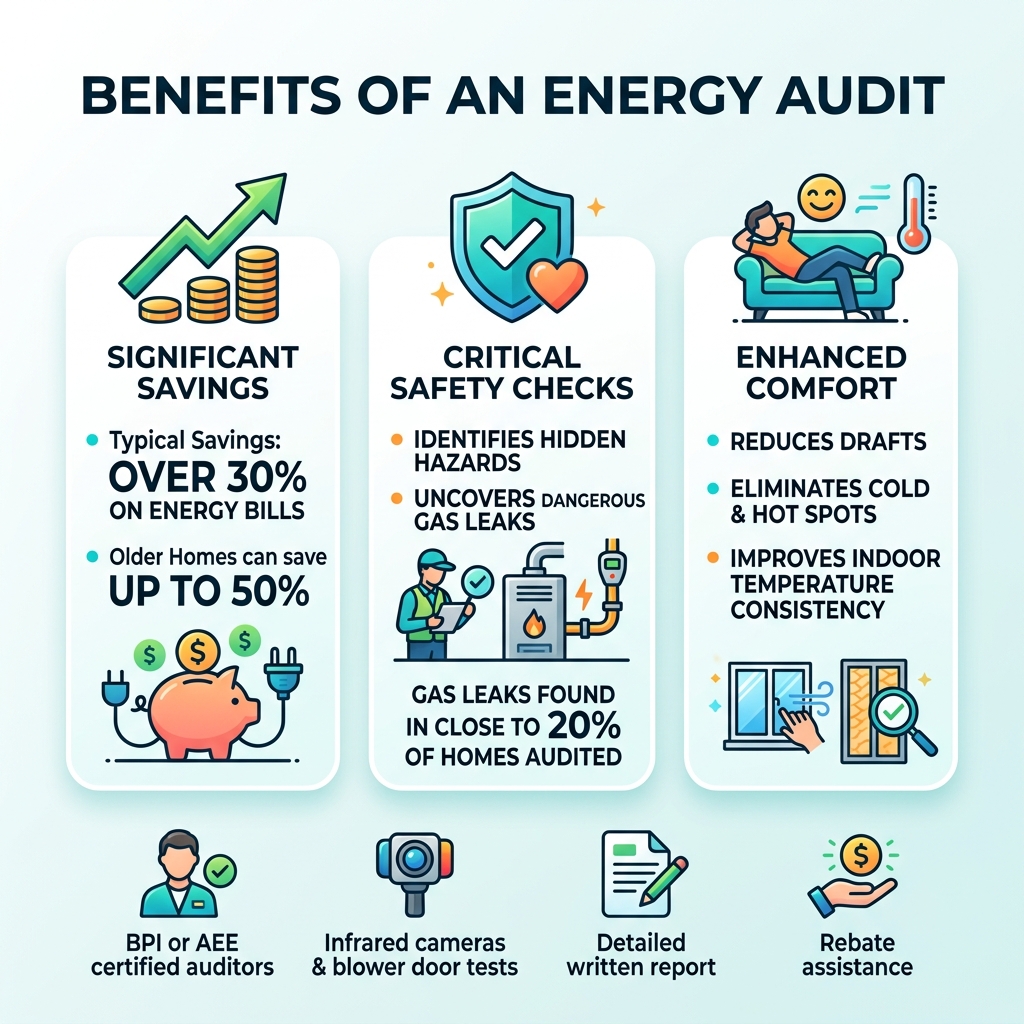
If you’re looking for the right provider, here’s a quick overview:
| What to Look For | Why It Matters |
|---|---|
| BPI or AEE certification | Ensures auditors meet industry standards |
| Infrared cameras + blower door tests | Key diagnostic tools for finding leaks |
| Detailed written report | So you know what to fix and in what order |
| Rebate assistance | Helps you access utility and federal savings |
| Free or subsidized options | Many utilities offer low-cost or no-cost audits |
If your home has cold drafts in winter, rooms that never seem to warm up, or heating bills that keep climbing, you’re not imagining things. Most homes are leaking energy constantly — through walls, attics, crawl spaces, and gaps you can’t even see.
The good news? A professional energy audit can identify exactly where that energy is going.
Most homes save over 30% on energy bills after an audit and follow-up improvements. Older homes can save as much as 50%. And the benefits go beyond just money — audits regularly uncover hidden safety hazards. Gas leaks, for example, are found in close to 20% of homes audited.
Choosing the right company makes all the difference. The quality of the inspection, the tools used, the certifications held, and the detail of the final report can vary widely from one provider to the next.
This guide walks you through everything you need to know to find a trustworthy energy audit company — and get the most out of the process.
What to Expect from Professional Energy Audit Companies
When we hire energy audit companies, we aren’t just paying for someone to walk around with a clipboard. A professional assessment is a data-driven “check-up” for your building. The primary goal is to identify energy waste, but a high-quality auditor also prioritizes health and safety.
A typical visit lasts between one and four hours, depending on the size of the property. During this time, the auditor performs a thorough visual inspection of the attic, crawl spaces, and basement. They aren’t just looking at insulation; they are checking for moisture issues, structural problems, and the condition of your mechanical systems.
One of the most valuable outputs of this process is the Home Energy Score. Much like a “miles-per-gallon” rating for your car, this score (on a scale of 1 to 10) estimates your home’s energy use and provides a standardized way to understand its efficiency.
Beyond the numbers, these experts often find critical safety risks. It is a sobering statistic that gas leaks are found in nearly 20% of audited homes. Auditors also perform combustion safety testing to ensure that your furnace and water heater are venting carbon monoxide safely outside rather than back-drafting into your living space.
Specialized Services Offered by Energy Audit Companies
Not all energy audit companies focus solely on residential draft-stopping. Many offer specialized services designed for modern energy goals like electrification—transitioning away from fossil fuels to high-efficiency heat pumps and induction cooking. Others focus on power resiliency, assessing your home’s potential for solar power and battery storage to keep the lights on during a grid outage.
For business owners, the stakes are even higher. Commercial audits often focus on BEPS (Building Energy Performance Standards) compliance to avoid hefty regulatory fines. Some specialized firms even provide IAC-equivalent assessments, which can unlock up to $300,000 in implementation grants for small manufacturers and wastewater treatment plants.
| Feature | Residential Audit | Commercial Audit |
|---|---|---|
| Primary Goal | Comfort & Bill Reduction | ROI & Regulatory Compliance |
| Key Tools | Blower Door, IR Camera | Data Loggers, BAS Analysis |
| Standards | BPI, Home Energy Score | ASHRAE Levels I, II, III |
| Incentives | Utility Rebates, 25C Tax Credit | Federal Grants, Utility Custom Incentives |
Understanding the Different Levels of Energy Assessments
If you’ve started calling energy audit companies, you might have heard them mention “ASHRAE Levels.” These levels, defined by the American Society of Heating, Refrigerating and Air-Conditioning Engineers, determine the depth of the study.
- ASHRAE Level I (Walk-Through): This is a basic screening. It involves a brief site visit and an analysis of utility bills to identify low-cost or no-cost improvements. It’s a great starting point but lacks the deep data needed for major retrofits.
- ASHRAE Level II (Energy Survey & Analysis): This is the industry standard for most businesses. It includes a more detailed building survey, break-down of energy use by system (lighting, HVAC, etc.), and a clear list of recommended improvements with estimated costs and savings.
- ASHRAE Level III (Detailed Analysis of Capital-Intensive Modifications): Often called an “investment-grade audit,” this level involves long-term data collection and complex building modeling. It is used when a company is planning multi-million dollar upgrades and needs absolute certainty on the ROI.
For homeowners, the U.S. DOE Home Energy Score Map is a fantastic tool to find certified assessors in your area who can provide a residential equivalent of these professional standards.
Interestingly, we are seeing a rise in remote audits. By leveraging aerial photography, utility data software, and remote access to building automation systems (BAS), some companies can provide a preliminary screening without ever stepping foot on-site. While not as thorough as an in-person visit, they are an excellent, low-cost way to identify the biggest “energy hogs” in a large portfolio of buildings.

Essential Tools and Diagnostic Tests Used by Experts
A reputable energy audit company won’t just guess where the air is leaking; they use specialized technology to “see” the invisible.
The Blower Door Test
This is the “gold standard” of energy auditing. The auditor installs a powerful fan in the frame of an exterior door. This fan pulls air out of the house, lowering the air pressure inside. Higher-pressure outside air then rushes in through every crack and gap. By measuring the airflow required to maintain that pressure difference, the auditor can calculate exactly how “leaky” your home is.
Infrared Thermography
While the blower door is running, auditors often use infrared cameras. These thermal imaging tools show temperature differences on surfaces. On a cold day, an uninsulated wall cavity will show up as a dark blue “cold spot” on the camera, while a well-insulated wall will appear yellow or orange. This allows us to find missing insulation behind finished walls without having to tear anything down.
Combustion Safety and Air Quality
Expert auditors also use furnace efficiency meters and carbon monoxide detectors. They test the “draft” of your chimney to make sure exhaust gases are leaving the home. They may also test for indoor air quality (IAQ) issues like radon, formaldehyde, or volatile organic compounds (VOCs). Ensuring your home is airtight is great for energy, but it must remain safe for the people breathing inside.
How to Choose the Right Energy Audit Provider for Your Needs
With so many energy audit companies out there, how do you pick the right one? The first thing we look for is certification.
Look for auditors certified by the Building Performance Institute (BPI) or the Association of Energy Engineers (AEE). These organizations require rigorous training and testing. If you are a commercial client, look for ASHRAE-certified professionals or Building Energy Modeling Professionals.
Before you sign a contract, we recommend checking this comprehensive home energy audit checklist to ensure you know what should be included. A good provider should also have a solid reputation; check their Better Business Bureau (BBB) ratings and ask for at least three references from similar projects.
How to Vet Energy Audit Companies for Quality
Don’t be afraid to ask tough questions. A high-quality company will:
- Have a construction background: This allows them to suggest practical fixes, not just theoretical ones.
- Provide a detailed report: We’ve seen “audits” that are just a one-page checklist. You want a report that includes computer modeling, photos of the issues found, and a prioritized list of improvements based on ROI.
- Offer “Value Engineering”: This means they look for the most cost-effective way to solve a problem. Instead of just suggesting a $20,000 window replacement, they might show you how $2,000 in air sealing and attic insulation provides five times the energy savings.
For more preparation tips, you can also view our secondary energy audit checklist to make sure your home is ready for the visit.
Costs, Rebates, and Financial Incentives for Improvements
The cost of an energy audit varies. Some utility companies, like Avista, offer FREE home energy audits that even include free LED bulbs and low-flow showerheads. Other independent firms may charge between $400 and $800 for a comprehensive residential audit.
However, the audit often pays for itself through the incentives it unlocks. For example:
- The 25C Tax Credit: Under the Inflation Reduction Act, homeowners may be eligible for a tax credit of up to $150 for the audit itself, and thousands more for the improvements (like heat pumps or insulation) recommended in that audit.
- State and Local Rebates: Programs like Efficiency Vermont offer rebates ranging from $400 to $1,000 for thermal improvements.
- Utility Programs: Many utilities offer “direct-install” programs where they pay for a significant portion of the air sealing or insulation work if it’s done by one of their approved contractors.
Frequently Asked Questions
How do I prepare for a site visit?
To get the most out of your auditor’s time, have your utility bills (gas and electric) for the last 12 months ready. Make a list of “problem areas”—the drafty bedroom, the ice dams on the roof, or the room that never stays cool in July. Ensure the auditor has clear access to the attic, crawl space, and all mechanical equipment like the furnace and water heater.
Are remote energy audits actually effective?
Remote audits are surprisingly effective for a “first look.” By using software to analyze your interval meter data (how much energy you use hour-by-hour), experts can often tell if your heating system is running when it shouldn’t be. While they can’t perform a blower door test, they are a great way to screen buildings to see which ones need a deeper, in-person dive.
Frequently Asked Questions about Energy Audit Companies
How much can I really save? While 30% is the average, we have seen cases where homeowners reduced their energy bills by 43% or more. Older, uninsulated homes see the biggest jumps.
How long does the audit take? The site visit usually takes 2 to 4 hours. However, a quality auditor will spend another 4 to 6 hours analyzing the data and writing your custom report. If they hand you a report before they leave your driveway, it might not be as detailed as you need.
Why does certification matter? BPI and AEE certifications ensure the auditor understands “building science”—the way heat, air, and moisture move through a structure. Without this knowledge, an auditor might suggest sealing a house so tight that it creates mold issues or causes a furnace to back-draft.
Conclusion
Finding the right energy audit companies is the first step toward a home that is more comfortable, safer, and significantly cheaper to run. Whether your goal is simple monthly savings or a total home decarbonization, a professional assessment provides the roadmap you need to spend your money wisely.
At Financefyx, we believe that energy efficiency is one of the best investments you can make. It increases your property value, improves your indoor air quality, and reduces your carbon footprint—all while putting money back in your pocket every single month.
Ready to start saving? Explore more info about energy saving tips and take control of your utility bills today.
