
Can I Add Insulation to My Attic Myself Without Regretting It
Is DIY Attic Insulation Worth It? Here’s the Quick Answer
Can I add insulation to my attic myself? Yes, most homeowners can — and for the right attic, it’s one of the smartest home improvement projects you can tackle on a weekend.
Here’s a fast answer based on your situation:
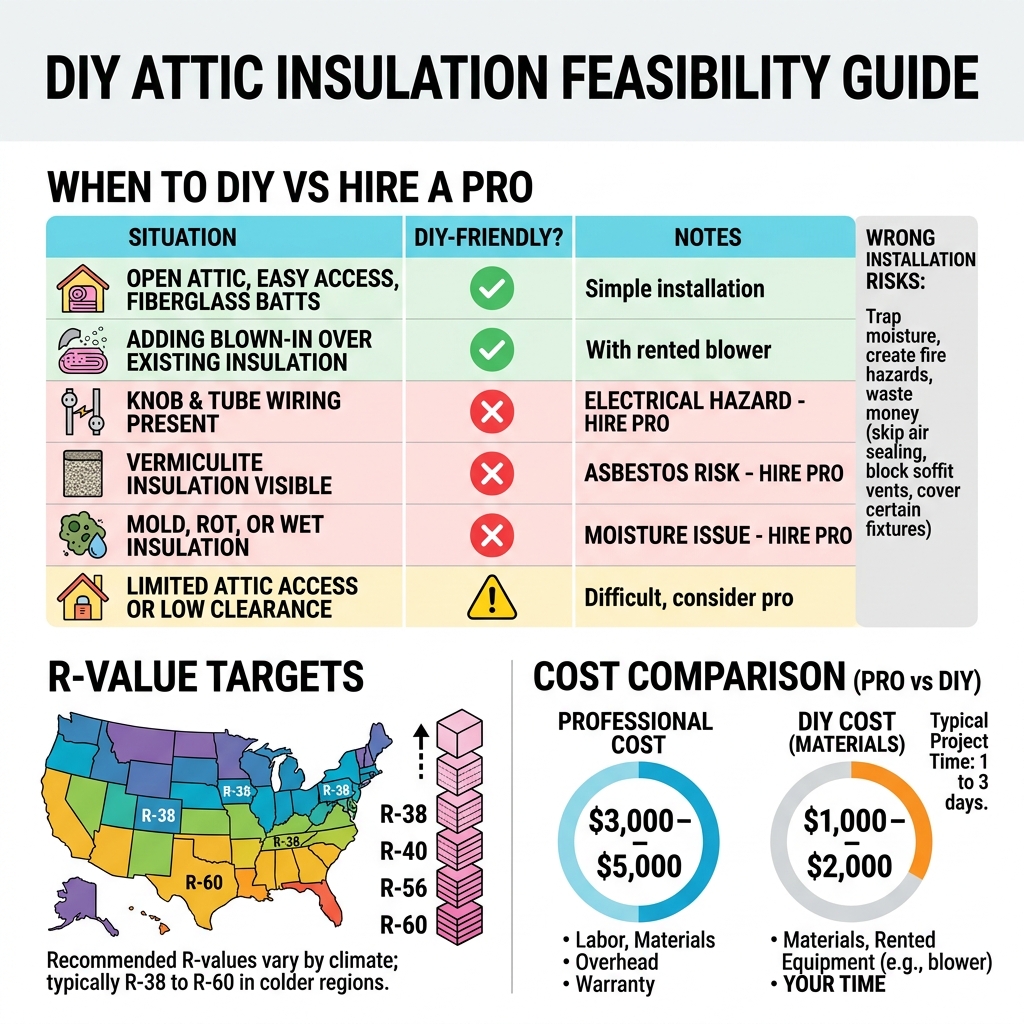
| Your Situation | DIY-Friendly? |
|---|---|
| Open attic with easy access, fiberglass batts | ✅ Yes |
| Adding blown-in insulation over existing material | ✅ Yes (with rented blower) |
| Knob and tube wiring present | ❌ Hire a pro first |
| Vermiculite insulation visible | ❌ Stop — asbestos risk |
| Mold, rot, or wet insulation present | ❌ Hire a pro |
| Limited attic access or very low clearance | ⚠️ Difficult, consider pro |
The project typically takes 1 to 3 days and costs significantly less than hiring out. One homeowner spent around $1,300 in materials on a job that would have run $3,000–$5,000 professionally — and cut their monthly utility bills nearly in half within a year.
But here’s the thing: doing it wrong can cost you more than doing nothing at all. Skipping air sealing, blocking soffit vents, or covering the wrong light fixtures can trap moisture, create fire hazards, and waste every dollar you spent on insulation.
More than 90% of homes in North America don’t have adequate attic insulation. If your heating bills feel out of control, or certain rooms never seem to warm up, your attic is almost certainly part of the problem.
This guide walks you through everything — what type of insulation to use, how much you need, what hazards to watch for, and exactly how to install it safely.
Why Attic Insulation is Your Best Home Investment
We often think of home improvement in terms of new kitchens or fancy decks, but the real MVP of home value is often hidden right above your head. Adding attic insulation is widely considered one of the highest ROI (Return on Investment) projects a homeowner can undertake.

When your attic isn’t properly insulated, your home acts like a chimney. In the winter, expensive heated air rises and escapes right through the roof. In the summer, the sun beats down on your shingles, turning your attic into an oven that radiates heat back into your living space. By following attic-insulation-tips-save-energy-and-money, you can stop this thermal transfer in its tracks.
The benefits go far beyond just lower utility bills:
- HVAC Lifespan: When your home holds its temperature, your furnace and AC don’t have to work nearly as hard. This extends the life of your expensive HVAC system.
- Ice Dam Prevention: In colder climates, heat leaking into the attic melts snow on the roof. That water then refreezes at the cold eaves, creating “ice dams” that can tear off gutters and cause roof leaks. Proper insulation keeps the roof deck cool and prevents this cycle.
- Noise Reduction: Insulation isn’t just for heat; it’s a fantastic sound dampener. You’ll notice a significant decrease in street noise and the sound of rain on the roof.
- Enhanced Comfort: No more drafty rooms or “hot spots” upstairs. You can learn more about the broader impacts of insulating-your-home-for-energy-efficiency to see how it transforms your daily living experience.
Can I Add Insulation to My Attic Myself?
The short answer is yes, but the long answer depends on your attic’s “personality.” Before you buy a single bag of fiberglass, we need to look at the complexity of the job. For most, the question of “can i add insulation to my attic myself” comes down to a trade-off between sweat equity and professional speed.
| Factor | DIY Approach | Professional Contractor |
|---|---|---|
| Cost | ~$1,000 – $1,500 (Materials only) | ~$3,000 – $5,000+ |
| Time | 1 – 3 Days | 4 – 8 Hours |
| Difficulty | Moderate to High (Prep is hard) | Low (for the homeowner) |
| Equipment | Rented blower or basic hand tools | Industrial-grade machinery |
According to the Specifications Manual, proper installation requires more than just throwing material around. It involves air sealing and ensuring ventilation isn’t blocked. If you are comfortable crawling in tight spaces and following a Specifications Manual for safety, you are a prime candidate for a DIY win.
When can i add insulation to my attic myself?
You are in the “green zone” for a DIY project if:
- You’re using fiberglass batts: These are the large rolls or blankets of insulation. They are incredibly user-friendly and don’t require heavy machinery.
- Your attic has open joists: If you can see the “floor” of your attic and move between the wooden beams easily, the job is much simpler.
- Access is easy: A standard pull-down ladder or a large hatch makes moving materials significantly safer.
- Ventilation is standard: If your home has clear soffit and ridge vents, you can easily install How to Insulate Your Attic | True Value Hardware tips to keep the air flowing.
When should i not add insulation to my attic myself?
There are “red flags” that mean you should put down the staple gun and call a pro:
- Knob and Tube Wiring: Common in homes built before 1950, this wiring is a major fire hazard if covered by insulation. It needs air space to stay cool.
- Mold or Rot: If you see black spots on your rafters or smell a musty odor, you have a moisture problem. Adding insulation will only trap that moisture and make the rot worse.
- Asbestos Risk (Vermiculite): If your attic has pebble-like insulation that is gray-brown or silver-gold, it might be vermiculite. This material often contains asbestos. According to the epa.gov asbestos guide, you should never disturb it yourself.
- Wet Insulation: If your current insulation is soggy, you have a roof leak that must be fixed first.
Understanding R-Values and Material Options
To win at the insulation game, you have to understand the “R-Value.” This is simply a measure of how well a material resists heat flow. The higher the number, the better the insulation.
Depending on where you live, building codes usually require a target of R-49 to R-60 for attics. If you currently have 3 or 4 inches of old insulation, you’re likely sitting at an R-11 or R-19 — nowhere near enough!
Here are your main DIY contenders:
- Fiberglass Batts: The classic “pink stuff.” It’s cost-effective ($0.30–$1.50 per sq. ft.) and easy to handle. However, it can leave small gaps that allow air to leak through.
- Blown-In Cellulose: Made from recycled newspaper treated with fire retardant. It has a higher R-value per inch (R-3.6 to R-3.8) than fiberglass. Because it’s blown in as small particles, it fills every nook and cranny. Many DIYers find this to be the best insulation type for attics because you can rent a blower machine for free from many big-box stores if you buy enough bags.
- Mineral Wool: Highly fire-resistant and excellent at soundproofing, though more expensive and heavier than fiberglass.
- Spray Foam: While it offers the best air sealing, it is generally considered too complex and toxic for a DIY attic-wide project. It’s best reserved for professional “hot roof” applications.
Check the Specifications Manual to calculate exactly how many bags or rolls you’ll need to hit your target R-value.
Critical Preparation, Safety, and Hazard Management
Most people think the “work” is putting the insulation in. In reality, 80% of the job is the prep work. If you skip this, you’re just throwing money away.
Step 1: Gear Up
Attics are dusty, itchy, and often have nails sticking out of the roof deck. You need full PPE (Personal Protective Equipment):
- N95 Mask: Fiberglass and cellulose dust are not things you want in your lungs.
- Eye Protection and Gloves: Keep the fibers out of your eyes and off your skin.
- Headlamp: You need both hands free to navigate joists.
- Disposable Coveralls: Trust us, you don’t want to wash these clothes in your family’s washing machine.
Step 2: Air Sealing
Insulation is like a sweater; it keeps you warm, but it doesn’t stop the wind. Air sealing is like the windbreaker. Before adding insulation, use expanding foam or fire-rated sealant to plug holes where wires, pipes, and light fixtures go through the ceiling. Use a-comprehensive-home-energy-audit-checklist to find all the hidden leaks.
Step 3: Protecting Fixtures
- Recessed Lights: Unless they are “IC-Rated” (meaning they can handle contact with insulation), you must keep insulation 3 inches away. We recommend using Tenmat Recessed Light Covers to create a safe, airtight box over them.
- B-Vents: These are the metal exhaust pipes for your furnace or water heater. They get hot! Maintain at least a 1-inch clearance using a metal heat shield.
- Soffit Vents: Never block these! Use insulation baffles (also called rafter vents) to ensure air can still flow from your eaves up to the ridge vent. This prevents moisture buildup and mold.
Step 4: Safety First
Only walk on the joists (the wooden beams). If you step on the drywall between them, you will fall through the ceiling. We recommend laying down a few pieces of plywood to act as a temporary “catwalk.”
Costs, Savings, and Federal Tax Credits
Let’s talk numbers. Is the effort worth the reward?
The Costs:
- Materials: For a 1,000 sq. ft. attic, expect to spend $800 – $1,500 on insulation, foam, and baffles.
- Equipment: A blower machine rental is often free with a minimum purchase, otherwise it’s about $100/day.
The Savings: Properly insulating and air sealing can cut your energy bills by 15% to 50% depending on your starting point. You can find more energy-saving-methods-for-home-insulation to stack your savings even higher.
Financial Incentives:
- Federal Tax Credit: Under the Inflation Reduction Act, you can claim 30% of the cost of insulation materials (up to $1,200 annually) through 2032.
- Rebates: Use the Energy Star Rebate Finder to see if your local utility company offers cash back.
- Assistance: If you are a low-to-moderate income family, the Weatherization Assistance Program may even cover the cost of the project for you.
Frequently Asked Questions
What is the best insulation for a DIY attic project?
For most, blown-in cellulose is the winner. It fills gaps better than batts and is easier to install in tight corners. However, if you have a wide-open attic with standard joist spacing, unfaced fiberglass batts are the easiest “no-machine-required” option.
How many inches of insulation do I need for R-49?
It depends on the material. For fiberglass batts, you’ll need about 16–18 inches. For blown-in cellulose, you’ll need about 13–14 inches. Always check the bag’s coverage chart, as it varies by manufacturer.
Should I remove old insulation before adding new?
Usually, no. As long as the old insulation is dry and mold-free, you can simply add the new layer right on top. If you’re using batts, lay them perpendicular to the existing ones to cover the joists and reduce “thermal bridging.”
Conclusion
So, can i add insulation to my attic myself? Absolutely. While the work is sweaty and the environment is dusty, the financial and comfort rewards are massive. By taking the time to air seal, install baffles, and hit the recommended R-values, you aren’t just saving money — you’re making your home a more durable, comfortable place to live.
At Financefyx, we believe that smart home ownership starts with projects that pay you back. Before you head to the hardware store, do one final safety check for knob and tube wiring or vermiculite. If the coast is clear, grab your mask and get started!
