
Don’t Sweat It with These Easy DIY Insulation Projects
Why Insulation Do It Yourself Projects Can Cut Your Energy Bills Fast
Insulation do it yourself is one of the most effective ways homeowners can slash heating and cooling costs — without spending thousands on contractors.
Here’s what you need to know upfront:
- Best DIY insulation types: Fiberglass batts, mineral wool batts, and blown-in cellulose
- Potential savings: Properly installed insulation can cut energy bills by 15–25%
- DIY cost vs. professional: A 1,200 sq. ft. attic costs roughly $500 DIY vs. $1,500–$2,000 with a contractor
- Easiest starting point: Attic floors — accessible, low-risk, and high-impact
- Most important first step: Air seal gaps before adding any insulation
- Who should hire a pro: Anyone dealing with spray foam, asbestos, mold, or complex spaces like cathedral ceilings
If your home feels drafty in winter and your heating bills keep climbing, poor insulation is likely the culprit. The good news? Many insulation projects are genuinely beginner-friendly.
Think of your home’s thermal envelope like a winter coat. A coat full of holes won’t keep you warm — no matter how thick it is. The same logic applies to your walls, attic, and floors.
In fact, air leaks from cracks and gaps around lights, pipes, and walls can be the equivalent of leaving a 2-foot-wide hole in your ceiling. That’s a lot of heat — and money — escaping into the cold.
The projects in this guide are designed for regular homeowners, not contractors. With the right materials, basic tools, and a few hours of your time, you can make a real difference in your home’s comfort and efficiency.
Is Insulation Do It Yourself Right for You?
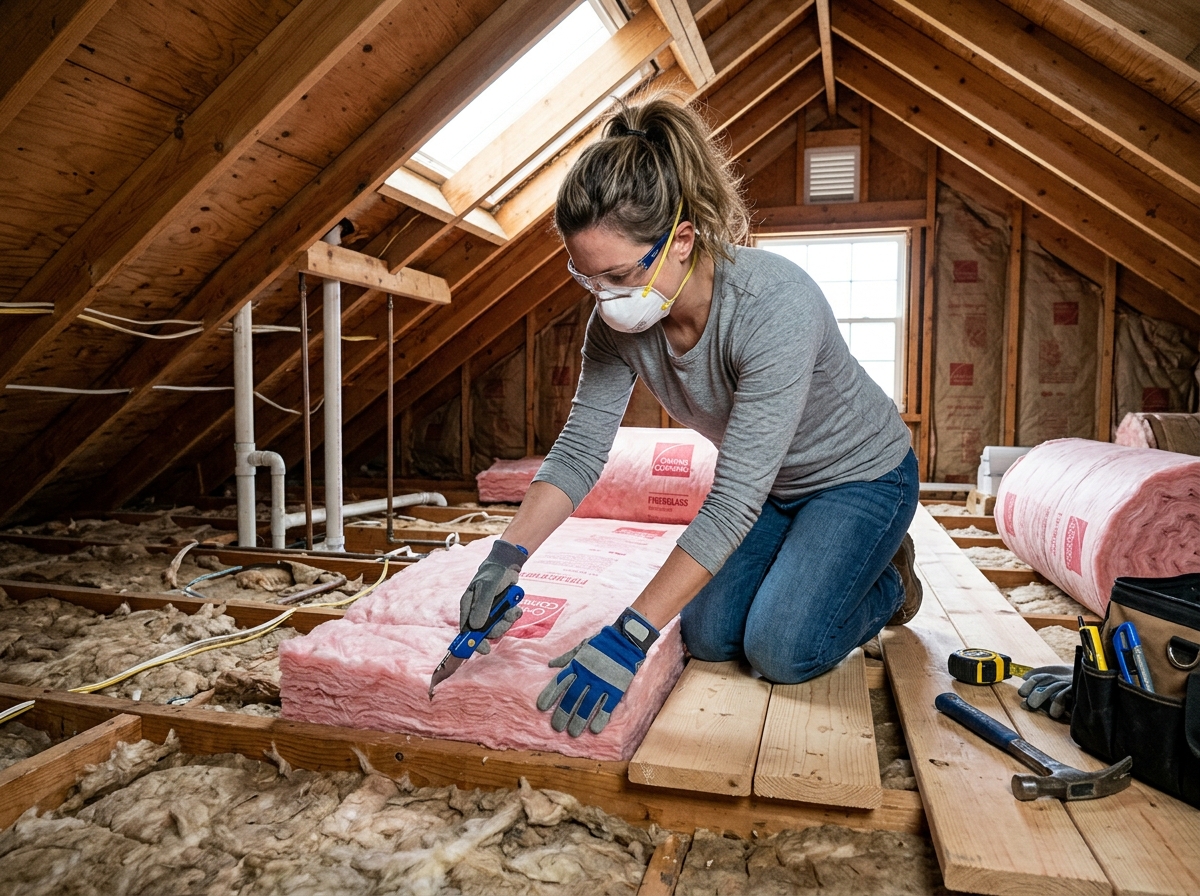
We often get asked: “Can a beginner really handle insulation?” The answer is a resounding yes—provided you choose the right materials. If you are comfortable with a utility knife, a tape measure, and spending a Saturday in your attic or crawlspace, you are already halfway there.
Beginner Suitability
For those new to home improvement, fiberglass batts and mineral wool (often called rock wool) are the gold standards. These materials come in pre-cut widths designed to fit snugly between standard wall studs or attic joists. Mineral wool is particularly great because it’s denser, easier to cut precisely, and highly fire-resistant.
When remodeling your home for energy efficiency, starting with the attic is usually the smartest move. It is generally the most accessible area and offers the highest return on investment.
DIY vs. Professional Costs
The financial argument for doing it yourself is hard to ignore. When you hire a pro, you aren’t just paying for the fluff; you’re paying for their truck, their insurance, their crew, and their profit margin.
| Project Type (1,200 sq. ft. Attic) | DIY Estimated Cost | Professional Estimated Cost |
|---|---|---|
| Fiberglass Batts/Rolls | $500 – $1,200 | $1,500 – $3,000 |
| Blown-In Cellulose | $800 – $1,500 | $2,000 – $4,000 |
| Spray Foam (Whole House) | Not Recommended | $6,000 – $12,000+ |
By taking the DIY route, you can save anywhere from $1,000 to $2,500 on a standard attic job. While the project timeline might stretch from a single afternoon (pro) to a full weekend (DIY), those labor savings can be funneled into other home upgrades.
Essential Preparation: Air Sealing and Safety
Before you even think about unrolling a single batt of fiberglass, we need to talk about the “hidden” part of the job: air sealing. Adding insulation without air sealing is like putting on a thick wool sweater while standing in a wind tunnel. The air will blow right through the fibers, stealing your heat.
The Power of Air Sealing
We recommend focusing on “attic bypasses”—the holes where wires, pipes, and exhaust fans enter the attic from the living space below. Use high-quality caulk for small gaps and expanding spray foam (from a can) for larger holes. Energy-saving methods for home insulation always begin with creating a continuous air barrier. This not only keeps you warmer but also provides vital moisture control, preventing humid indoor air from hitting cold attic surfaces and causing mold.
Safety First for Insulation Do It Yourself
Fiberglass loves to remind you it’s made of tiny glass shards. It itches, it stings, and if you aren’t careful, you’ll feel it for days. To stay safe, you need proper Personal Protective Equipment (PPE). Learn more Make sure you have right clothing and personal protective equipmentLearn more.
- Respirator: A standard dust mask isn’t enough. Use a dual-cartridge N95 respirator to keep fibers out of your lungs.
- Clothing: Wear long sleeves, long pants, and tuck your sleeves into your work gloves.
- Safety Glasses: Protect your eyes from falling debris and floating fibers.
- Asbestos Awareness: If your home was built before 1980 and has lightweight, pebble-like insulation (vermiculite), stop immediately. It may contain asbestos and requires professional testing.
- Joist Walking: Never step between the joists in an attic; you will fall through the drywall ceiling below. Always walk on the wooden joists or use a piece of plywood as a portable work platform.
Ventilation and Hazard Checks
Your attic needs to breathe. One of the most common DIY mistakes is stuffing insulation all the way to the edges of the roof, blocking the soffit vents. We suggest installing plastic or foam vent chutes (also called baffles) between the rafters. These ensure that fresh air can still flow from the eaves up to the ridge vent. Houle Insulation notes that nearly 95% of homes they inspect have missing or improperly installed vent chutes—don’t let yours be one of them!
Also, keep a 3-inch clearance around heat-generating objects like heater flues and recessed lights, unless the light fixtures are “IC-rated” (Insulation Contact rated).
Determining Your Home’s R-Value and Material Needs
“R-value” is simply a measure of thermal resistance—the higher the number, the better the material is at stopping heat flow. The amount of insulation you need depends entirely on where you live.
Climate Zones and Calculations
The Department of Energy provides a map of climate zones to help you decide. For most attics, the goal is between R-38 and R-49. In the coldest northern climates, you might even aim for R-60.
- Fiberglass batts typically offer an R-value of 3.2 to 3.4 per inch.
- To reach R-38, you need about 12 to 15 inches of insulation.
www.eere.energy.gov offers a “ZIP Code Insulation Program” calculator where you can plug in your location to get a specific recommendation for your home. Once you know your target R-value, measure the square footage of the area and check the charts on the back of the insulation bags at the store to see how many you need to buy. For a deeper dive into these metrics, check out the-ultimate-guide-to-insulating-your-home/.
Step-by-Step Guide to Installing Attic Insulation
Ready to start? If you are adding to existing insulation, the process is slightly different than starting from scratch. Here is how we recommend doing it:
- Prep the Area: Clear out any old boxes, seal air leaks, and install your vent chutes.
- Layer One (Between Joists): If the joist cavities are empty, lay your first layer of batt or roll insulation there. If the insulation has a paper “face,” that face should always point toward the heated living space (downward in an attic).
- The “Friction Fit”: Cut your batts about 1/2 inch wider than the space between the joists. This creates a snug friction fit that holds the material in place without gaps.
- Layer Two (Perpendicular): To maximize efficiency, lay the second layer of insulation perpendicular to the joists. This covers the wooden joists themselves (which can act as “thermal bridges” that leak heat) and ensures total coverage. Use unfaced insulation for this second layer to avoid trapping moisture between two layers of paper.
For more detailed strategies, see our attic-insulation-tips-save-energy-and-money/ and insulating-your-home-for-energy-efficiency/.
Mastering Blown-In Insulation Do It Yourself
If your attic has a lot of odd angles, low clearances, or existing loose-fill insulation, blown-in cellulose is often the better DIY choice. Cellulose is made from recycled newspaper treated with fire retardants and is very effective at filling every nook and cranny.
This is a two-person job. One person stays outside at the blower machine (which you can usually rent a blow-in insulation machine for free if you buy enough bags), feeding the material into the hopper. The second person is in the attic with the hose, distributing the “snow” evenly.
- Marking Trusses: Before you start blowing, use a permanent marker or tape to mark the desired depth on the roof trusses. This helps you maintain a consistent R-value across the whole floor.
- Settling Allowance: Blown-in insulation will settle over time. We suggest blowing about 10-15% more than your target depth to account for this.
- Communication: Use walkie-talkies or a cell phone to talk to your partner at the machine. You’ll need to tell them when to start and stop the flow! For a visual walkthrough, watch this video Install Blown-In Attic Insulation | Lowe’s.
Handling Hard-to-Reach Areas and Common Pitfalls
The big, open areas of an attic are easy. It’s the small details that trip people up. Remember the 1% rule: if you leave just 1% of your attic uninsulated (like a 10-square-foot hatch in a 1,000-square-foot attic), you can lose a disproportionate amount of your total thermal protection.
Hard-to-Reach Spots
- Attic Hatch: This is often the biggest “hole” in your home’s thermal coat. Glue a piece of rigid foam board to the top of the hatch and use weatherstripping around the edges to create a tight seal. DIY Blown-In Insulation in the Attic | The Family Handyman provides great diagrams for this.
- Pipes and Wires: Never pack insulation tightly around wires, as it can cause them to overheat. For plumbing pipes, use foam pipe sleeves to prevent condensation.
- Gap Prevention: Avoid the temptation to “stuff” insulation into small cracks. When you compress fiberglass, you squeeze out the air pockets that provide the insulation, significantly lowering the R-value.
For more seasonal advice on keeping the warmth where it belongs, read catch-the-heat-insulation-tips-for-winter/ and explore eco-friendly-home-renovations-to-save-energy/.
Frequently Asked Questions about DIY Insulation
Can I install spray foam insulation myself?
While you can buy small “froth packs” or cans for sealing gaps, we do not recommend whole-house spray foam as a DIY project. It requires professional equipment to heat and mix chemicals at precise ratios. If the mix is off, the foam may not cure properly, leading to lingering odors or structural issues. For small gaps around windows or the attic hatch, How to Apply DIY Spray Foam Insulation is a great resource for using canned foam safely.
Are there tax credits or rebates for DIY insulation?
Yes! Under the Energy Efficient Home Improvement Credit, you may be able to claim a federal tax credit for 30% of the cost of your insulation materials (up to $1,200 annually). Make sure to keep your material receipts. Many local utility companies also offer rebates for energy audits and weatherization. You can find more details at energystar.gov.
How do I know if my current insulation is adequate?
The “eye test” is the easiest way. Go into your attic and look at the floor. If the insulation is level with or below the top of the floor joists, you definitely need more. You should also look for signs like drafty rooms, high utility bills, and uneven temperatures between different floors of your home.
Conclusion
Embarking on an insulation do it yourself project is one of the most rewarding ways to improve your home. Not only will you see a long-term ROI through lower energy bills—often paying for the materials in just a few seasons—but you’ll also increase your home’s overall value and comfort.
At Financefyx, we want to help you make smart financial decisions for your home. By taking control of your home’s efficiency today, you’re putting money back in your pocket for years to come.
