
Hold Your Ground Against the Snow with These Solar Mounts
When Snow Meets Your Roof: Why the Right Mounting System Matters
Mounting systems for snowy roofs are specialized hardware solutions designed to hold snow in place, support solar panels under heavy loads, and prevent dangerous roof avalanches — here’s a quick overview of what to look for:
Best mounting systems for snowy roofs at a glance:
| System Type | Best For | Key Strength |
|---|---|---|
| Rail-based snow retention | Metal & standing seam roofs | Continuous load distribution |
| Pad-style snow guards | Asphalt, tile, slate | Simple retrofit installation |
| Extended solar brackets | Solar panels in snow zones | Supports panels above snow line |
| Double roof hooks | Tiled roofs with high snow loads | ~1.5x capacity of single hooks |
| Membrane rail systems | Flat/low-slope commercial roofs | Non-penetrating, watertight seal |
If you’ve ever watched a wall of snow suddenly slide off a roof — or worse, heard the crash when it lands — you already understand the problem. Uncontrolled snow slides can crush landscaping, damage equipment, block doorways, and seriously injure anyone standing below.
But here’s the part that surprises most homeowners: the roof itself can suffer too. The repeated stress of heavy snow loading, followed by sudden release, puts real strain on your roof structure. And if you’re also running solar panels up there, the stakes are even higher — your investment needs to stay secure through every freeze-thaw cycle.
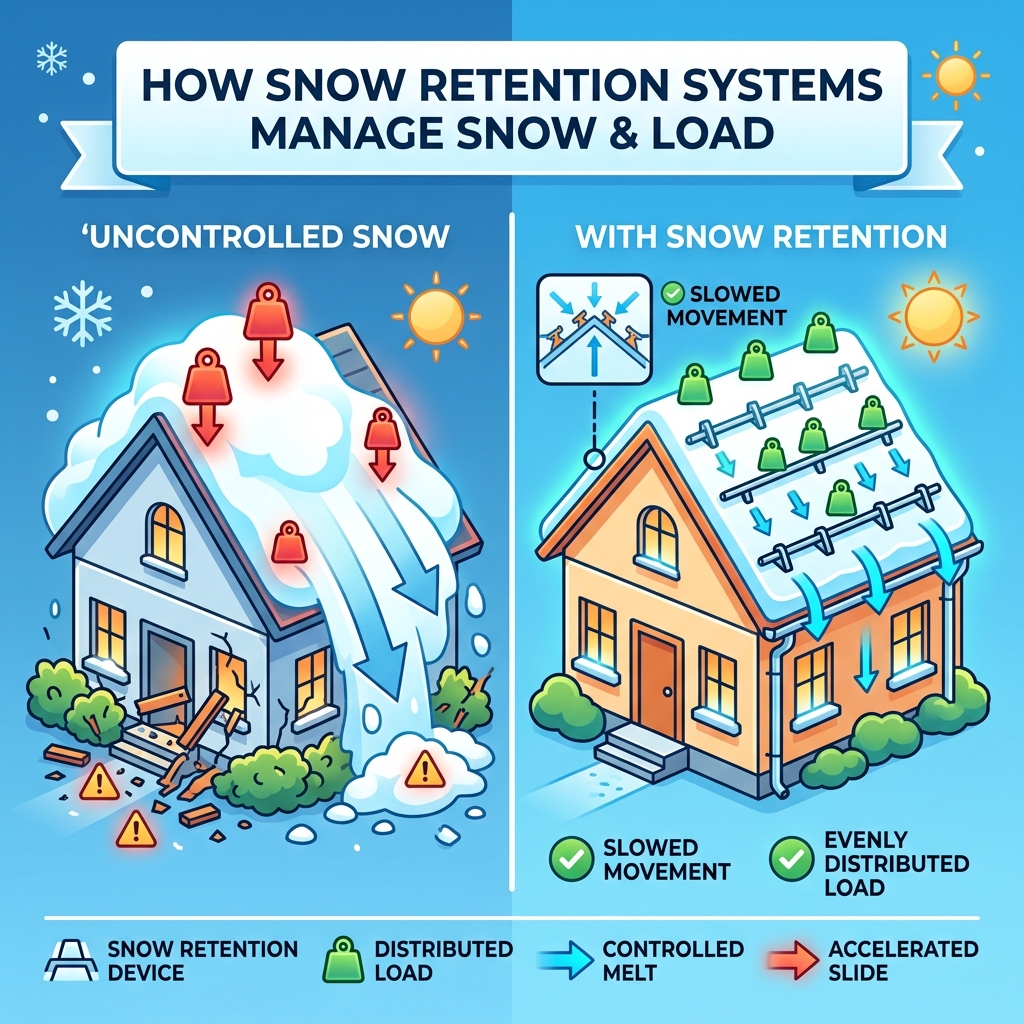
The good news is that the right mounting hardware does more than just hold things in place. Engineered snow retention and mounting systems slow the evacuation of snow, letting it melt gradually rather than releasing all at once. They also distribute weight more evenly across the roof, reducing structural stress.
This guide walks you through everything you need to evaluate snow-resistant mounting hardware — from system types and materials to installation methods and roof compatibility.
Understanding Mounting Systems for Snowy Roofs
When we talk about mounting systems snowy roofs require, we aren’t just talking about “stops” or “fences.” These systems are sophisticated pieces of engineering designed to manage the physics of frozen precipitation. On a slick surface like a metal roof, snow doesn’t just sit there; it wants to succumb to gravity.
The primary function of these systems is friction enhancement. By introducing brackets, clamps, or rails, we increase the mechanical bond between the roof surface and the snow pack. This keeps the snow in a “holding field,” allowing it to evacuate the roof in a controlled manner through two natural processes: thaw (melting into water) and sublimation (turning directly from ice to water vapor).
Maintaining structural integrity is the name of the game. Without these systems, the weight of the snow accumulates until the “static friction” is overcome, leading to a sudden, violent release known as a roof avalanche. By holding the snow in place, we ensure the weight is distributed across the rafters rather than concentrating at the eaves. If you are just starting your green energy journey, check out our more info about home solar panel installation to see how these components fit into the bigger picture. Understanding the PV systems for snowy regions | stable and secure | mounting solutions is the first step toward a winter-proof home.
Engineering for High-Load Environments
We don’t just guess how much snow a bracket can hold; we use math. Rigorous engineering is what separates a professional system from a “guinea pig” DIY project. For instance, leading manufacturers have conducted over 1,000 allowable load test results specifically tailored to different roof profiles.
In Europe, standards like Eurocode 1 and DIN EN 1991-1-3 dictate how we calculate these loads. We have to consider:
- The Exposition Coefficient (ce): How much wind hits the roof?
- The Shape Coefficient (µ): What is the pitch and shape of the roof?
- Snow Load Zones: Does your region get “polite dusting” or “buried alive” levels of snow?
Testing also involves durability. High-quality components undergo over 2,000 hours of salt-fog testing (ASTM B117-19) to ensure they won’t corrode. Furthermore, more than 5,000 individual tensile load tests are often performed on various roof gauges to ensure the clamps won’t rip the metal skin off your home. This level of detail is as important as durable snow retention systems for metal roofs are to your home’s overall thermal envelope.
Impact on Energy Production
Snow on solar panels is a bit of a “good news, bad news” situation. The bad news is that snow blocks sunlight. The good news? Modern mounting systems snowy roofs use clever tricks to keep the power flowing.
In snowy regions, we often recommend a portrait orientation for modules. Why? Most solar panels are divided horizontally with separate string lines. If the bottom half of a portrait-mounted panel is covered in snow, the top half can often still generate electricity. If the panel were in landscape, a small strip of snow along the bottom edge could shut down the entire module.
Additionally, integrated snow stops in the mounting rails help prevent “mini-avalanches” from the glass surface of the panels, which could otherwise damage the module frames or the racking below. This efficiency is just as vital as attic insulation tips to save energy and money when trying to keep your winter utility bills low.
Types of Snow Retention and Mounting Hardware
Choosing the right hardware depends on your roof type and the typical “snow dump” your area receives.
| Hardware Type | Design Feature | Best Application |
|---|---|---|
| Pad-Style Guards | Individual “cleats” or “snow birds” | Staggered patterns on asphalt or tile |
| Rail Systems | Continuous bars or fences | High snow loads on metal or membrane |
| Pipe Systems | Multiple horizontal tubes | Rustic or “mountain” aesthetic on tile/slate |
| Ice Flags | Snap-on clips for rails | Prevents ice from sliding under the rails |
For those looking for heavy duty extended snow brackets: extra strength for solar panels, the choice usually comes down to how much weight the system needs to “catch.”
Rail-Based Mounting Systems for Snowy Roofs
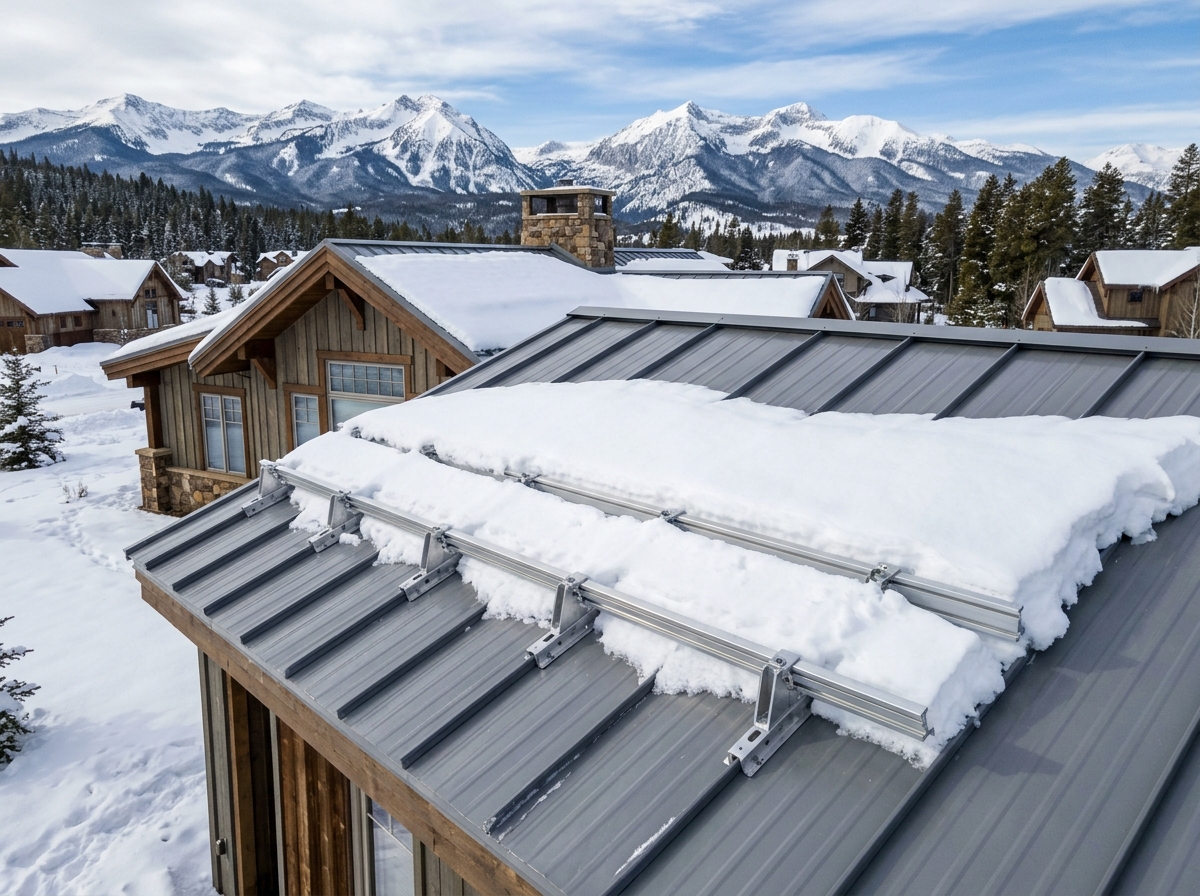
For heavy-duty commercial or residential applications, rail-based systems are the heavyweights. Some of these systems utilize a triangular structured snow-rail, which provides almost twice the strength and holding power of conventional flat systems.
These rails are typically installed in straight continuous runs across the entire roof. For very steep or long roofs, we might install multiple rows to distribute the weight evenly. High-end systems can handle spans of up to 48 inches between attachments, making them incredibly efficient for large-scale projects. If you need enhanced strength snow retention for metal roofs, rail systems are usually the top recommendation.
Specialized Brackets for Solar Integration
Integrating solar panels adds a layer of complexity. We can’t just throw a snow fence anywhere; it has to live in harmony with the solar racking. Extended snow brackets are designed to sit specifically below solar arrays. They are often “heavy duty” (available in 3-bar or 4-bar configurations) to handle the combined weight of the snow and the potential sliding force from the slick glass of the panels.
These systems often use a screw-down application for asphalt or slate, while metal roofs utilize non-penetrating clamps. If you are looking for a heavy duty snow bar bracket for screw down applications, ensure it includes a base plate to protect the underlying roofing material.
Material Selection for Mounting Systems on Snowy Roofs
Material choice isn’t just about looks; it’s about survival. The components on your roof will face extreme UV rays in the summer and sub-zero, ice-crushing pressure in the winter.
- Aluminum: Lightweight, corrosion-free, and strong. Most modern clamps and rails are made from high-grade aluminum.
- Stainless Steel: Used for high-tension bolts and “pad-style” guards where maximum tensile strength is needed.
- Polycarbonate: Often used for clear, “invisible” snow guards. While these are industry standards, we generally recommend metal for high-load areas as plastic can warp or lose strength over time when exposed to heavy ice.
- TitanCore™: A newer proprietary material that offers the strength of steel at a fraction of the weight, and it’s completely rust-proof.
Selecting the right material is part of the ultimate guide to insulating your home and protecting its exterior.
Durability and Aesthetic Integration
We know you care about curb appeal. Nobody wants “industrial-looking” junk on a beautiful slate or metal roof. That’s why many mounting systems snowy roofs manufacturers offer over 150 different powder coat options.
One of the best innovations in this space is color-matching strips. Some systems allow you to slide a 2-inch wide strip of the actual roofing material into the face of the snow rail. This ensures a 100% color match for the life of the roof, avoiding the fading issues common with painted or powder-coated alternatives. This attention to detail is as satisfying as when you stop the chill with these easy ways to fix drafty upvc windows.
Sealant Technology and Longevity
If a system requires screws, it requires a seal. You don’t want a snow guard that prevents an avalanche but causes a leak. The “gold standard” here is a factory-applied, 60-year butyl polymer seal.
Unlike field-applied sealants that can be messy or degrade in the sun, factory-applied seals are tucked into integrated reservoirs. This prevents the seal from being over-compressed or exposed to UV rays. It’s a “set it and forget it” solution, much like using high-quality draft proof window strips and other ways to chill out during a storm.
Installation Considerations Across Different Roof Profiles
Every roof is a snowflake—unique and requiring specific care.
- Standing Seam Metal: The “holy grail” of snowy roofs. We use non-penetrating clamps that grip the seam without piercing the metal.
- Exposed Fastener Metal: These require brackets that are screwed through the “flats” of the panel into the structure below.
- Membrane Roofs (Flat/Low-Slope): Often found on commercial buildings, these use universal mounts that provide a watertight seal to the deck.
- Tile/Slate: These often require “hooks” that reach under the tile to attach to the rafters, or specialized base plates to prevent the tiles from cracking under the snow load.
For those with commercial properties, snow guards for membrane roofs with universal mounts are essential to prevent ballasted solar racks from shifting during a freeze.
Preserving Roof Warranties
This is the big one. If you drill a hole in a brand-new standing seam metal roof, you might just void your 30-year finish warranty. This is why we advocate for zero-penetration technology.
By using round-point setscrews, the clamp “dimples” the metal seam to create a mechanical interlock without breaking the protective paint or zinc coating. This allows the roof to expand and contract naturally during thermal cycling (the way metal grows in heat and shrinks in cold). As we often say, don’t sweat under your steel roof this summer—proper mounting ensures your roof stays healthy year-round.
Mounting on Tile and Membrane Surfaces
Tiled roofs present a unique challenge because tiles are brittle. Double roof hooks are a fantastic solution here; they can carry approximately 1.5 times the weight of a single hook by distributing the load across a wider area of the substructure.
On membrane roofs, systems like the PowerGrip Universal 7 can accommodate up to 2,200 lbs of downward load per mount. This is crucial for supporting heavy solar racking. Proper mounting on these surfaces is just as important as when you stop heating the neighborhood with this attic insulation guide.
Frequently Asked Questions about Snow-Resistant Mounts
Will installing a snow retention system void my roof warranty?
Generally, no—provided you use the right hardware. For standing seam roofs, using non-penetrating clamps is the industry-standard way to keep warranties intact. For other roof types, following the manufacturer’s torque and sealant specifications is key. It’s a lot like choosing the right ultimate guide to sash window draft strips; using the correct tool for the job prevents damage.
How are snow loads calculated for mounting systems?
We look at three main factors:
- Roof Pitch: Steeper roofs have higher “sliding” forces.
- Snow Load Zones: Based on your geographic location and local building codes.
- Roof Length: The longer the run from the peak to the eave, the more snow accumulates. Modern software can now automatically calculate these loads for dozens of countries, ensuring your insulating your home for energy efficiency includes a safe roof structure.
What maintenance is required for snowy roof mounting systems?
Most systems are designed to be “maintenance-free,” but we recommend a quick visual inspection every autumn. Check for:
- Debris: Ensure leaves or branches aren’t caught in the rails.
- Torque: Ensure the clamps are still tight (though many use self-locking technology to prevent loosening).
- Sealants: On screw-down systems, check that the gaskets aren’t cracked.
Conclusion
Protecting your home from the weight of winter doesn’t have to be a guessing game. By prioritizing engineered mounting systems snowy roofs can handle, you’re investing in long-term safety and roof integrity. Whether you are installing a high-tech solar array or just want to make sure your front porch doesn’t get buried in a roof avalanche, the right hardware makes all the difference.
At Financefyx, we believe that a secure home is a happy home. From the peak of your roof to the seal of your windows, every detail counts towards your comfort and your wallet. Ready to take the next step in your home’s evolution? Explore renewable energy solutions with us and hold your ground against the snow this winter.
