
Is Your AC Secretly Draining Your Wallet?
An air conditioning energy assessment is a professional evaluation of how efficiently your cooling system uses energy — and it can reveal exactly why your utility bills are climbing every summer.
Here’s what you need to know at a glance:
- What it is: A detailed inspection of your AC system, ductwork, insulation, and building envelope to find energy waste
- Who needs it: Homeowners and businesses with high cooling bills, uneven temperatures, or aging HVAC equipment
- What you gain: A prioritized action plan that can cut energy bills by 5% to 30%
- What it costs: Ranges from free (utility-sponsored) to a few hundred dollars — often offset by tax credits
- How to start: Contact a DOE-certified assessor, your local utility, or try a free DIY online assessment
Heating and cooling account for the largest share of energy use in a typical home — often more than 40% of your total utility bill. Yet most homeowners have no idea how much energy their AC system is wasting through leaky ducts, poor insulation, or an oversized unit that short-cycles instead of dehumidifying properly.
The result? Higher bills. Less comfort. And a system that wears out faster than it should.
An energy assessment cuts through the guesswork. Instead of just replacing equipment and hoping for savings, you get a data-backed roadmap — showing exactly where your home is losing money and which fixes will deliver the biggest return.
Whether you own a single-family home in a full-blown heatwave or manage a commercial facility, the process works the same way: find the waste, fix it, and save.
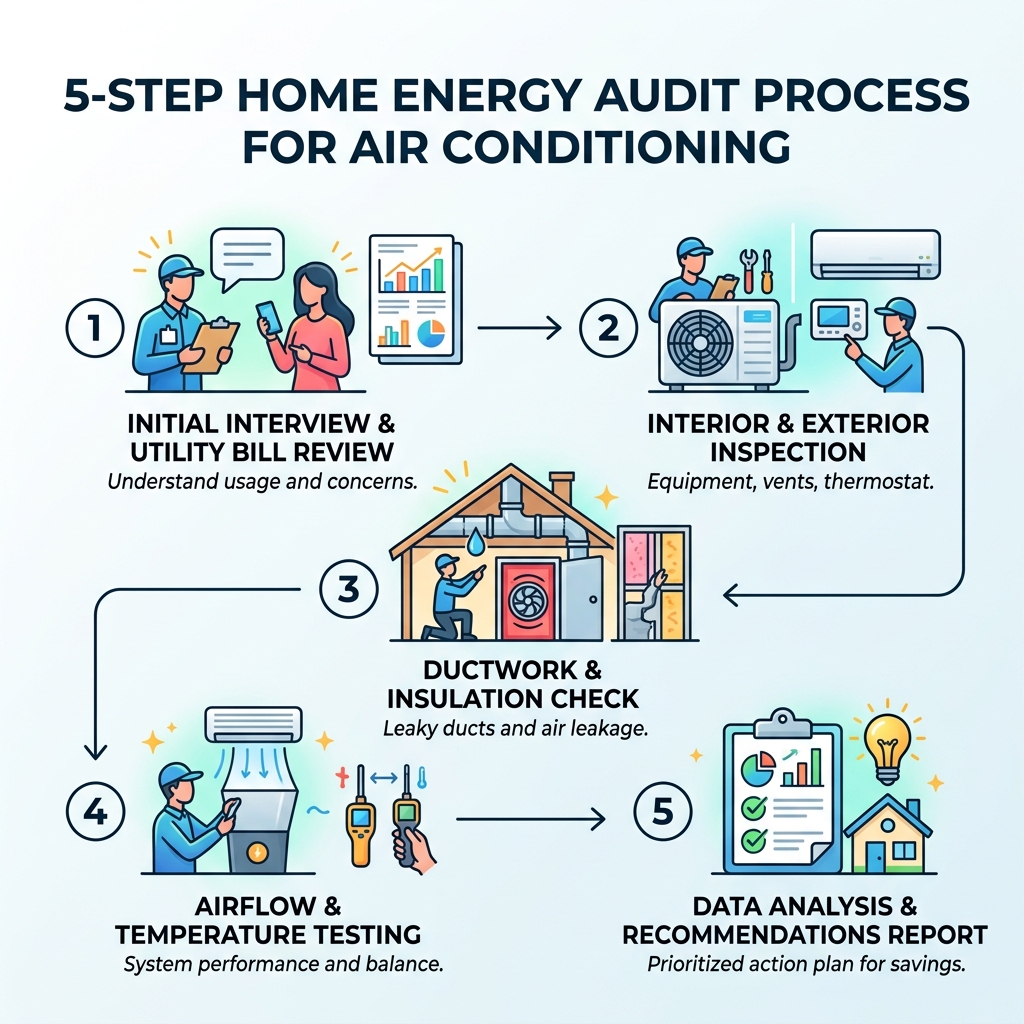
What is an Air Conditioning Energy Assessment?
Think of an air conditioning energy assessment as a “health checkup” for your home’s cooling habits. While a standard AC tune-up focuses on whether the machine is running, an energy assessment looks at the entire ecosystem. It evaluates not just the HVAC unit itself, but also the “building envelope”—the walls, windows, and insulation that keep the cold air in and the heat out.
When we conduct or review an assessment, we are looking at how the whole house breathes. A professional assessor will examine your equipment, controls, distribution systems (like ducts), and even the piping. This holistic view is essential because even the most expensive, high-efficiency AC unit will “burn money” if it’s pumping air into a leaky attic or through unsealed ducts. To get a head start on what these pros look for, you can check out a-comprehensive-home-energy-audit-checklist to see how your home currently stacks up.
According to the Professional Home Energy Assessments guidelines, these audits often result in a “Home Energy Score.” Much like a vehicle’s miles-per-gallon rating, this score estimates your home’s energy use and provides a standardized way to understand your efficiency.

Why Homeowners and Businesses Need an Audit
Why bother with all this paperwork? For starters, it’s about the bottom line. Research shows that making the upgrades recommended in a home energy audit can save you anywhere from 5% to 30% on your monthly bills. But the benefits go beyond just cash:
- System Longevity: When your AC doesn’t have to fight against air leaks and poor insulation, it doesn’t work as hard. This prevents premature breakdowns and extends the life of your expensive equipment.
- Indoor Air Quality: Assessments often find duct leaks that pull in dust, pollen, or mold from crawlspaces. Fixing these improves the air you breathe.
- Preventative Maintenance: By identifying issues early—like a slightly low refrigerant charge or a failing capacitor—you avoid the “emergency” Sunday afternoon repair bill when the temperature is 100 degrees.
- Carbon Footprint: Using less electricity means less demand on the power grid, making your home or business more environmentally friendly.
When to Schedule Your Assessment
We often get asked, “Is now the right time?” Generally, if you’re asking the question, the answer is yes. However, there are a few “red flag” moments when an air conditioning energy assessment becomes a must:
- The “Shock” Bill: If your utility bill jumped significantly compared to the same month last year, but your habits haven’t changed.
- The Hot Room Syndrome: If your living room is an ice box but your bedroom feels like a sauna, you likely have air distribution or insulation issues.
- Before Buying a New AC: Never buy a new system based on the size of your old one. An assessment includes a “load calculation” to ensure you don’t buy an oversized unit that wastes energy.
- Buying or Selling a Home: Knowing the energy score of a property can be a huge negotiating point or a way to plan your future renovation budget.
To prepare your home for maximum efficiency even before the pro arrives, take a look at our guide on how to make-your-home-energy-efficient-with-these-tips.
The Professional Process: Tools and Tests
A professional air conditioning energy assessment isn’t just a guy with a clipboard walking around. It involves high-tech diagnostic tools that “see” what the human eye cannot.
One of the coolest (pun intended) tools used is infrared imaging. An infrared camera can detect “thermal bridges” or spots where heat is radiating through your walls or where cool air is escaping. It creates a heat map of your home, showing exactly where your insulation is failing.
Another standard test is the blower door test. The auditor installs a powerful fan in the frame of an exterior door. This fan pulls air out of the house, lowering the air pressure inside. The higher outside air pressure then “squeezes” through every crack and crevice. This makes it easy to find leaks around windows, baseboards, and attic hatches. Once those leaks are identified, you can follow our guide on how-to-seal-air-leaks-to-save-energy to plug the holes.
For those in states like California, specific protocols like the RA3.2 Field Verification and Diagnostic Testing are used to verify refrigerant charge. This ensures the AC has exactly the right amount of “juice” to operate at peak efficiency.
Key Metrics in an Air Conditioning Energy Assessment
When you receive your report, you’ll see a lot of acronyms. Don’t let them make your head spin! Here is a breakdown of the most important efficiency ratings you’ll encounter:
- SEER2 (Seasonal Energy Efficiency Ratio 2): As of January 2023, this is the new standard. It measures how much cooling a system provides per dollar of electricity over an entire season. The “2” indicates more stringent testing conditions that better reflect real-world duct pressure.
- EER2 (Energy Efficiency Ratio 2): This measures efficiency at a specific, high outdoor temperature (usually 95°F). It tells you how well the unit performs during the hottest part of the day.
- CEER (Combined Energy Efficiency Ratio): This is primarily used for room air conditioners (window units). It accounts for the energy used while the unit is cooling and the energy used while it’s in standby mode.
When shopping for new units, always look for the ENERGY STAR Room Air Conditioner Specifications label. These units are certified to save more energy than the federal minimum standards.
| Metric | Focus Area | What a High Number Means |
|---|---|---|
| SEER2 | Central AC / Heat Pumps | Better efficiency over a full cooling season. |
| EER2 | Peak Performance | Better efficiency during the hottest “peak” hours. |
| CEER | Room/Window Units | Better overall efficiency, including standby power. |
| HSPF2 | Heat Pump Heating | Better efficiency during the heating season. |
Evaluating Performance with TSPR
For larger buildings or commercial spaces, professionals use a metric called Total System Performance Ratio (TSPR). Unlike SEER, which just looks at the outdoor unit, TSPR evaluates the entire system—including fans, controls, and how the system reacts to different loads.
According to the HVAC System Performance for Energy Codes brief, switching from a “prescriptive” system (just following basic rules) to one optimized for TSPR can result in 20% to 58% HVAC energy savings. In advanced setups, those savings can even exceed 100% compared to older, low-efficiency designs. It’s the difference between having a fast car and having a fast car with a professional driver who knows exactly how to shift gears.
Maximizing ROI: Rebates, Tax Credits, and Savings
We know what you’re thinking: “This sounds expensive.” But here’s the good news: the government and utility companies want you to do this. They would rather help you use less energy than build a new power plant.
Under the Inflation Reduction Act, homeowners can claim the 25C tax credit, which covers 30% of the cost of a professional energy audit (up to $150) and thousands more for upgrades like heat pumps. If you combine this with master-your-energy-consumption-with-smart-home-energy-monitors, you can track your ROI in real-time on your smartphone.
To find out what’s available in your specific zip code, the Database of State Incentives for Renewables & Efficiency is an incredible resource that lists every local, state, and federal incentive available.
Local Utility Programs and Incentives
Many local utilities offer their own perks. For example:
- Tucson Electric Power (TEP): Their Efficient Home Program offers rebates for AC tune-ups ($80), duct sealing (up to $300), and high-efficiency heat pump installations (up to $720). To get these, you must use an Efficient Home Program contractor list approved professional.
- TVA EnergyRight: This program offers a mix of rebates and financing for energy upgrades, helping homeowners in the Tennessee Valley area reduce their footprint without massive upfront costs.
Starting with a DIY Air Conditioning Energy Assessment
If you’re not ready to hire a pro, you can start today for $0. Many organizations offer “Virtual Assessments.” You walk through your home with a smartphone, and an expert on the other end helps you spot issues.
The TVA DIY Home Energy Assessment is a great place to start. By answering a few questions about your home’s age and cooling sources, you can get a customized report and even a free energy-saving kit (often including LED bulbs and weatherstripping). For the tech-savvy, integrating smart-home-energy-automation-a-detailed-overview can help you identify “vampire” energy drains that are quietly adding to your bill.
Common Recommendations for a Cooler Home
Once your air conditioning energy assessment is complete, you’ll receive a list of recommendations. We usually see them fall into three categories: sealing the “shell,” fixing the “veins,” and upgrading the “heart.”
- Sealing the Shell (Insulation): Adding insulation to your attic is often the #1 most cost-effective way to save on cooling. If your attic is 140°F and your ceiling is poorly insulated, your AC is fighting a losing battle. Check out our tips on insulating-your-home-for-energy-efficiency to see how to do it right.
- Fixing the Veins (Duct Sealing): Typical homes lose 20% to 30% of the air moving through the duct system due to leaks and poorly connected ducts. Sealing these ensures the cold air actually reaches your bedroom.
- The Manual J Calculation: A pro should perform a Manual J load calculation. This takes into account your home’s square footage, window orientation, and insulation levels to determine exactly how many BTUs of cooling you need. Remember: bigger is not better. An oversized unit will turn on and off too quickly (short-cycling), which fails to remove humidity, leaving you feeling “clammy” even if the air is cold.
You can find certified assessors to help with these tasks using the U.S. Department of Energy’s Home Energy Score Map.
Upgrading to High-Efficiency Systems
If your assessment shows that your 15-year-old AC is on its last legs, it might be time for an upgrade. Modern options are light-years ahead of older models:
- Air-Source Heat Pumps: These don’t just “create” cold air; they move heat from inside your house to the outside. They are incredibly efficient and provide both heating and cooling.
- Mini-Splits (Ductless): Perfect for additions or homes without existing ductwork. They allow for “zoning,” so you aren’t paying to cool the guest room you only use twice a year.
- Variable-Speed Compressors: Traditional ACs are either “100% on” or “off.” Variable-speed units can run at 30% or 50% capacity, maintaining a steady temperature and using much less energy.
When looking at these, pay attention to the ENERGY STAR heating mode performance if you live in a climate where you’ll use the unit year-round.
Low-Cost Efficiency Improvements
Not every fix requires a contractor. Here are some “quick wins” we recommend:
- Thermostat Settings: Set your thermostat to 78°F when you are home and higher when you are away. Every degree below 78°F can increase your cooling costs by up to 8%.
- Ceiling Fans: Fans don’t cool the room; they cool people via the wind-chill effect. Turn them off when you leave the room!
- Clean the Coils: Dust and debris on your outdoor condenser unit act like a blanket, trapping heat. A simple rinse with a garden hose (carefully!) can boost efficiency.
- Filter Changes: A dirty filter makes your AC motor work harder. Change it every 1–3 months.
For more advanced tracking, check out master-your-energy-consumption-with-smart-home-energy-monitors-2.
Frequently Asked Questions about AC Efficiency
How much can I save after an air conditioning energy assessment?
Most homeowners see a 5% to 30% reduction in their energy bills after implementing the recommended changes. If your home has major issues like disconnected ducts or zero attic insulation, your savings could be even higher. The ROI on simple fixes like weatherstripping and duct sealing is often realized in less than a year.
What is the difference between SEER and SEER2?
SEER2 is the updated version of the Seasonal Energy Efficiency Ratio. As of January 1, 2023, the Department of Energy (DOE) required new testing procedures (M1) that better account for the external static pressure found in real-world duct systems. Essentially, SEER2 is a more “honest” and accurate measurement of how a unit will perform in your actual home compared to the old SEER rating.
How do I find a qualified energy assessor?
We recommend looking for assessors certified by the Department of Energy (DOE) or those who can provide a Home Energy Score. You can also contact your local utility company, as many have “Participating Trade Allies” or licensed contractors who are specifically trained to meet the utility’s rebate requirements. Always check for a valid contractor’s license and insurance before work begins.
Conclusion
At Financefyx, we believe that your home should be a sanctuary, not a source of financial stress. An air conditioning energy assessment is the first step toward taking control of your utility bills and ensuring your summer is spent in comfort rather than worry.
By following this roadmap—identifying energy waste, utilizing available rebates, and making smart, data-backed upgrades—you aren’t just saving money; you’re investing in a more sustainable and comfortable future for your family. Don’t let your AC burn another dollar this season.
Ready to dive deeper into making your home the most efficient on the block? Explore more energy saving tips on our blog and start your journey toward a cooler, cheaper summer today!
