
A Homeowner’s Guide to Qualifying for Every Possible Insulation Rebate
How Insulation Rebates Can Cut Your Energy Bills This Year
Insulation rebates are financial incentives from the federal government, state programs, and local utilities that pay you back for upgrading your home’s insulation and air sealing.
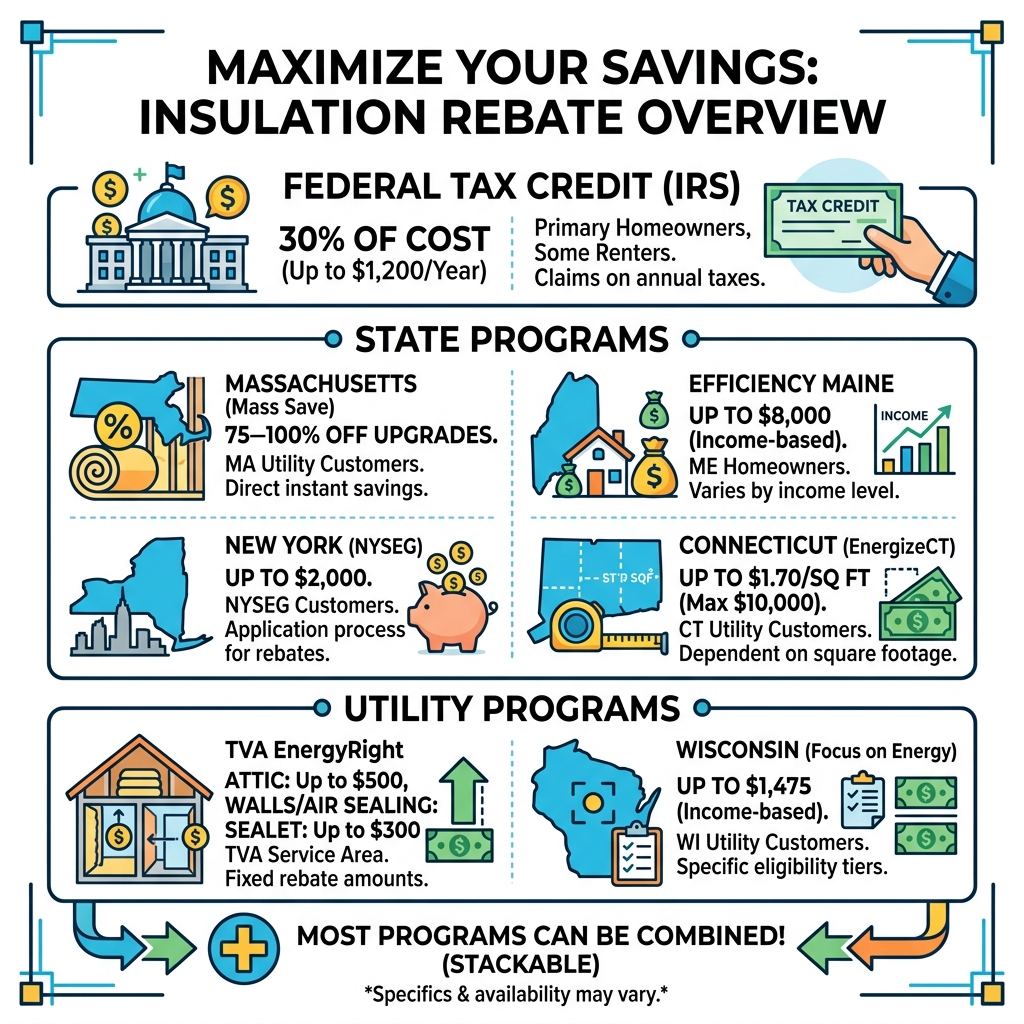
Here’s a quick look at what’s available right now:
| Program | Rebate Amount | Who Qualifies |
|---|---|---|
| Federal Tax Credit (IRS) | 30% of cost, up to $1,200/year | Primary homeowners, some renters |
| Mass Save (Massachusetts) | 75–100% off approved upgrades | MA utility customers |
| Efficiency Maine | Up to $8,000 (income-based) | ME homeowners |
| NYSEG (New York) | Up to $2,000 | NYSEG customers |
| TVA EnergyRight | Up to $500 attic, $300 walls/air sealing | TVA service area |
| EnergizeCT (Connecticut) | Up to $1.70/sq ft, max $10,000 | CT utility customers |
| Focus on Energy (Wisconsin) | Up to $1,475 (income-based) | WI utility customers |
The good news? Most of these stack. You can often combine a federal tax credit with a state or utility rebate on the same project.
If your home feels drafty in winter or your heating bills keep climbing, the problem is likely air leaking out through gaps and under-insulated walls, attics, or basements. Upgrading insulation is one of the most cost-effective fixes available — and right now, multiple programs will pay a significant portion of that cost for you.
This guide walks you through every major insulation rebate program available, what you need to qualify, and exactly how to apply — so you leave no money on the table.
Understanding the Federal Tax Credit for Insulation and Air Sealing
When we talk about insulation rebates, the heavy hitter at the federal level is the Energy Efficient Home Improvement Credit, also known as Section 25C. This isn’t just a one-time perk; it is a robust tax credit designed to help us tighten our “building envelope”—the barrier between the conditioned air we pay for and the wild outdoors.
Under this program, we can claim a tax credit of 30% of the qualified expenses for insulation and air sealing materials. While there is an overall annual limit of $3,200 for all energy-efficient improvements (including heat pumps), the specific cap for the building envelope—which includes insulation, windows, and doors—is $1,200 per year.
This annual nature is a huge advantage. If we have a massive project, we can strategically spread the work over multiple years to maximize our savings. For example, you might insulate the attic this year and tackle the basement walls next year to stay under the $1,200 cap each time. Before you start stuffing fiberglass into your rafters, it is worth checking out the ultimate guide to insulating your home to ensure you’re picking the right spots for maximum ROI.
Eligibility Requirements for Federal Insulation Rebates
To get your hands on that 30% credit, there are a few “must-haves” regarding your residency:
- Primary Residence: The home must be your principal residence located in the United States.
- Existing Homes Only: This credit is for retrofitting and improving existing homes. New constructions do not qualify because builders are already expected to meet modern efficiency codes.
- Renters Can Join In: Surprisingly, renters who pay for these improvements on their principal residence can also claim the credit, provided they have the landlord’s permission to make the upgrades.
- No Landlords: If you own a property but don’t live in it (e.g., you’re a landlord), you generally cannot claim this specific credit for those rental units.
When tax season rolls around, we use IRS Form 5695 to claim these savings. That this is a non-refundable credit, meaning it can reduce the tax you owe to zero, but the IRS won’t send you a check for any “leftover” credit. For more on how this fits into your broader financial plan, see our breakdown of renewable energy incentives for homeowners.
Qualifying Materials and Performance Standards
Not all fluff is created equal in the eyes of the IRS. To qualify for insulation rebates via the tax credit, materials must meet specific standards:
- IECC Standards: The insulation must meet the International Energy Conservation Code (IECC) standards in effect two years prior to the installation. For 2024 and 2025, this generally points toward IECC 2021.
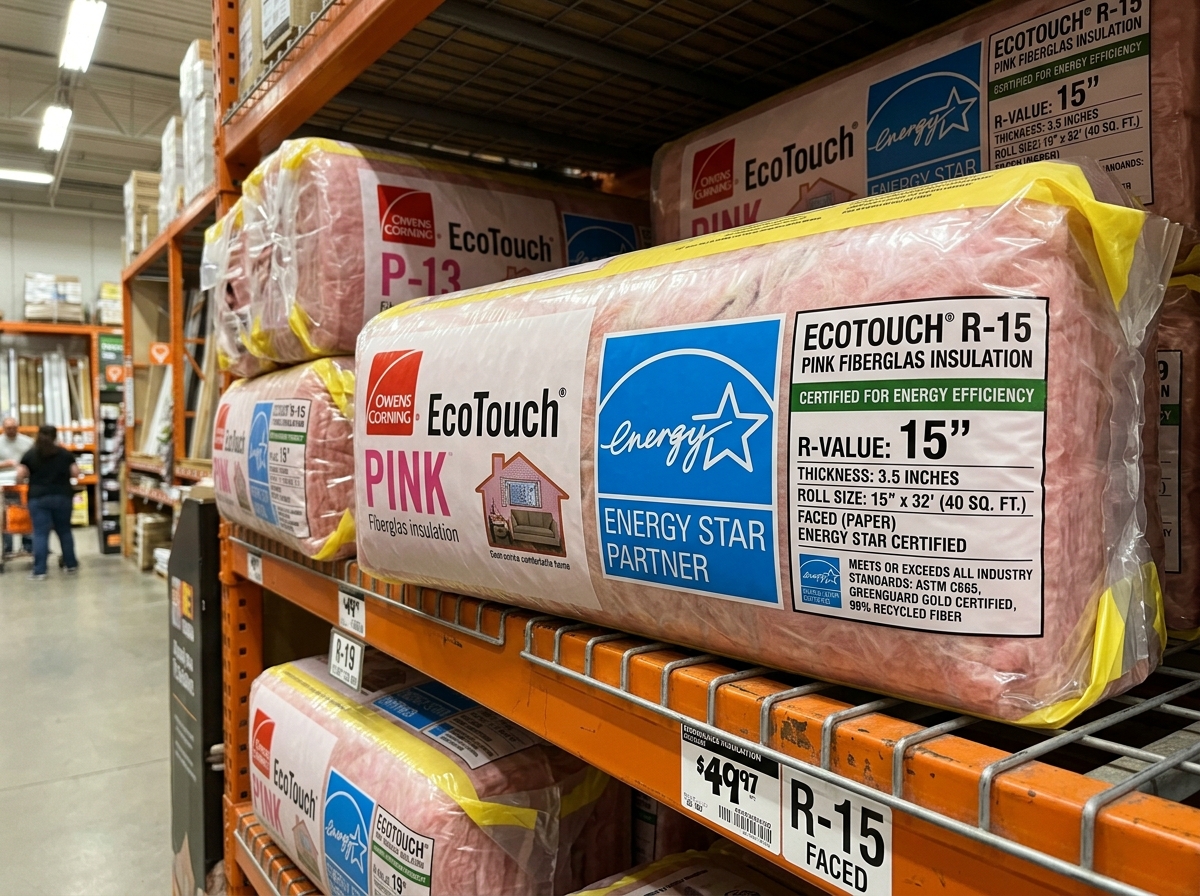
- Bulk Insulation: This includes fiberglass batts, rolls, blown-in cellulose, rigid foam boards, and expanding spray foam.
- Air Sealing: Products like weather stripping, caulk, and house wrap also qualify if they are primarily designed to stop air leaks.
- Documentation: You should keep the Manufacturer’s Certification Statement provided by the product maker. Starting in 2025, the IRS will require a Qualified Manufacturer Identification Number (QMID) for many items, though insulation is currently one of the few items exempt from certain PIN requirements.
By insulating your home for energy efficiency, you aren’t just chasing a tax break; you’re creating a permanent shield against rising utility costs.
Maximizing State and Utility Insulation Rebates
While the federal credit is a great baseline, the real “magic” happens when we look at local utility programs. These often offer “instant rebates” that are deducted right from your contractor’s invoice, meaning you don’t have to wait until tax season to see the cash.
Programs like NYSEG in New York offer up to $2,000 for insulation and air sealing. Meanwhile, the Mass Save program is legendary for covering 75% to 100% of the cost for eligible residents. In Wisconsin, Focus on Energy provides tiered rebates based on how much “R-value” (thermal resistance) you add to your home.
| Upgrade Type | Typical Professional Rebate | Typical DIY Rebate |
|---|---|---|
| Attic Insulation | $500 – $1,500 | $200 – $250 |
| Air Sealing | $300 – $1,000 | Limited/Varies |
| Wall Insulation | $300 – $1,200 | Often Not Eligible |
| Basement/Crawlspace | $500 – $1,200 | Varies |
Regional Programs and Specific Rebate Amounts
Different states have different priorities. In Maine, Efficiency Maine offers massive rebates—up to $8,000—for those who meet certain income criteria. If you’re in Connecticut, the Residential Insulation Incentive through EnergizeCT can provide up to $1.70 per square foot for professional installation, with a total cap of $10,000.
These programs often target specific areas of the home:
- Attics: Usually the highest priority because heat rises. Most programs require you to reach a total R-value of R-38 or R-49.
- Rim Joists: The area where your home’s frame meets the foundation is a major source of drafts.
- Wall Cavities: Using “dense pack” cellulose can stop drafts in older, uninsulated walls.
Professional vs. DIY Installation Limitations
We all love a good weekend project, but when it comes to insulation rebates, “doing it yourself” might actually cost you money.
Most utility programs require you to use a “Trade Ally” or a member of their “Quality Contractor Network.” Why? Because they want to ensure the air sealing is done correctly before the insulation is added. If you insulate over a major air leak, you can actually trap moisture and cause mold—a nightmare no rebate can fix.
- Professional Perks: Access to much higher rebate caps (e.g., $10,000 vs $250). Contractors also handle the paperwork and permits.
- DIY Limitations: Programs like LADWP or EnergizeCT offer much smaller “self-install” rebates (around $0.25/sq ft). You usually won’t be reimbursed for your own labor, only for the cost of the materials.
If you are determined to go the DIY route, check out these attic insulation tips save energy and money to make sure you’re following best practices.
Income-Based and Low-Income Assistance Programs
We believe that energy efficiency shouldn’t be a luxury. That’s why many insulation rebates are “tiered” based on your household income. If your income falls below a certain percentage of the Area Median Income (AMI), you might qualify for 80% to 100% coverage of your project costs.
Efficiency Maine, for example, offers an 80% rebate up to $8,000 for low-income households and 60% up to $6,000 for moderate-income households. This is a game-changer for families who want to lower their monthly bills but can’t afford the upfront cost of a major renovation.
Qualifying for Enhanced Insulation Rebates
To qualify for these “enhanced” levels, you’ll usually need to provide:
- Income Verification: This is typically your most recent tax return or proof of participation in other assistance programs (like LIHEAP).
- Adjusted Gross Income (AGI): Many programs set the “moderate” limit at an AGI of $70,000 for individuals or $100,000 for joint filers.
- Household Size: Larger families often have higher income thresholds to qualify for the same rebates.
Programs like the “CleanBC Better Homes Energy Savings Program” in British Columbia even factor in your property’s assessed value, ensuring the funds go to those who need the most help.
Building Type and Residency Rules
The type of roof over your head also matters. While single-family homes are the easiest to qualify, many programs have expanded to include:
- Duplexes and 1-4 Unit Buildings: Often treated similarly to single-family homes.
- Condominiums: Usually eligible, though there may be “lifetime limits” per building or unit.
- Mixed-Use Buildings: If you live above your shop, you can often get rebates for the residential portion of the building.
If you are a renter, you aren’t left out! Many programs, like BC Hydro’s Insulation Rebates, allow renters to apply as long as they provide a landlord consent form. This is a win-win: the landlord gets a more valuable, efficient property, and you get lower utility bills.
How to Apply and Meet Installation Standards
Applying for insulation rebates isn’t just about filling out a form; it’s about following a specific sequence. If you install the insulation before getting an inspection or approval, you might disqualify yourself.
The gold standard for starting any project is a professional home energy audit. This often involves a “blower door test,” where a technician uses a giant fan to depressurize your house and find exactly where the air is leaking. In many states, this audit is the “key” that unlocks the highest rebate tiers. We recommend starting with a comprehensive home energy audit checklist to prepare.
Documentation and Filing Deadlines
Paperwork is the bane of every homeowner’s existence, but for these rebates, it’s literally money in the bank. You will typically need:
- Itemized Invoices: These must show the name of the product, the square footage covered, and the price paid. It must be marked “PAID” or show a zero balance.
- R-Value Proof: A Manufacturer’s Certificate or a photo of the insulation packaging showing the R-value per inch.
- Photos: Many programs (like LADWP) require “Before” and “After” photos taken from the exact same angle in your attic or crawlspace.
- Permits: In cities like Los Angeles, you must have a “finaled” building permit to receive your rebate.
Deadlines to Watch:
- Federal Tax Credit: Currently available through December 31, 2025.
- State Programs: Many, like Wisconsin’s Focus on Energy, have applications that must be submitted within 60 days of installation.
- Launch Specials: Keep an eye out for “Launch Specials” or extensions. For instance, some programs have extended higher rebate amounts through June 30, 2026.
Using energy-saving methods for home insulation correctly the first time ensures you don’t run into issues during the post-installation verification.
Frequently Asked Questions about Insulation Rebates
Can I combine federal tax credits with state utility rebates?
Yes! This is the most effective way to save. Generally, the federal government requires you to subtract any utility “subsidies” from your total cost before calculating your 30% tax credit. However, many state-level incentives do not count as “subsidies” in the eyes of the IRS, allowing you to double-dip. Always consult a tax professional to be sure.
Do labor costs qualify for the federal insulation credit?
No. For the federal insulation credit (Section 25C), only the cost of the materials qualifies for the 30% credit. Labor costs for installation are excluded. However, labor is often covered or subsidized by state and utility rebate programs like Mass Save or Efficiency Maine.
What is the maximum annual limit for energy efficiency credits?
The total annual limit for the Energy Efficient Home Improvement Credit is $3,200. This is split into two categories:
- $1,200 for “building envelope” components (insulation, windows, doors) and home energy audits.
- $2,000 for “heat pump” categories (heat pump water heaters, biomass stoves, and heat pumps for heating/cooling).
Conclusion
Navigating insulation rebates might feel like a full-time job, but the payoff is worth it. By combining the 30% federal tax credit with state-specific programs like NYSEG, Mass Save, or Efficiency Maine, we can often cut the cost of weatherizing our homes by half—or more.
Beyond the immediate cash back, proper insulation provides a long-term ROI that few other home improvements can match. You’ll see it in your lower monthly bills, feel it in the lack of drafts during a blizzard, and appreciate it when your roof stays clear of damaging ice dams.
At Financefyx, we want to help you make every dollar count. By treating your home as a system—starting with a comprehensive home energy audit and following up with high-quality insulation—you are investing in a more comfortable, sustainable future. Don’t let these 2025 and 2026 deadlines pass you by; start your energy-saving journey today at Financefyx.
