
Stop Throwing Money Out the Roof with These DIY Attic Tips
Why Your Attic Is Costing You More Than You Think
DIY attic insulation tips can help you cut your energy bills nearly in half — and the good news is that most homeowners can tackle this project in a weekend.
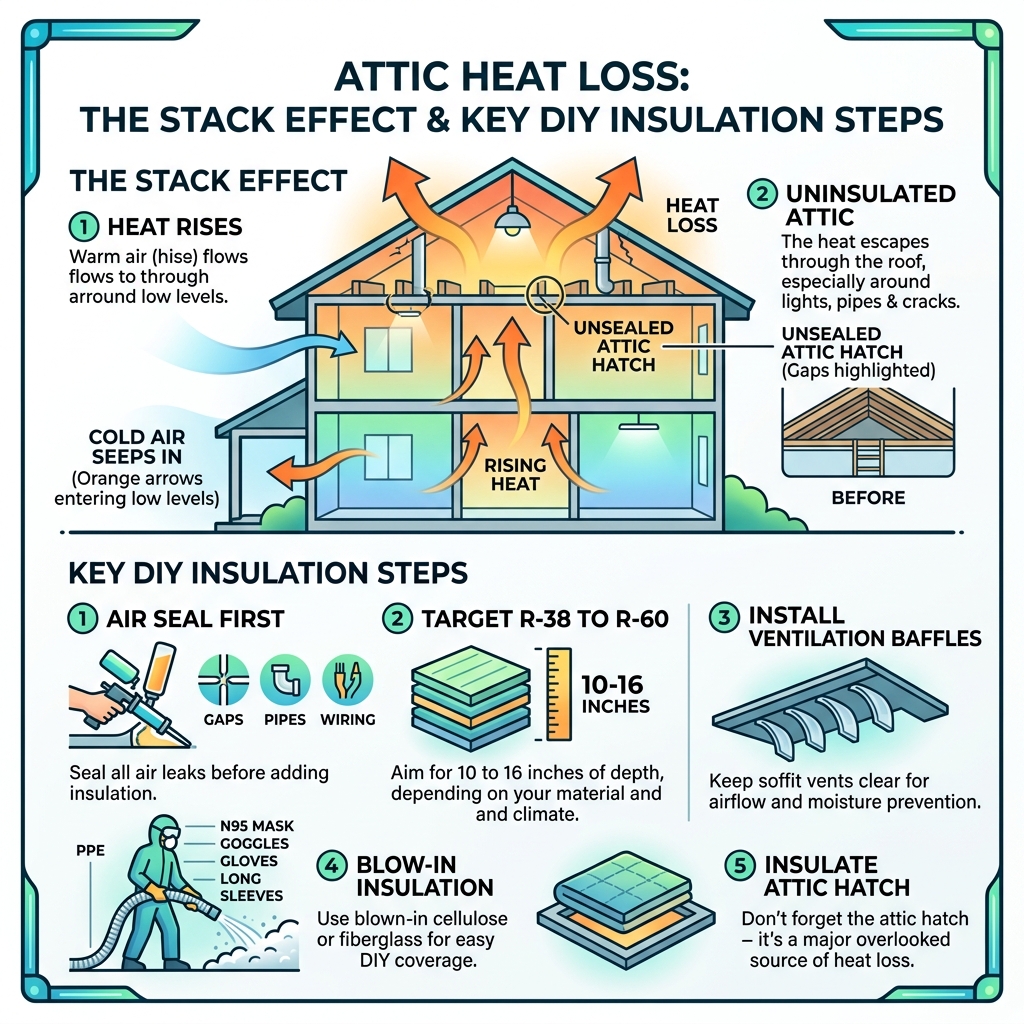
Here’s a quick overview of the most important steps:
- Check your current insulation — if you can see the tops of your ceiling joists, you need more
- Air seal first — foam and caulk all gaps before adding any insulation
- Target R-38 to R-60 — that’s roughly 10 to 16 inches depending on your material and climate
- Install ventilation baffles — keep soffit vents clear to prevent moisture buildup
- Choose blown-in cellulose or fiberglass — both are budget-friendly and easy to DIY
- Wear full PPE — N95 mask, gloves, goggles, and long sleeves are non-negotiable
- Don’t forget the attic hatch — it’s one of the biggest overlooked sources of heat loss
Your attic is one of the biggest energy drains in your home. Heat rises — and if your attic isn’t properly insulated, that warmth goes straight through your ceiling and out into the cold. One homeowner described their attic hitting 135°F in summer, with high AC bills to match. In winter, the same problem works in reverse: cold air seeps in and your furnace works overtime.
The fix isn’t complicated. It’s not even that expensive. A DIY attic insulation project can cost around $1,300 in materials — compared to $3,000–$5,000 for professional installation — with a payback period of just one to two years.
This guide walks you through everything you need to know, from checking your current insulation levels to blowing in your first bag of cellulose.
Assessing Your Current Insulation and R-Value Needs
Before we go running to the hardware store, we need to know exactly what we’re working with. Assessing your current situation is the foundation of all good diy attic insulation tips. Insulation is measured by its “R-value,” which is a fancy way of saying how well it resists heat flow. The higher the R-value, the better the material is at keeping your expensive conditioned air inside your living space.
A great starting point to see how your home stacks up is the Home Energy Yardstick. This tool helps you compare your home’s energy efficiency against similar households. For a deeper dive into the mechanics of thermal barriers, check out the-ultimate-guide-to-insulating-your-home/.
The quickest “eye test” for any homeowner is to simply look across your attic floor. If the insulation is level with or below the floor joists (the wooden beams), you definitely don’t have enough. In a perfectly insulated attic, those joists should be completely buried under a thick, fluffy blanket of material.

To get precise, you should consult a Specifications Manual for R-values. Different regions of the country require different levels of protection. If you live in a chilly Northern state, you’ll want a much higher R-value than someone in the Sun Belt. Generally, most experts recommend aiming for at least R-40, though R-60 is becoming the gold standard for maximum savings.
Determining Your Target Depth
How deep should you go? It depends on the material you choose. Standard fiberglass batts usually provide about R-3.2 to R-3.4 per inch. This means if you have 3.5 inches of insulation, you’re only at R-11. To hit that sweet spot of R-60, you’re looking at a total depth of 14 to 16 inches.
If you are using loose-fill fiberglass, you might need 15 to 16 inches to reach an R-38 rating. We recommend using a Specifications Manual to determine target levels based on your specific zip code and existing layers. More is almost always better here, as long as you aren’t blocking your ventilation (more on that later!).
Essential Safety and DIY Attic Insulation Tips
Working in an attic is not like working in your living room. It’s dark, dusty, cramped, and—if you aren’t careful—dangerous. Safety is the most important part of our diy attic insulation tips.
First, let’s talk about the “floor.” In most attics, the space between the joists is just drywall—the back of your ceiling. If you step there, you will fall through into the room below. We always recommend building a temporary “catwalk” using sturdy plywood platforms laid across the joists. This gives you a stable place to kneel and move materials.
Protective Personal Equipment (PPE) is mandatory. Insulation fibers are notorious for causing skin irritation and respiratory issues. You should wear:
- Long sleeves and pants (tuck your pants into your socks!)
- Safety glasses or goggles
- Gloves
- A high-quality N95 Mask or respirator to avoid breathing in dust and fibers.
Before you start digging around, you must check for vermiculite. This is a pebble-like, silver-gold or gray-brown insulation common in older homes. It often contains asbestos. If you see it, do not disturb it. Stop immediately and consult the EPA Asbestos Warning. For more on safely navigating these projects, read attic-insulation-tips-save-energy-and-money/.
Avoiding Common Hazards
Beyond the material itself, keep an eye out for knob-and-tube wiring. This pre-1950s electrical system is a major fire hazard if covered by insulation because the wires need air space to dissipate heat. If you find this, you’ll need to have a pro replace the wiring before you can insulate.
Also, be mindful of heat exhaustion. Attics can easily reach 130°F+ on a sunny day. Work early in the morning, stay hydrated, and take frequent breaks. And here’s a pro tip: wear a hard hat or a sports helmet. Trust us, you will bump your head on a roof rafter at least once, and your skull will thank you for the padding.
The Critical First Step: Air Sealing and Ventilation
One of the biggest mistakes DIYers make is blowing in insulation before sealing air leaks. Insulation is like a wool sweater; it keeps you warm, but if the wind blows right through it, it’s useless. You need a “windbreaker” layer, which we achieve through air sealing.
Air leaks are often found around plumbing stacks, electrical wires, and recessed lights. Use expanding foam or caulk to plug these gaps. This prevents the “stack effect,” where warm air from your house is sucked up into the attic like a chimney. For a deep dive into this process, see how-to-seal-air-leaks-to-save-energy/ and energy-saving-methods-for-home-insulation/.
While we want the floor of the attic to be airtight, we want the attic itself to breathe. Proper ventilation is crucial to prevent moisture buildup, which leads to mold and wood rot. It also helps prevent ice dams in the winter.
Installing Baffles for Proper Airflow
To keep the attic breathing, you must install insulation baffles (also called rafter vents or chutes). These are plastic or foam channels that you staple to the roof structure at the eaves. They ensure that the fresh air coming in from your soffit vents has a clear path to flow over the insulation and out through the ridge vents.
Without these, your new insulation will block the airflow, trapping moisture against your roof deck. You can find detailed Specifications Manual for vent instructions to ensure you’re maintaining the required 1-inch air space between the baffle and the roof.
Handling Obstacles and DIY Attic Insulation Tips
Attics are full of obstacles like recessed “can” lights, chimney flues, and exhaust fans.
- Recessed Lights: If they aren’t “IC-rated” (Insulation Contact), you must keep insulation at least 3 inches away to prevent a fire. We recommend using Tenmat Recessed Light Covers, which allow you to insulate over the light safely.
- Flues and Chimneys: Never put combustible insulation directly against a hot flue. Use a metal dam or fire-rated sealant to maintain a safe gap (usually 1–3 inches depending on the type of vent).
- Exhaust Fans: Ensure your bathroom fans vent all the way to the outside of the house, not just into the attic space.
Choosing and Installing Your Insulation Material
When it comes to diy attic insulation tips, choosing the right material is half the battle. Here’s a quick breakdown:
| Material | R-Value per Inch | Best For… | DIY Difficulty |
|---|---|---|---|
| Cellulose | ~3.5 – 3.8 | Topping off, air sealing | Easy (with blower) |
| Fiberglass (Loose) | ~2.2 – 2.7 | Budget, fire resistance | Easy (with blower) |
| Fiberglass (Batts) | ~3.2 – 3.4 | Standard joist spacing | Moderate (lots of cutting) |
| Mineral Wool | ~3.0 – 3.3 | Fire and soundproofing | Moderate |
For more on choosing the right fit, visit insulating-your-home-for-energy-efficiency/ and catch-the-heat-insulation-tips-for-winter/.
Step-by-Step Blown-In vs. Batt DIY Attic Insulation Tips
If you choose blown-in insulation, you’ll need to rent a blower machine (often free from home centers if you buy enough bags). This is a two-person job: one person stays outside to feed the machine, and the other stays in the attic with the hose.
- Mark your depth: Use a marker or tape to indicate your target depth (e.g., 15 inches) on the roof trusses.
- Start at the edges: Work from the furthest corners back toward the hatch.
- Use a sweeping motion: Keep the hose level and move it back and forth to ensure even coverage. Don’t forget to check the DOE’s Home Improvement Expert Checklists for quality control.
If you choose batts or rolls, the key is a snug fit.
- Don’t compress: Squishing insulation to make it fit actually ruins its R-value. It needs that trapped air to work.
- Layering: If you’re adding a second layer, lay the batts perpendicular to the first layer. This covers the gaps over the joists and significantly boosts efficiency.
- Unfaced is best: For a second layer, always use “unfaced” insulation (no paper backing) to prevent trapping moisture between layers.
Insulating the Attic Access Hatch
The attic hatch is often the “weakest link” in your home’s thermal envelope. It’s essentially a giant hole in your ceiling. To fix this, use a Specifications Manual for hatch sealing.
Attach rigid foam board or a fiberglass batt to the top of the hatch cover. Then, apply weatherstripping around the perimeter of the opening so that when the hatch closes, it creates an airtight seal. It’s a small step that makes a massive difference in preventing drafts.
Frequently Asked Questions about Attic Insulation
How much does a DIY attic insulation project cost?
On a tight budget, you can expect to spend about $1,300 for materials to add 14–16 inches of cellulose to a standard attic. This includes the cost of baffles, foam sealant, and the insulation itself. Compared to the $3,000+ a pro would charge, you’re saving thousands in labor. If you are struggling with costs, look into How to apply for Weatherization Assistance, as many government programs help low-income families with these upgrades.
Can I install new insulation over old insulation?
Yes! In fact, it’s very common. You can blow cellulose over old fiberglass or lay new batts over old loose-fill. The only rule is to ensure the new layer is unfaced. If you put a vapor barrier (paper) in the middle of your insulation sandwich, you’ll trap moisture and end up with a mold problem. Also, make sure the old insulation isn’t wet or moldy—if it is, it needs to be removed first.
When should I hire a professional instead of doing it myself?
While we love a good DIY project, sometimes it’s best to call in the experts. You should hire a pro if:
- You find mold or significant structural damage.
- You have active knob-and-tube wiring.
- Your attic has very low clearance (less than 3 feet), making it dangerous to move.
- You suspect the presence of asbestos. Always review the DOE’s Home Improvement Expert Checklists to decide if a project is within your skill level.
Conclusion
At Financefyx, we believe that energy efficiency is one of the smartest investments you can make for your home and your wallet. By following these diy attic insulation tips, you aren’t just saving money on your next utility bill; you’re increasing your home’s value and doing your part for sustainability.
Properly insulating your attic is a “one and done” project that pays for itself in record time. So, grab your mask, head up that ladder, and stop throwing your hard-earned money out through the roof!
For More info about energy saving tips, explore our other guides on home maintenance and efficiency.
