
A Step-by-Step Guide to Build a Solar Tracker from Scratch
Why Building a Solar Tracker Can Transform Your Energy Output
If you want to build a solar tracker, here is the fastest path to get started:
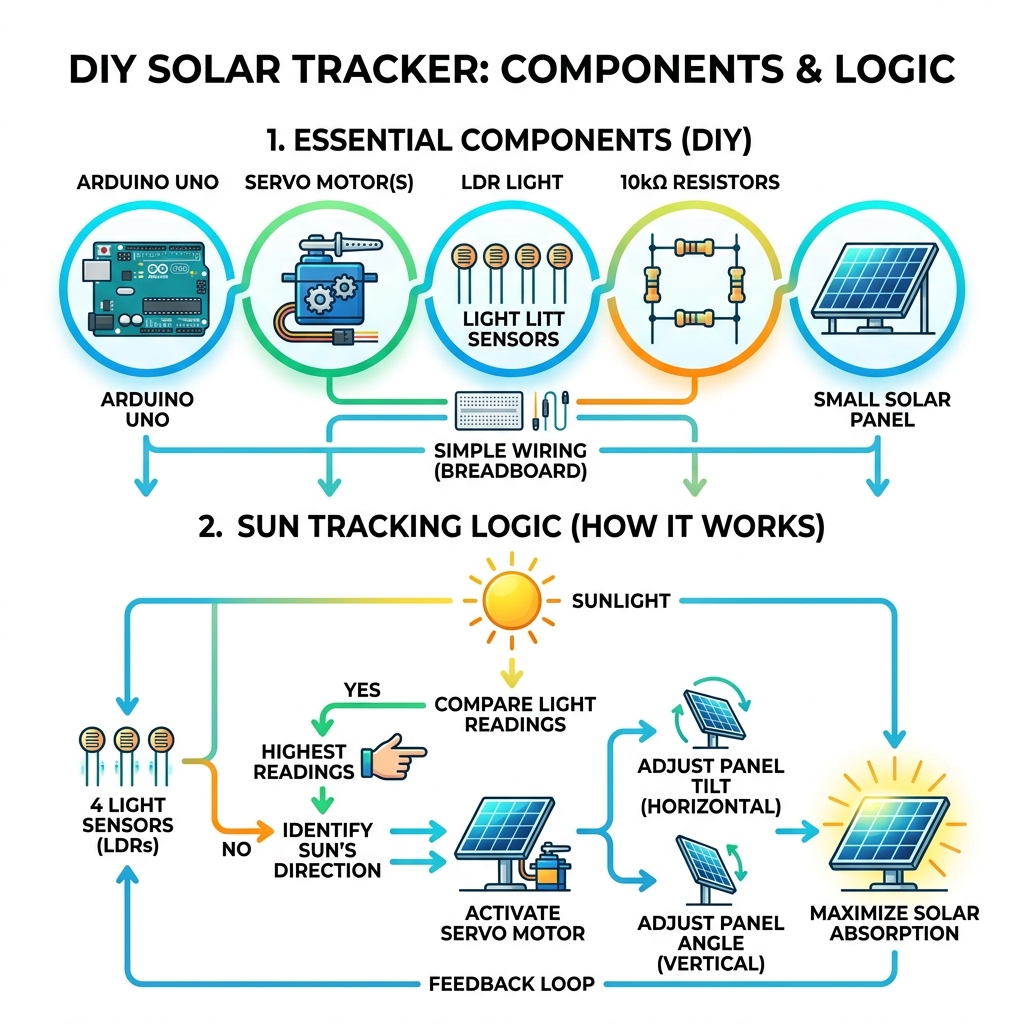
- Gather components – Arduino Uno, 2-4 LDR light sensors, servo motor(s), 10kΩ resistors, breadboard, and a small solar panel
- Wire the circuit – Connect LDRs to analog pins, servo to pin 9, with 10kΩ resistors forming a voltage divider
- Upload the code – Use the Arduino IDE with the Servo.h library to move the panel toward whichever sensor reads more light
- Build the frame – Mount the servo and panel on a sturdy base (cardboard, PVC, or metal)
- Test and calibrate – Compare voltage output against a fixed panel over several sunny days and adjust sensor sensitivity
A fixed solar panel is simple. But it leaves a lot of power on the table.
Solar panels produce their maximum output only when sunlight hits them at a direct, perpendicular angle. Early morning, late afternoon, and seasonal shifts all reduce that angle — and your power output drops with it.
A solar tracker solves this by automatically rotating the panel to follow the sun throughout the day. The numbers speak for themselves: a well-built single-axis tracker can boost energy production by 25% or more compared to a fixed panel. In some climates, like southern Spain, DIY single-axis trackers have harvested 30–40% more energy during summer months.
The good news? You do not need an engineering degree to build one. With an Arduino microcontroller, a handful of light sensors, and basic tools, this is a weekend-scale project — though budgeting 6–10 days and around $100–$150 gives you a realistic timeline and cost estimate.
This guide walks you through every step: choosing your components, wiring the circuit, writing the code, building the frame, and testing your results.
Build a solar tracker further reading:
Why You Should Build a Solar Tracker: Benefits and Efficiency
When you set out to build a solar tracker, you are essentially upgrading your energy system from a “passive” harvester to an “active” hunter. Traditional rooftop panels are installed at a fixed angle, usually optimized for the average position of the sun throughout the year. While this is low-maintenance, it means that for most of the day, the sun’s rays strike the panel at an inefficient slant.
By ensuring the panel remains perpendicular to the sun’s rays, you maximize the intensity of the light hitting the photovoltaic cells. Research shows that rotating a panel from East to West over the course of the day can result in nearly a 90% increase in production during those peak hours compared to a panel that misses the morning and evening sun entirely. Even a basic manual adjustment can lead to improvements of around 25%.
If you are new to photovoltaics, checking out a solar energy guide for beginners can help you understand the core physics before you dive into the mechanics of tracking.
Understanding Single-Axis vs. Dual-Axis Systems
Before you start buying parts, you need to decide which “dimension” of the sun you want to follow.
- Single-Axis Trackers: These follow the sun’s daily journey from East to West. They are simpler to build, require only one motor, and offer the biggest “bang for your buck.” A single-axis system typically achieves about 85% of the efficiency of a perfect dual-axis tracker.
- Dual-Axis Trackers: These follow the sun East-to-West and North-to-South. Because the sun sits higher in the sky during summer and lower in the winter, a dual-axis tracker adjusts the tilt (elevation) as well as the rotation (azimuth). While more complex, these can increase energy output by up to 40% compared to stationary installations.
| Feature | Fixed Mount | Single-Axis Tracker | Dual-Axis Tracker |
|---|---|---|---|
| Energy Gain | 0% (Baseline) | 20% – 25% | 30% – 40% |
| Complexity | Very Low | Moderate | High |
| Maintenance | Minimal | Moderate | High (Moving parts) |
| Best Use Case | Large Rooftops | Residential DIY | Scientific/High Latitude |
Step-by-Step Instructions to Build a Solar Tracker
Building your own tracker is a rewarding mix of electronics, programming, and “backyard engineering.” Whether you use professional 3D-printed parts or follow the “hillbilly” method of using PVC pipes and scrap timber, the logic remains the same.
Essential Hardware to Build a Solar Tracker
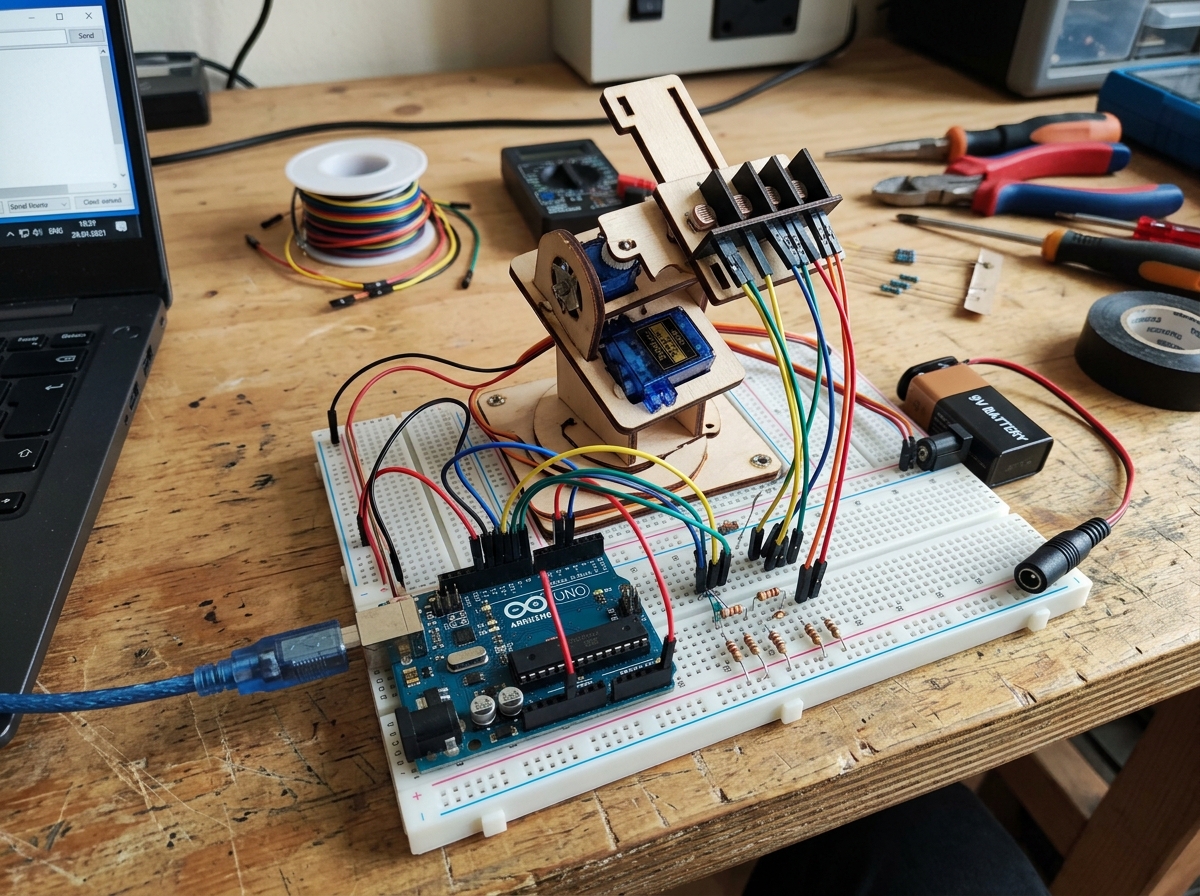
To build a solar tracker that actually works, you need a brain (the microcontroller), eyes (the sensors), and muscles (the motors). Here is the shopping list for a standard Arduino-based build:
- Arduino Uno: The “brain” that processes sensor data and tells the motors where to move.
- LDR Sensors (Photoresistors): You’ll need at least two for single-axis or four for dual-axis. These “light-dependent resistors” change their electrical resistance based on how much light hits them.
- Servo Motors: We recommend micro-servos (like the SG90) for small desktop models or linear actuators (12V) for full-sized panels.
- 10kΩ Resistors: These are used to create a “voltage divider” circuit so the Arduino can read the LDR values.
- Breadboard and Jumper Wires: For making connections without soldering (at least during the testing phase).
- Frame Materials: Cardboard and popsicle sticks work for science projects, but for real outdoor use, consider PVC pipes, aluminum profiles, or even repurposed TV antenna rotators.
If you enjoy this kind of hands-on work, you might find inspiration in other DIY solar panel projects that can complement your tracker.
Coding the Logic to Build a Solar Tracker
The software side of this project is surprisingly elegant. We use the Arduino IDE and the standard Servo.h library. The logic follows a “differential” approach:
- The Arduino reads the light levels from two LDRs (let’s call them East and West).
- It calculates the difference between the two values.
- If the West sensor is significantly brighter than the East sensor (beyond a set threshold margin), the Arduino tells the servo to rotate a few degrees toward the West.
- If the readings are nearly equal, the motor stays put to save power.
We also recommend implementing a “Night Mode.” If all sensors report very low light for an extended period (like 10 hours), the code should trigger a reset, swinging the panel back to the East to wait for the sunrise. This prevents the tracker from “hunting” in the dark and ensures it’s ready for the next day.
Testing and Evaluating Your DIY System
Once the glue has dried and the code is uploaded, it’s time to see if your hard work paid off. Testing is crucial because a tracker that points in the wrong direction 25% of the time (a common issue with uncalibrated DIY builds) can actually produce less energy than a fixed panel.
To evaluate your system, you’ll need a multimeter to measure the voltage and current. Ideally, you should set up a “control” panel — a fixed panel of the same wattage — and record the output of both every hour.
- Calibration: If your motor jitters or moves constantly, increase the “margin” variable in your code. This tells the Arduino to ignore small, insignificant differences in light.
- Performance Data: Graph your results. You should see the tracker’s voltage remain relatively flat and high throughout the day, while the fixed panel’s voltage will look like a bell curve, peaking only at noon.
Understanding these metrics is key to calculating your solar panels cost and savings over the long term.
Troubleshooting Common Challenges
No DIY project is without its hiccups. Here are the most common hurdles when you build a solar tracker:
- Sensor Saturation: In direct, mid-day sun, LDRs can become “saturated,” meaning they both read their maximum value, and the Arduino can’t tell which side is brighter. Adding a small “occulting bar” (a vertical divider) between the sensors creates a shadow that helps the Arduino distinguish the sun’s direction.
- Motor Jitter: This often happens if the sensors are too sensitive or if the servo isn’t getting enough current. Always use a separate power supply for your motors rather than drawing power directly from the Arduino board.
- Weatherproofing: Electronics and rain don’t mix. Use a weatherproof enclosure (like an old ammo box or a sealed plastic container) for your Arduino. For the mechanical parts, ensure your wires have enough “slack” to flex as the panel rotates without snapping.
- Wind Loading: A solar panel is essentially a giant sail. If you are building a larger system, ensure your frame is anchored with steel stakes or weighted with bricks.
For those planning to use their tracker in rugged environments, our off-grid solar panel tips offer more advice on durability.
Frequently Asked Questions about Solar Trackers
Is a dual-axis tracker worth the extra cost?
For most DIYers, the answer is no. A single-axis tracker gets you 85% of the way there with half the complexity. Dual-axis systems are fantastic for high-latitude areas where the sun’s elevation changes drastically between seasons, but for a standard home project, the extra motor and complex frame often outweigh the 10-15% additional gain.
How much does it cost to build a DIY solar tracker?
A small-scale Arduino tracker costs between $100 and $150. This includes the microcontroller, sensors, a small panel, and basic framing materials. If you are scaling up to a full-sized 300W panel, your costs will increase due to the need for heavy-duty linear actuators and steel framing.
Can I use a solar tracker for a portable setup?
Absolutely! Portable trackers are excellent for camping or van life. Since you can’t always park your vehicle in the perfect orientation, a portable tracker allows you to set the panel on the ground and let it find the sun automatically. Just ensure the base is stable enough to handle a breeze.
Conclusion
When you build a solar tracker, you aren’t just making a gadget; you are mastering the art of energy efficiency. By following the sun, you can squeeze every possible drop of power out of the daylight, making your setup more resilient and productive.
While the added complexity means you’ll need to perform occasional maintenance—like cleaning the LDR sensors and checking for loose bolts—the reward is a deeper connection to how renewable energy works. Whether you’re powering a remote cabin or just learning the ropes of automation, a solar tracker is a giant leap toward true energy independence and sustainable living.
Ready to take your setup to the next level? Explore more renewable energy solutions and start planning your next big build today!
