
Smart Lighting That Wont Leave You in the Dark
Why App Based Smart Lighting Is Worth Comparing Before You Buy
App based smart lighting lets you control your home’s lights from your phone — dimming, scheduling, and changing colors without touching a switch.
But not all smart lighting apps are equal. Some lock you into one brand. Others are cluttered with ads or hidden subscription fees. Picking the wrong system can mean frustrating setup headaches and lights that stop responding at the worst moments.
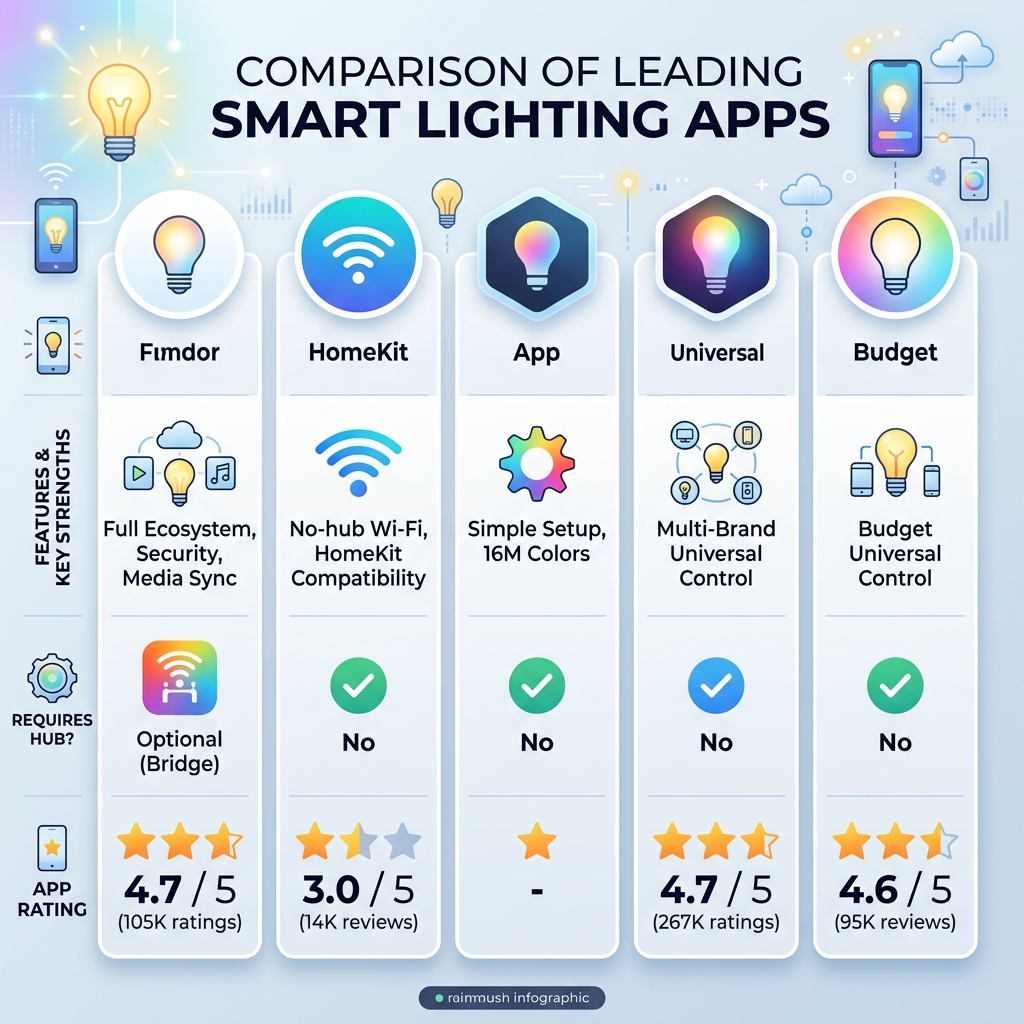
Here’s a quick comparison of the most popular options to help you decide fast:
| App | Best For | Requires Hub? | Rating |
|---|---|---|---|
| Philips Hue | Full ecosystem, security, media sync | Optional (Bridge) | 4.7/5 (105K ratings) |
| LIFX | No-hub Wi-Fi, HomeKit users | No | 3.0/5 (14K reviews) |
| WiZ | Simple setup, 16M colors | No | – |
| SmartLife / Tuya | Multi-brand universal control | No | 4.7/5 (267K ratings) |
| Smart Life Smart Home Control | Budget universal control | No | 4.6/5 (95K reviews) |
The short answer: If you want the most features and reliability, Philips Hue leads the pack. If you want no-hub simplicity across brands, SmartLife is a strong universal option. But every choice involves trade-offs between cost, compatibility, and privacy.
Keep reading for the full breakdown.
Walk into any hardware store today and the smart lighting aisle can feel overwhelming. There are dozens of brands, multiple connectivity standards, and apps that promise to do everything — but often deliver far less.
For homeowners already watching their energy bills, the last thing you need is a lighting system that’s complicated to set up or expensive to maintain.
The good news: the right app based smart lighting setup can genuinely simplify your life, save energy, and even boost home security. You just need to know what to look for.
App based smart lighting terms to remember:
Choosing the Best app based smart lighting for Your Home
When we look at the landscape of app based smart lighting, the first major decision is whether to stick with a single brand’s ecosystem or try to unify everything under one “universal” roof. Brand-specific apps like Philips Hue are designed to work perfectly with their own hardware, offering polished features like deep media synchronization and advanced security.
On the other hand, universal controllers promise to manage multiple brands from one screen. This sounds like a dream for those of us who have a mix of bulbs from different manufacturers. However, as we’ll see, “universal” doesn’t always mean “unlimited.”
Brand-Specific Apps vs. Universal Controllers
The “Big Three” in the brand-specific world are Philips Hue, LIFX, and WiZ.
- Philips Hue: This is often considered the gold standard. With over 10 million downloads on Google Play, the Philips Hue app is incredibly reliable. It allows you to organize lights into Rooms or Zones, mirroring your actual home layout.
- LIFX: Known for vibrant colors and a “no hub required” philosophy, LIFX bulbs connect directly to your Wi-Fi. While the app offers unique features like “Paint” (where you draw colors onto light strips with your finger), it has faced some criticism for connectivity issues and an interface that some users find unintuitive.
- WiZ: This brand focuses on simplicity. It’s “as simple as a light switch, only more powerful,” offering 16 million colors and easy multi-user access without messing up your carefully crafted presets.
Then there are the universal apps like Smart Life and Tuya Smart. These are powerhouses in the industry, boasting high ratings (4.7/5 on the App Store) and compatibility with thousands of white-label smart devices. While they are great for energy tracking and basic scheduling, they might lack the highly specialized entertainment “sync” features found in official brand apps. You can discover energy savings with smart lighting systems by using these apps to monitor exactly how much power your bulbs are pulling.
Ecosystem Compatibility and Selection Criteria
Before you buy your first bulb, you need to consider your existing smart home ecosystem. Are you an “Alexa” household, a “Hey Google” fan, or do you strictly use Siri?
- Alexa and Google Assistant: Most major apps, including Philips Hue, LIFX, and Smart Life, integrate seamlessly here.
- Apple HomeKit (Siri): This can be pickier. LIFX is often cited as a top choice for HomeKit users, while Philips Hue requires their Bridge to bridge the gap to Apple’s ecosystem.
Reliability is also key. We recommend looking at update frequency. An app like Philips Hue is updated constantly (as recently as April 2025 in our research), which indicates ongoing support and bug fixes. In contrast, some “budget” universal apps may go months without an update, leading to “regressions” where features that used to work suddenly break after a phone OS update. For more on making the right choice, check out these smart bulbs essential energy saving tips for home owners.
Connectivity and Setup: Wi-Fi, Bluetooth, and Hubs
The “how” of connectivity is where many users get tripped up. Most app based smart lighting uses one of three methods: Wi-Fi, Bluetooth, or a dedicated Zigbee/Z-Wave hub.

Connectivity Requirements for app based smart lighting
- Wi-Fi (2.4GHz): Most smart bulbs, including LIFX and WiZ, use 2.4GHz Wi-Fi. Why not 5GHz? Because 2.4GHz has a much longer range and can penetrate solid walls and floors far better than the faster 5GHz band. This is vital for a bulb tucked away in a corner lamp.
- Bluetooth: Some systems, like the newer Philips Hue bulbs, offer Bluetooth control. This is great for a single room, but it has a limited range (usually around 30 feet). To control your lights from the office or set up complex automations, you’ll eventually want to upgrade to a Bridge.
- The Hub (Bridge): Hubs like the Philips Hue Bridge use Zigbee. This creates a “mesh network” where each bulb acts as a repeater, strengthening the signal across your whole house. This is often more stable than having 50 individual bulbs all trying to talk to your Wi-Fi router at once.
If you are looking for a budget-friendly start, you might explore affordable LED lighting solutions that connect via Bluetooth first, allowing you to add a hub later as your collection grows.
Troubleshooting Your app based smart lighting Setup
Even the best systems have hiccups. The most common complaint in reviews is the dreaded “failed to connect” error. If you find yourself in this situation, here is our expert checklist:
- The 2.4GHz Rule: Ensure your phone is on the 2.4GHz Wi-Fi band during the initial pairing. Many routers combine 2.4GHz and 5GHz into one name, which can confuse smart bulbs.
- Bluetooth Unpairing: If a bulb fails to pair, “forget” it from your phone’s Bluetooth list and power cycle the light (turn it off at the switch for 5-10 seconds) to reset the pairing mode.
- Proximity: During setup, keep your phone within 10 feet of the bulb. Once it’s paired, you can move away.
- Firmware Updates: If a bulb is unresponsive right after pairing, it might be downloading an update. Give it a few minutes to finish before you pull the plug!
Advanced Features: Syncing Your World with Light
This is where app based smart lighting goes from “convenient” to “cool.” Modern apps offer features that would have seemed like science fiction a decade ago.
Automation, Scheduling, and Routines
Beyond just turning lights on and off, you can automate your entire life.
- Natural Light Scenes: The Philips Hue app features a “Natural Light” scene that mimics the sun. It starts with cool blue tones in the morning to energize you and transitions to warm, amber hues at sunset to help you produce melatonin.
- Moccupancy: This is a clever security feature (highlighted by LIFX) that sets irregular schedules while you’re on vacation. Instead of the lights turning on at exactly 7 PM every night (which looks like a timer), they turn on at random intervals to make it look like someone is actually home.
- Location-Based Triggers: Using your phone’s GPS, your lights can “greet” you by turning on the hallway lights the moment you pull into the driveway.
You can learn more about how these routines impact your wallet by reading about how to discover energy savings with smart lighting systems 2.
Immersive Entertainment and AI Tools
For the gamers and movie buffs, synchronization is the killer feature.
- TV and Gaming Sync: Apps like Brilliant and specialized Hue apps can sync your lights to the colors on your screen. If an explosion happens on the right side of your TV, the lamp on the right side of your couch flashes orange.
- Music Visualization: Many apps now offer a “Music Mode” that uses your phone’s microphone to pulse the lights to the beat of your favorite Spotify playlist.
- PC Integration: Brands like Monster and Philips Hue integrate with Razer Chroma, allowing your keyboard, mouse, and room lighting to work as one unified, glowing ecosystem during gameplay.
Security, Privacy, and Avoiding Common Pitfalls
With all this connectivity comes the question of data. When you use an app based smart lighting system, you are often sharing more than just your lighting preferences.
Data Privacy and Security Practices
Research shows that data practices vary wildly between apps:
- Philips Hue and LIFX: Generally provide clear disclosures about what data is collected. They often link data to your identity for account purposes but use encryption in transit.
- Smart Life / Tuya: While they offer incredible features, their privacy labels often show they collect location data and identifiers.
- The “Scam” Warning: Some third-party “universal” apps on the App Store have been criticized by users for being “pointless.” Reviews mention apps that claim to be universal but only work with one or two brands, or worse, require a $2.99/month subscription just to unlock the color wheel. Always read the “In-App Purchases” section before downloading.
Common User Pain Points and Reviews
The most frequent complaints we see in user reviews include:
- Intrusive Ads: Some free universal apps will show a video ad every time you try to change a light’s color. This is a massive “pain point” that can ruin the experience.
- Account Requirements: Some users were frustrated that they lost control of their lights after their phone broke because they hadn’t set up a cloud account.
- Hidden Subscriptions: Be wary of apps that require a “Monthly Plan” for basic features like motion sensing or cloud storage for security cameras.
For more tips on keeping your home secure and efficient, see our guide on smart bulbs essential energy saving tips for home owners 2.
Frequently Asked Questions about Smart Lighting
What is the best app for controlling multiple brands of smart lights?
Smart Life (by Tuya) is generally considered the best for multi-brand control because so many manufacturers use their underlying technology. However, if you have high-end bulbs like Philips Hue, you’ll still want the official Hue app for advanced features like media sync.
Do I need a hub for all app-based smart lighting systems?
No. Brands like LIFX and WiZ use Wi-Fi and connect directly to your router. However, if you plan to have more than 15-20 bulbs, a hub-based system (like Philips Hue) is recommended to prevent your Wi-Fi from slowing down.
Why do smart lighting apps require 2.4GHz Wi-Fi instead of 5GHz?
2.4GHz Wi-Fi is the “marathon runner” of wireless signals. It travels further and passes through walls much better than 5GHz. Since smart bulbs don’t need to stream 4K video—they just need a tiny bit of data to turn on or off—the stability and range of 2.4GHz are much more important than the speed of 5GHz.
Conclusion
At Financefyx, we believe the future of the home is unified and efficient. App based smart lighting is no longer just a party trick; it’s a tool for energy monitoring, home security, and personal well-being. Whether you choose the polished ecosystem of a major brand or the flexibility of a universal controller, the key is to prioritize reliability and privacy.
By choosing a system that matches your home’s connectivity (like 2.4GHz Wi-Fi) and your favorite voice assistant, you can ensure your smart home never leaves you in the dark.
