
A Comprehensive Guide to Solar Operations and Maintenance Resources
Why Solar Operations and Maintenance Determines the Success of Your Solar Investment
Solar operations and maintenance (O&M) refers to the ongoing activities required to keep a solar PV system running safely, reliably, and at its expected energy output — for its entire operational life.
Here’s a quick overview of what solar O&M covers:
| O&M Category | What It Includes |
|---|---|
| Operations | Continuous monitoring, performance reporting, fault detection |
| Preventive Maintenance | Scheduled cleaning, inspections, inverter servicing |
| Corrective Maintenance | Fault repairs, component replacement, troubleshooting |
| End-of-Life Management | Decommissioning, recycling, component disposal |
Solar panels are often called a “set-and-forget” investment. And in many ways, they are. But what happens between installation and year 25 matters enormously — both for how much energy your system produces and how much money it makes.
Research from the National Renewable Energy Laboratory (NREL) shows that a comprehensive O&M program can improve the average Performance Ratio (a key measure of system efficiency) from 91.7% to at least 95%. That gap translates directly into lost or recovered revenue over a system’s lifetime.
Beyond performance, O&M protects the asset itself. A poorly maintained system degrades faster, loses warranty coverage, and becomes harder to finance or sell. For homeowners dealing with rising energy costs, a system that quietly underperforms for years is a hidden drain — not the savings engine it should be.
Analysis of over 2,200 solar systems in California found that up to 8.3% of lost energy production could be recovered simply through better O&M practices. That’s not a small number.
This guide breaks down everything you need to know — from basic maintenance tasks to cost modeling, safety standards, and battery storage considerations.
The Core Pillars of Solar Operations and Maintenance
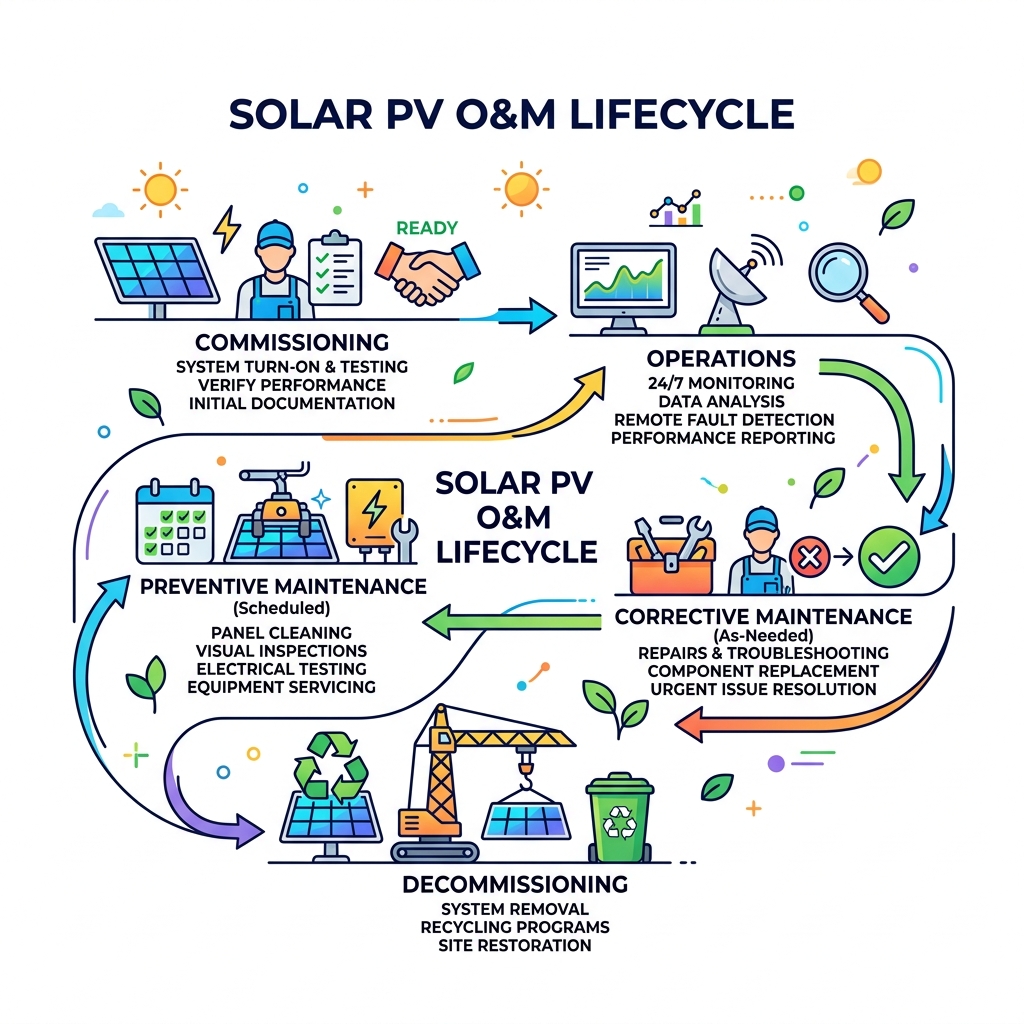
When we talk about solar operations and maintenance, we aren’t just talking about a guy with a ladder and a bucket of soapy water. Modern O&M is a sophisticated blend of data science, electrical engineering, and proactive site management. At its heart, it rests on four distinct pillars that ensure your system hits its 25-to-30-year lifespan.
1. Operations: The “Brain” of the System
Operations involve the continuous “eyes-on” management of the plant. This includes 24/7 remote monitoring, performance reporting, and energy forecasting. We use software to track real-time data, ensuring that if a string goes down at 10:00 AM, a technician is notified by 10:05 AM. This minimizes downtime and protects the financial returns modeled during the home solar panel installation guide phase.
2. Preventive Maintenance: The “Check-up”
This is the “health insurance” for your solar panels. It consists of scheduled activities designed to prevent failures before they happen. Think of it like changing the oil in your car. According to O&M in Solar — What Operations & Maintenance Includes, this involves:
- Electrical Inspections: Checking for loose connections or “snail trails” (micro-cracks in cells).
- Inverter Servicing: Cleaning filters and ensuring cooling fans are operational.
- Cleaning: Removing dust, pollen, and bird droppings that can cause “hot spots.”
3. Corrective Maintenance: The “Repair”
Even with the best planning, “stuff happens.” Corrective maintenance is the reactive work performed to fix a fault. This could range from replacing a faulty DC optimizer to repairing wiring damaged by rodents. The goal here is speed; every hour an inverter is offline is an hour of lost revenue.
4. Predictive Maintenance: The “Future”
This is where AI and data analytics come in. By analyzing historical performance data, we can predict when a component is likely to fail. For example, if an inverter’s internal temperature is rising steadily compared to its peers, we can schedule a repair before it actually breaks.
| Task | Preventive | Corrective |
|---|---|---|
| Tightening terminal lugs | X | |
| Replacing a blown fuse | X | |
| Thermal imaging of modules | X | |
| Managing vegetation/weeds | X | |
| Repairing storm damage | X |
Technical Requirements for PV and Energy Storage Systems
The technical complexity of solar operations and maintenance depends heavily on the hardware used. A system with a single central inverter has different needs than one using micro-inverters or DC optimizers.
Inverter Configurations and Their Impact
Inverters are the most common failure point in a solar system. Their topology dictates your long-term O&M strategy:
- String Inverters: These are easier to access but if one fails, the entire string goes dark. Operators often play “whack-a-mole” with failures in aging string inverter fleets.
- Micro-inverters: These offer module-level monitoring, making it easy to spot a single underperforming panel. However, since they are located on the roof, labor costs for replacement can be higher ($0.40/W estimated replacement cost).
- Central Inverters: Common in utility-scale plants, these require specialized HV (High Voltage) services and regular retorquing of conductor fasteners.
Advanced Diagnostic Tools
We don’t just guess what’s wrong anymore. Modern O&M utilizes:
- Thermal Imaging: Handheld or drone-mounted infrared cameras identify “hot spots” where cells are overheating due to internal damage.
- SCADA Systems: Supervisory Control and Data Acquisition systems provide the high-level data needed for grid-scale synchronization.
- I-V Curve Tracing: This measures the current-voltage relationship of a string to identify degradation that isn’t visible to the naked eye.
As noted in the New Best-Practices Guide for Photovoltaic System Operations and Maintenance, NREL, considering these technical requirements during the design phase is a prerequisite for an “A-grade” system. You cannot maintain your way out of a poor design.
Optimizing Solar Operations and Maintenance for Batteries
Adding storage adds a new layer of complexity. If you’ve looked into home battery storage for solar, you know that batteries are sensitive to temperature and cycling.
Key Battery O&M Best Practices:
- State-of-Charge (SoC) Management: Preventative lead-acid failure often stems from low SoC sulfation. Lithium-ion systems need careful balancing of cells.
- Parallel String Design: We recommend designing battery banks with parallel strings so that one string can be taken offline for maintenance without shutting down the entire system.
- Thermal Management: Checking HVAC or cooling systems for battery enclosures is critical. Heat is the number one enemy of battery longevity.
- Round-Trip Efficiency Tracking: By monitoring how much energy goes in versus how much comes out, we can detect early degradation in the chemistry.
Check out our guide on the best-home-batteries-for-energy-storage to understand which technologies require the least amount of hands-on maintenance.
Managing Environmental Factors in Solar Operations and Maintenance
The environment is constantly trying to “reclaim” your solar site. From snow in the north to hurricanes in the south, O&M must be site-specific.
- Soiling and Dust: Construction-site dust can cause a 5% energy loss. In dry climates, regular cleaning is mandatory.
- Snow Removal: Snow can reduce annual production by 3% on average, but in places like Truckee, California, that number jumps to 15%. Labor for snow removal can cost $50-$75 per hour.
- Vegetation Control: In high-rainfall areas, grass cutting can cost more than the electrical maintenance itself! Some sites use “biological mowers”—sheep grazing—to keep growth down without the risk of lawnmowers kicking up rocks and breaking modules. (Pro tip: Avoid goats; they like to climb and chew wires!)
- Hurricane Preparedness: Lessons from St. Croix in 2017 showed that through-bolting is superior to self-tapping screws, which can pull out under high wind loads.
- Heat Insulation: Extreme heat can degrade panels faster. Understanding the-ultimate-guide-to-solar-panel-heat-insulation can help you mitigate these environmental stressors.
For those living off the grid, check our off-grid solar panel tips for managing these factors without professional help.
Financial Modeling and Cost Estimation
Is solar operations and maintenance worth the cost? The data says yes. For a 10-megawatt project, O&M typically costs about $141,000 per year—just under 1% of the initial investment. For smaller residential systems, it might be closer to 2%.
The LCOE Factor
The goal of O&M is to lower the Levelized Cost of Energy (LCOE). By spending a little on preventive care, we avoid the massive costs of emergency repairs and extended downtime.
Inverter Replacement Reserves
We always advise budgeting for inverter replacement. Based on industry averages:
- String Inverters: $0.25/W (usually replaced twice in a 25-year cycle).
- Central Inverters: $0.14/W.
- Micro-Inverters: $0.40/W.
Proper financial modeling, as discussed in solar-panels-cost-and-savings, must include these “sinking funds” so you aren’t hit with a surprise five-figure bill in year 12.
Labor and Spares
Labor rates vary by region, but having a “spares management” plan can save thousands. Keeping a few spare inverters or modules on-site reduces “truck rolls” and shipping delays. The Solar System Operations and Maintenance Analysis by NREL emphasizes that standardized O&M makes costs predictable, which is exactly what investors and banks want to see.
Health, Safety, and Industry Standards
Working on solar systems is inherently dangerous. We are dealing with high-voltage DC electricity that cannot be “turned off” as long as the sun is shining.
Electrical Safety and PPE
Technicians must follow strict Arc Flash protection protocols. This includes:
- PPE: Fire-resistant clothing, insulated gloves, and face shields.
- Lockout/Tagout (LOTO): Ensuring systems are de-energized before work begins.
- Training: Only qualified personnel should handle inverter internals or HV transformers.
Cybersecurity: The New Frontier
As systems become more connected, they become targets. Cybersecurity in PV plants is now a major focus of NREL research. This involves securing the IT infrastructure used for remote monitoring to prevent unauthorized grid interference.
Decommissioning and the Circular Economy
O&M doesn’t end until the system is recycled. Currently, less than 10% of modules are recycled, but that is changing. A “circular economy” approach focuses on repairing modules rather than shredding them. If you’re interested in the “build” side of things, our guide on power-to-the-people-a-step-by-step-guide-to-building-a-solar-power-plant covers how to plan for the end-of-life stage from day one.
Frequently Asked Questions about Solar O&M
How does O&M improve the average performance ratio of a solar system?
Comprehensive O&M can boost a system’s Performance Ratio (PR) from roughly 91.7% to 95% or higher. This is achieved by reducing “masking” issues like inverter clipping, identifying failed strings through monitoring, and ensuring panels are clean enough to capture maximum irradiance. Over 25 years, that 3.3% difference can represent tens of thousands of dollars in extra energy.
What are the estimated replacement costs for different inverter types?
Inverters typically have a 10-to-15-year lifespan. Estimated 20-year replacement costs are:
- String Inverters: $0.25 per Watt.
- Central Inverters: $0.14 per Watt.
- Micro-Inverters: $0.40 per Watt. These costs include both the hardware and the labor required to perform the swap.
Why is O&M considered a prerequisite for solar project financing?
Investors prioritize risk mitigation over sheer ROI. A solar project without a documented O&M plan is considered a high-risk asset. Banks and investors want to see standardized practices (like those from SolarPower Europe or NREL) to ensure the system will actually produce the energy required to pay back the loan.
Conclusion
At Financefyx, we believe that solar operations and maintenance is the “secret sauce” of a successful renewable energy strategy. It is the difference between an asset that produces clean energy for decades and a “stranded asset” that becomes a liability.
By focusing on asset value protection, long-term reliability, and performance optimization, you ensure that your solar investment remains a savings engine for its entire life. Whether you are managing a small rooftop array or a utility-scale plant, the principles remain the same: monitor closely, maintain proactively, and always put safety first.
Explore more renewable energy resources to keep your system shining bright!
