
The Best Rates for Professional Thermostat Installation
What Does Professional Thermostat Installation Actually Cost?
A thermostat installation cost guide is exactly what you need before calling an HVAC technician — because prices vary more than most homeowners expect.
Here’s a quick snapshot of what you’ll pay in 2026:
| Installation Type | Total Cost Range |
|---|---|
| Manual thermostat (DIY) | $30 – $110 |
| Manual thermostat (professional) | $120 – $190 |
| Programmable thermostat (professional) | $160 – $340 |
| Smart/Wi-Fi thermostat (professional) | $200 – $650 |
| Multi-zone system (full install) | $2,000 – $12,500 |
The national average for professional thermostat installation is $184, with most homeowners paying between $114 and $264. The full possible range runs from $67 on the low end to $500 or more for complex smart thermostat setups.
Labor alone typically runs $50 to $150 per hour, and most installations take one to three hours. That means labor can easily match or exceed the cost of the thermostat itself.
What pushes costs higher? A few common culprits:
- No C-wire in your home (adds $90–$140)
- Moving the thermostat to a new wall location (adds $65–$450)
- Permit requirements for major HVAC upgrades ($25–$100)
- Multi-zone systems or older wiring
The good news: smart thermostats can cut your heating and cooling bills by 8% to 15% annually — often $50 to $250 in savings each year. For many homeowners facing high winter energy bills, that payback period is surprisingly short.
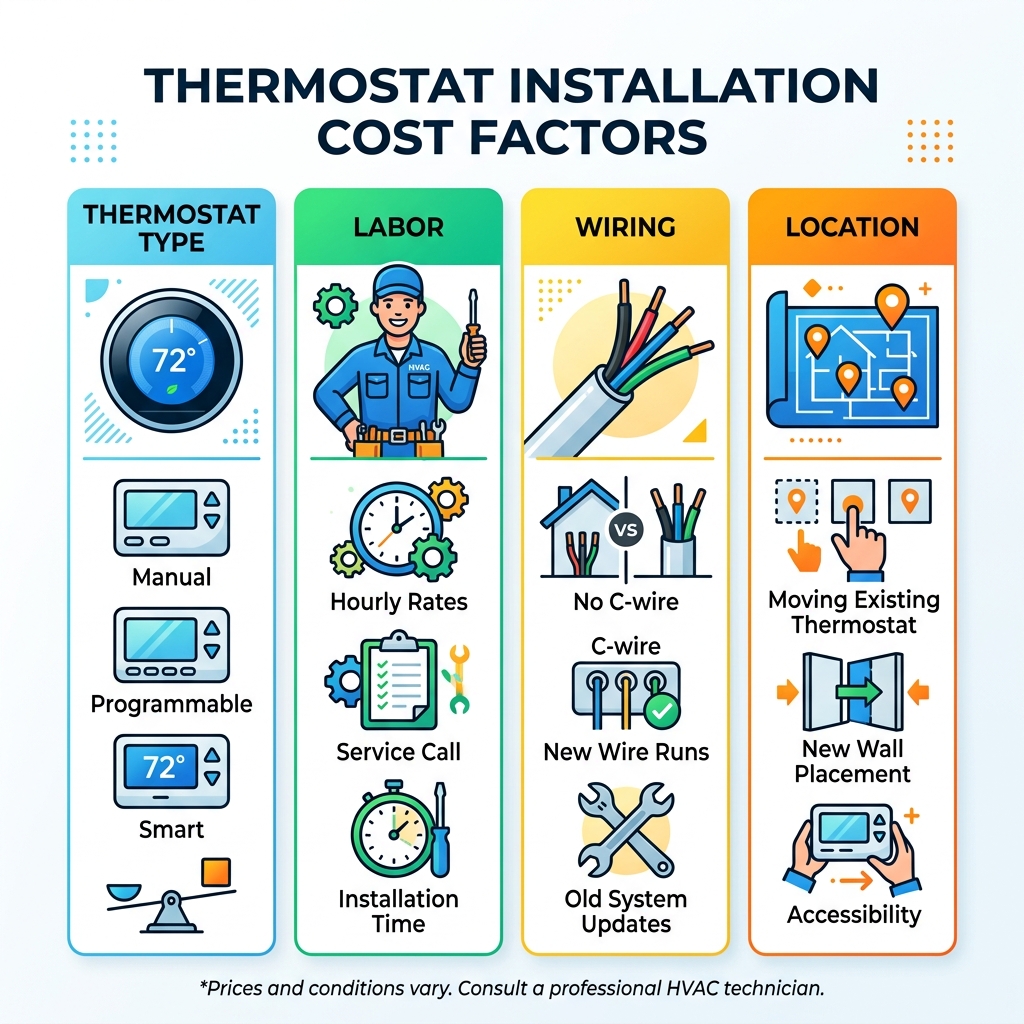
Average Thermostat Installation Cost Guide for 2026
As we navigate through 2026, the cost of maintaining a comfortable home environment continues to evolve with technology. While the $184 national average is a solid benchmark, we find that the “real world” price tag is rarely a single number. Instead, it’s a sliding scale based on what you’re installing and where you live.
For a basic replacement where the wiring is already in place and the new unit is compatible, you might get away with a bill as low as $67 to $150. However, if you are upgrading from a 1990s “dumb” thermostat to a top-tier learning model, the total project cost—including the device and professional labor—often lands between $250 and $500.
Geographic Location: Urban vs. Rural Rates
Location plays a massive role in any thermostat installation cost guide. If you are living in a major metro area like New York City or Chicago, expect to pay at the higher end of the labor spectrum ($100 to $150 per hour). In contrast, rural areas or smaller towns in the Midwest or South often see rates closer to $65 to $85 per hour.
For example, data shows that a professional install in Seattle might average $445, while the same job in a smaller town like Dothan, Alabama, might only set you back $350. We always recommend getting at least three local quotes to ensure you aren’t overpaying for your specific zip code.
Cost Breakdown by Thermostat Type
The type of “gizmo” you choose is the biggest variable in your budget. Let’s look at the options available in 2026:
- Manual Units ($15 to $80): These are the old-school dial or basic digital sliders. They are cheap to buy and fast to install, but they offer zero energy savings because they require you to remember to turn them down every time you leave the house.
- Programmable Thermostats ($20 to $150): This is the sweet spot for many budget-conscious homeowners. By using programmable thermostats your definitive guide to home energy efficiency, you can set a schedule that automatically lowers the heat while you’re at work. These units typically cost between $50 and $150 for the device itself.
- Smart Wi-Fi Models ($85 to $640): These are the heavy hitters like the Google Nest or Ecobee Premium. They offer remote access via your phone, energy reports, and integration with Alexa or Google Home. While the units start around $85 for basic versions, high-end models with built-in speakers and air quality sensors can reach $300 to $400 for the hardware alone.
- Learning Algorithms: Some high-end smart thermostats “learn” your schedule without you having to program them. These are generally the most expensive but offer the highest ROI over time.
Line Voltage vs. Low Voltage
It is critical to know your system’s voltage before buying. Most modern central HVAC systems use low voltage (24V). However, if you have electric baseboard heaters, you likely have a line voltage (120V or 240V) system. Smart thermostats for line voltage systems are rarer and often more expensive to install because they involve handling high-voltage wires that carry a significant risk of fire or shock if mishandled.
Professional Labor Rates and Timeframes
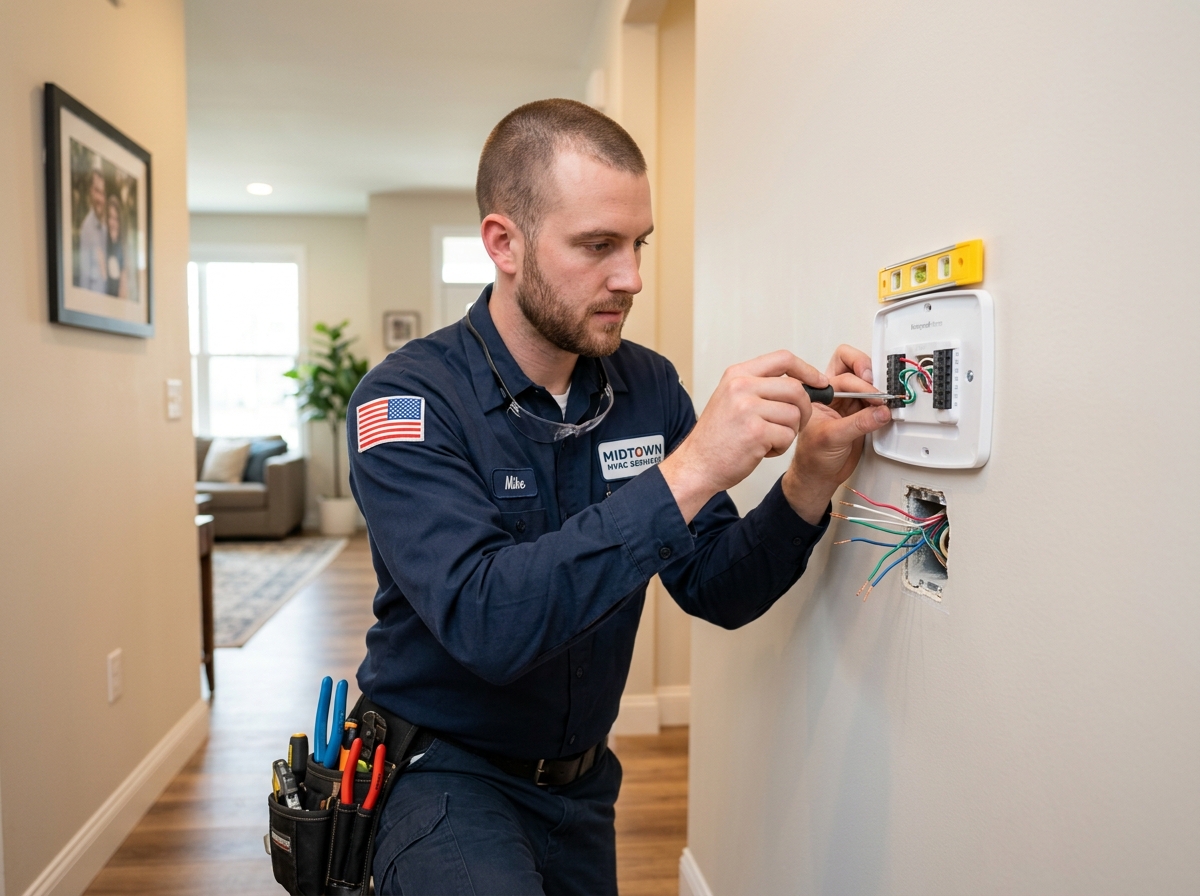
When you hire a professional, you aren’t just paying for them to turn a screwdriver; you’re paying for their expertise in HVAC circuitry.
- Hourly Rates: Most HVAC technicians and master electricians charge between $50 and $150 per hour.
- Flat Fee Options: Many companies offer a flat installation fee ranging from $75 to $250 for a standard swap. This is often preferred because it removes the guesswork from your bill.
- Installation Time: A straightforward replacement usually takes 1 to 2 hours. If the technician has to run a new C-wire or repair the drywall from a previous oversized unit, expect it to take closer to 3 hours.
Pro Tip: Avoid booking your installation during the “First Freeze” or the “First Heatwave” of the year. Seasonal demand skyrockets during these times, and you may face higher emergency labor rates or long wait times.
Key Factors Influencing Your Installation Expenses
Beyond the unit and the hourly rate, several “hidden” factors can inflate your thermostat installation cost guide budget.
C-Wire Requirements
Most modern smart thermostats require a “Common Wire” (C-wire) to provide continuous power for the Wi-Fi and backlit display. If your old thermostat only had two wires, you’ll need a C-wire adapter or a completely new wire run.
- Adapter Cost: $25 – $50 for the part.
- Labor to Install: $90 – $140.
Thermostat Relocation
If your current thermostat is in a drafty hallway or directly under a sun-drenched window, it’s giving your HVAC system bad data. Moving it to a more central, “neutral” location is a great idea for efficiency, but it’s pricey.
- Relocation Cost: $65 – $450. This involves fishing new wires through walls and potentially repairing the drywall at the old site.
System Compatibility
Before you buy, check out our smart thermostat reviews 2026 a comprehensive guide to ensure your chosen model works with your specific HVAC system. High-end heat pumps or multi-stage systems require specific thermostats; using the wrong one could actually damage your expensive furnace or AC unit.
Permit Fees
While a simple swap rarely requires a permit, some local jurisdictions require one if you are making significant electrical changes or upgrading a multi-zone HVAC system. These fees typically range from $25 to $100.
Multi-Zone Systems and Home Size Impact
If you live in a large home with separate upstairs and downstairs temperature controls, your costs will scale up. A single-zone home is simple, but a multi-zone system requires a zone controller and multiple thermostats.
- Full Multi-Zone Systems: Can range from $2,000 to $12,500 depending on the complexity of the dampers and control boards.
- Remote Sensors: Instead of a full zone system, many people opt for smart thermostats with remote sensors ($40–$100 each). These help the thermostat understand the temperature in a nursery or home office rather than just the hallway.
For more on managing these complex setups, refer to programmable thermostats your definitive guide to home energy efficiency 2.
DIY vs. Professional Thermostat Installation Cost Guide
The “Do It Yourself” route is tempting. You can buy a unit at a big-box store and follow a YouTube video, but is it worth the risk?
The DIY Approach ($30 to $450)
If you are doing a “like-for-like” replacement (e.g., replacing an old Honeywell with a newer Honeywell using the exact same wires), DIY is usually straightforward.
- Pros: Saves $100–$250 in labor.
- Cons: Risk of blowing a fuse in your furnace control board (a $300 repair), electrical shock, or improper calibration leading to high energy bills.
The Professional Approach ($120 to $650)
Hiring a pro gives you more than just a working device; it gives you a warranty on the labor.
- Pros: Guaranteed compatibility, proper C-wire installation, and system testing.
- Cons: Higher upfront cost.
When to Hire a Professional HVAC Technician
We strongly recommend a professional for the following scenarios:
- Heat Pump Systems: These have complex “O” and “B” wiring that is easy to mix up.
- Mercury Disposal: If your old thermostat has a glass bulb with silver liquid, it contains mercury. A professional knows how to dispose of this hazardous material safely according to EPA guidelines.
- No C-Wire: If you have to go into the furnace’s control board to add power, leave it to the experts.
- Multi-Zone Systems: Coordinating dampers and multiple units is not a beginner project.
Maximizing ROI with Smart Thermostat Energy Savings
Is a $300 smart thermostat actually a good investment? According to the Department of Energy and various utility studies, the answer is a resounding yes.
- Annual Savings: Most homeowners see an 8% to 15% reduction in heating and cooling costs.
- Dollar Value: This equates to roughly $50 to $250 per year in savings. In many cases, the thermostat pays for itself in less than two years.
- Geofencing: This feature uses your phone’s GPS to know when you’ve left the house, automatically shifting the system into “Eco Mode.”
- Utility Rebates: Many energy companies offer incentives to install smart thermostats. Check the smart thermostat reviews for energy saving to see which models qualify for local $50 to $100 rebates.
Troubleshooting and Replacement: A Thermostat Installation Cost Guide
Nothing is more frustrating than a thermostat that refuses to turn on when the temperature is dropping. But when do you fix it, and when do you toss it?
The Lifespan of a Thermostat
A typical thermostat lasts 10 to 20 years. If yours is older than 15 years, it’s likely using outdated technology that is costing you money every month in wasted energy.
The 50% Rule
We use the “50% Rule” for repairs: If the cost to fix your old thermostat (calibration or wiring repair) is more than half the price of a brand-new unit, just replace it.
- Calibration Fix: $50 – $100.
- Wiring Fixes: $75 – $150.
- New Unit: $120+ (installed).
Signs Your Thermostat is Failing:
- The “Ghost” Heater: The HVAC kicks on when the house is already at the target temperature.
- Unresponsive Screen: A blank display often means a dead battery, but it could also signal a blown transformer.
- Short Cycling: The furnace turns on and off every few minutes without actually reaching the set temperature.
Frequently Asked Questions about Thermostat Installation
How many thermostats does a typical home need?
Most standard homes only need one thermostat. However, if your home has a multi-zone HVAC system (with separate ductwork for different floors), you will need one thermostat for each zone. Larger homes (3,000+ sq. ft.) often benefit from a multi-zone setup to prevent the upstairs from becoming a sauna while the downstairs stays a fridge.
Are smart thermostats worth the higher upfront cost?
Yes, primarily because of the automation. Most of us forget to turn down the heat before leaving for work or going to bed. A smart thermostat remembers for you. When you factor in the $50–$250 annual savings and potential utility rebates, they are one of the highest-ROI home upgrades you can make.
How long does a professional thermostat installation take?
For a standard replacement, a pro will be in and out in 30 to 60 minutes. If they need to run new wiring or install a C-wire adapter, it can take 2 to 3 hours.
Conclusion
Upgrading your home’s climate control is one of the smartest financial moves you can make in 2026. While the initial thermostat installation cost guide might seem daunting, the long-term benefits of comfort and energy efficiency far outweigh the upfront labor fees. Whether you choose a simple programmable model or a high-tech learning device, getting professional quotes ensures the job is done safely and correctly.
By integrating these smart devices into your home, you aren’t just changing a wall plate; you’re taking control of your home’s energy future. For more tips on modernizing your living space, check out our More info about smart devices. We are here to help you navigate home finance and efficiency, one “gizmo” at a time!
