
The Hot List of Fabrics That Keep You Cool and Reflect Solar Heat
Why Breathable Solar Insulation Fabric Is the Smarter Way to Stay Comfortable Year-Round
Breathable solar insulation fabric is a textile that blocks solar heat and UV rays while still allowing moisture vapor to escape — keeping you cool in summer and warm in winter without trapping sweat.
Here are the top options worth knowing about:
| Fabric | Key Benefit | Best For |
|---|---|---|
| SolarJersey™ | UPF50, 4-way stretch | Sun-protective apparel |
| Temptrol™ | 95% reflectivity, 6.29 Perms | Cold-weather clothing, curtain liners |
| ES® Reflective Fabric | 92% reflectivity, perforated | Air ducts, tents, solar screens |
| Solarcore® | NASA aerogel insulation | Winter performance wear |
| HDPE Shade Sail (320 gsm) | >89% UV protection, breathable | Patios, outdoor shading |
If you’ve ever sat near a window in winter and felt that cold radiating through, you already understand the problem these fabrics solve. Traditional insulation traps heat — but it also traps moisture, adds bulk, and often fails the moment you need to move or breathe.
Breathable solar insulation fabrics are different. They use reflective coatings, porous structures, and advanced materials to bounce heat away or hold it in, depending on what you need — all while letting water vapor pass through freely.
The science here is real. Metallized fabrics like Temptrol™ reflect up to 95% of radiant heat (tested to ASTM C1371-04a). Hierarchical porous research fabrics have shown sunlight reflectance of over 91% with a measured temperature drop of around 14°C under direct sunlight. And aerogel-based materials like Solarcore® — derived from NASA spacecraft insulation technology — can maintain warmth down to -50°C.
Whether you’re a homeowner looking to cut heating bills or just trying to stay comfortable outdoors, this guide breaks down exactly which fabrics perform, what the numbers mean, and what to buy.
Key breathable solar insulation fabric vocabulary:
What is Breathable Solar Insulation Fabric?
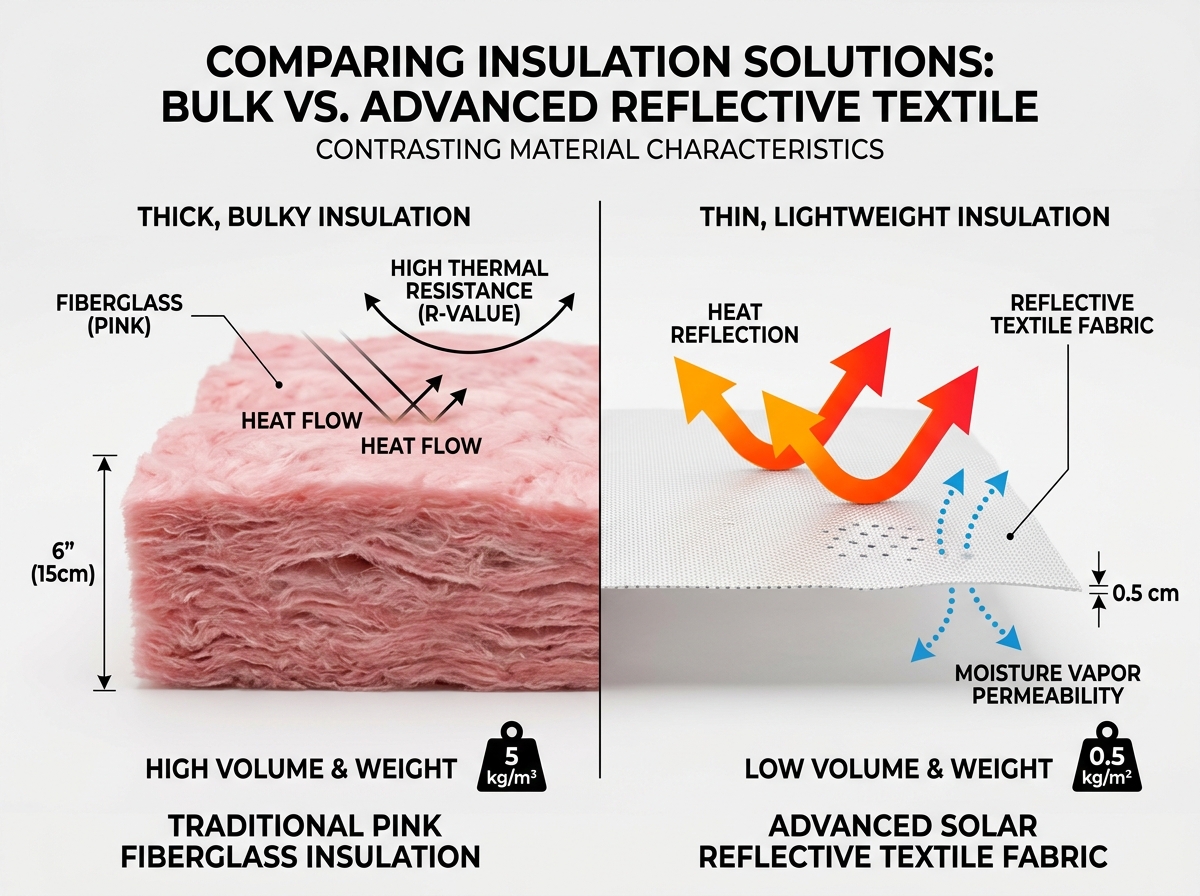
To understand breathable solar insulation fabric, we first have to look at how heat moves. Traditional insulation, like the pink fiberglass in your attic, works by slowing down “conduction” and “convection”—basically, it creates a thick barrier that heat struggles to crawl through. But in solar energy, the biggest enemy is “radiant heat.”
Radiant heat is what you feel when the sun hits your skin or a dark car dashboard. Most traditional fabrics absorb this heat, getting hotter and hotter until they eventually pass that warmth onto you. Breathable solar insulation fabric uses a radiant barrier—often a microscopic layer of metal or specialized polymers—to bounce that energy away before it ever gets absorbed.
However, there’s a catch. If you just wrap yourself in aluminum foil, you’ll stay warm, but you’ll also get incredibly sweaty. This is where “breathability” or “moisture vapor transmission” comes in. These advanced textiles are engineered with microscopic pores or perforations. They are large enough to let sweat molecules (vapor) escape but structured in a way that doesn’t compromise the fabric’s ability to reflect solar rays.
When evaluating these fabrics, we look at a few key metrics:
- Reflectivity: How much solar or infrared energy bounces off (usually 90-95%).
- Permeability (Perms): A measure of how much water vapor can pass through. For example, Temptrol™ sits at 6.29 Perms, making it significantly more breathable than standard plastic barriers.
- Thermal Resistance: While these are thin, they offer high thermal management by regulating the “microclimate” next to your body or inside a structure.
If you are looking for ways to improve your home’s thermal performance, learning how to master solar panel insulation without getting burned is a great place to start understanding these concepts in a practical setting.
Top Technologies in Breathable Solar Insulation Fabric
The “magic” of these fabrics isn’t magic at all—it’s high-level engineering. Several proprietary technologies lead the market today, each with a unique approach to managing heat.
Solarcore®: The Aerogel Revolution
One of the most exciting innovations is Solarcore® – J.LINDEBERG. This material utilizes aerogel, a substance originally developed by NASA to insulate spacecraft and Mars rovers. Aerogel is the world’s lightest solid and an incredible thermal insulator because it is composed of over 90% air. By infusing this into a flexible fabric, Solarcore® provides extreme warmth without the bulk of traditional down or synthetic fills. It’s thin, flexible, and—most importantly—breathable enough for high-intensity sports like skiing or golf.
Temptrol™ and ES® Reflective Fabric
If your goal is maximum heat reflection, metallized cloths are the gold standard.
- Temptrol™ is a lightweight metallized cloth that provides up to 95% reflectivity. It’s unique because it’s sewable and flexible, meaning it won’t crack or peel like cheap emergency blankets.
- ES® Reflective Fabric is an evolution of this tech, designed with specific perforations to prevent condensation. This makes it ideal for applications like air ducts or tents where moisture buildup is a major concern.
Comparison of Leading Solar Insulation Fabrics
| Technology | Reflectivity % | Permeability (Perms) | Weight (oz/sq yd) |
|---|---|---|---|
| Temptrol™ | 95% | 6.29 | ~0.47 |
| ES® Reflective | 92% | 0.026 | 2.7 |
| SolarJersey™ | N/A (UPF 50) | High (Cotton Blend) | 7.2 |
| Solarcore® | High Thermal | Breathable | Ultra-Light |
Engineering breathable solar insulation fabric with Nanofibers
Beyond coatings, some fabrics use the structure of the fibers themselves to manage heat. AirCore™ Fabric | Polartec® is a prime example. Using a process called “electrospinning,” they create a membrane of nanofibers that are 100 times thinner than a human hair. This creates a hydrophobic (water-repelling) barrier that is “air permeable.” Unlike traditional waterproof jackets that feel like wearing a plastic bag, this technology allows for active airflow (measured in CFM), meaning the fabric “breathes” with you as you move.
Real-World Applications and Performance Metrics
Where do we actually use breathable solar insulation fabric? It turns out, everywhere from your backyard to outer space.
Outdoor Shading and Architecture
If you’ve ever stood under a cheap plastic tarp in the sun, you know it feels like an oven. High-quality shade sails, like those made from 320 gsm HDPE (High-Density Polyethylene), are designed to be micro-perforated. This allows hot air to rise and escape through the fabric while blocking over 89% of UV rays. This “chimney effect” can make the area under the sail significantly cooler than the ambient temperature. For more on how these principles apply to larger systems, check out the ultimate guide to solar panel heat insulation.
Emergency and Rescue Gear
The “rescue blanket of the future” is evolving. Innovations like Dyneema solar fabrics combine the world’s strongest fiber with solar-absorbing properties. These materials can be used in disaster relief to provide lightweight, tear-resistant shelters that not only insulate survivors but can even be engineered to store solar energy to power small devices or lights.
Performance Apparel
For those who enjoy the outdoors, fabrics like SolarJersey™ offer a blend of 94% cotton and 6% spandex. While it looks like a normal T-shirt, it is tested to AATCC 183-2004 standards to provide a UPF50 rating. This means it blocks 98% of UV radiation while the cotton content wicks moisture away from the skin. For colder climates, the Solarcore Mid Layer uses its aerogel-infused back panels to keep your core warm during a round of golf or a day on the slopes without restricting your swing or movement.
The Future of Thermal Management: Dual-Mode and Sustainability
The next frontier of breathable solar insulation fabric is “dual-mode” management. Scientists are currently developing hierarchical porous dual-mode thermal management fabrics that can actually switch between cooling and heating.
By using different coatings on each side—such as a porous cooling side and an MXene-coated heating side—a user could simply flip their jacket inside out to adjust to changing weather. In cooling mode, these fabrics have demonstrated a sunlight reflectance of 91.42% and can drop the temperature by up to 14°C.
Sustainability and the Environment
We are also seeing a massive shift toward eco-friendly production. Modern solar fabrics are increasingly moving toward:
- Recycled Fibers: Many brands now target 100% recycled man-made fibers to reduce waste.
- Non-PFAS Materials: Moving away from “forever chemicals” while maintaining water and stain resistance.
- Microfiber Reduction: Technologies like Power Air™ | Polartec® encapsulate insulating fibers in a smooth shell, which reduces microfiber shedding into our oceans by up to 80% during laundering.
By choosing these fabrics, you aren’t just staying comfortable; you’re often contributing to energy-saving methods for home insulation and reducing the overall carbon footprint of your wardrobe or home.
Frequently Asked Questions about breathable solar insulation fabric
How does breathable solar insulation fabric differ from standard radiant barriers?
Standard radiant barriers (like the shiny foil used in attics) are usually non-porous. While they are great at reflecting heat, they trap moisture, which leads to mold and rot in buildings or discomfort in clothing. Breathable solar insulation fabric is specifically engineered with perforations or microscopic gaps that allow vapor to escape (measured in Perms) while still maintaining high reflectivity and sewability.
Can these fabrics be used for home energy efficiency?
Absolutely. Beyond clothing, fabrics like Temptrol™ and ES® Reflective are frequently used as:
- Curtain Liners: To bounce summer sun back out the window.
- Attic Insulation: As a breathable radiant barrier. For more tips, see our attic insulation tips to save energy and money.
- Air Duct Covers: To prevent heat loss or gain in HVAC systems.
- Solar Screens: For patios and windows to reduce air conditioning loads.
What are the typical costs and durability expectations?
Prices vary based on technology. Simple HDPE shade fabric or SolarJersey™ might cost between $15 and $30 per yard. Advanced NASA-derived materials like Solarcore® are typically found in premium finished garments ranging from $100 to $500. These fabrics are designed for durability, featuring high tensile strength (often 40+ lbs of force) and UV inhibitors that prevent the material from becoming brittle in the sun. Most are machine washable, though they often require gentle cycles and air drying to maintain their reflective coatings.
Conclusion
At Financefyx, we believe that the future of comfort lies in smart materials that work with the environment, not against it. Breathable solar insulation fabric represents a massive leap forward in how we manage our personal and home climates. By reflecting up to 95% of solar heat while allowing our bodies and buildings to “breathe,” these textiles offer a sustainable path to staying cool and saving money.
Whether you are upgrading your outdoor gear or looking for innovative home insulation choices, these high-tech fabrics are the key to a more energy-efficient lifestyle.
Ready to dive deeper into green energy? Explore more renewable energy solutions and see how the latest tech can transform your home.
