
Understanding Insulation R-Value Comparison Charts
Why an R-Value Insulation Comparison Chart Is the Starting Point for Every Energy Upgrade
An r value insulation comparison chart gives you a fast, side-by-side look at how well different insulation materials resist heat flow — so you can pick the right one for your home, budget, and climate.
Here is a quick-reference chart of the most common insulation materials:
| Insulation Type | R-Value per Inch | Approx. Cost per Sq Ft per R | Best For |
|---|---|---|---|
| Closed-Cell Spray Foam | R-6.0 to R-7.0 | $0.80 | Basements, crawl spaces, rim joists |
| Polyisocyanurate (Polyiso) | R-5.6 to R-6.5 | $0.22 | Exterior sheathing, roofing |
| Extruded Polystyrene (XPS) | R-5.0 | $0.18 | Below-grade, foundation walls |
| Open-Cell Spray Foam | R-3.5 to R-3.7 | $0.40 | Interior walls, cathedral ceilings |
| Mineral Wool Batt | R-3.2 to R-4.0 | $0.15 | Fire-rated walls, exterior walls |
| Fiberglass Batt | R-3.0 to R-3.8 | $0.12 | Standard wall cavities, attics |
| Blown-In Cellulose | R-3.5 to R-3.7 | $0.07 | Attic floors, wall retrofits |
| Blown-In Fiberglass | R-2.2 to R-2.8 | $0.08 | Attics with unlimited depth |
| Expanded Polystyrene (EPS) | R-3.9 | $0.12 | Foundations, continuous insulation |
Source: InsulationRValues.com and manufacturer data
If your heating bills keep climbing and your home never quite feels warm enough, insulation is almost always part of the problem. But not all insulation is equal — and choosing the wrong type or thickness can mean spending money without fixing the real issue.
R-value is the single number that tells you how well an insulation material slows heat flow. Higher means better. A material rated R-6 per inch does roughly twice the work of one rated R-3 per inch, in the same amount of space.
The tricky part? The number on the package is only the starting point. Real-world performance depends on installation quality, air leakage, temperature, and where in your home the insulation goes.
This guide walks you through everything the comparison chart shows — and everything it doesn’t.
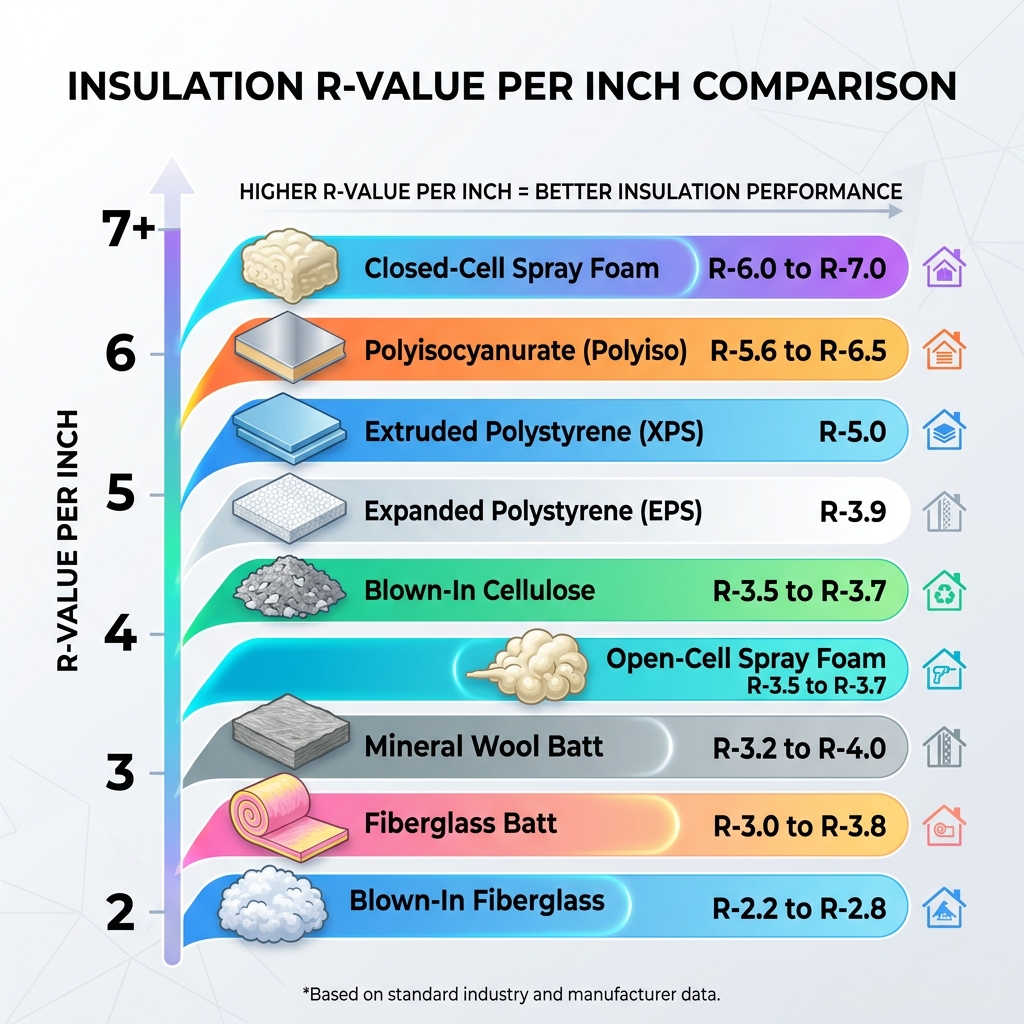
R value insulation comparison chart terms explained:
What is R-Value and Why Does It Matter?
At its simplest, R-value measures thermal resistance. In the scientific world, we define it based on the British Thermal Unit (BTU). One R-value unit is equal to one square foot of material with a one-degree Fahrenheit temperature difference across it per hour of heat transfer. If that sounds like a mouthful, just remember: it is a measure of how hard it is for heat to “push” its way through a material.
When we talk about insulation thermal conductivity comparison for beginners, we are looking at how heat moves via conduction. In the winter, heat wants to escape your warm living room for the cold outdoors. In the summer, the blistering sun wants to push heat into your air-conditioned sanctuary. Insulation acts as the gatekeeper.
However, there is a catch. R-values are typically tested in a laboratory at a mean temperature of 75°F. While this provides a standardized baseline, your attic doesn’t stay at 75°F. In the real world, factors like air leakage can drastically reduce the effective performance of your insulation. For example, the Department of Energy (DOE) estimates that air sealing alone can save you 15–25% on heating and cooling costs, regardless of the R-value of the material sitting on top of those leaks.
The Ultimate R-Value Insulation Comparison Chart
When you look at an r value insulation comparison chart, you’ll notice that materials are often grouped by how they are installed: batts, blown-in, spray foam, or rigid board. Each has a specific “R-per-inch” rating.
| Material | R-Value per Inch | Moisture Resistance | Fire Rating |
|---|---|---|---|
| Fiberglass Batts | 3.0 – 3.8 | Low (holds water) | Non-combustible |
| Blown Cellulose | 3.5 – 3.7 | Moderate | Treated (Fire-retardant) |
| Mineral Wool | 3.2 – 4.0 | High (hydrophobic) | Excellent (1,200°F+) |
| Closed-Cell Foam | 6.0 – 7.0 | High (vapor barrier) | Requires thermal barrier |
| Polyiso Board | 5.6 – 6.5 | High | Requires thermal barrier |
| XPS (Rigid) | 5.0 | High | Requires thermal barrier |
As we can see in this comprehensive thermal insulation comparison, the choice isn’t just about the highest number. For instance, while fiberglass is the most common and affordable, mineral wool is virtually impervious to flame and contains 70-90% recycled content compared to the 20-30% found in fiberglass. For more detailed breakdowns, you can reference the Insulation R-Value Chart: Complete Guide to Every Material (2026).
Highest R-Value Insulation Comparison Chart Materials
If you are working with very limited space—like a thin wall or a specialized architectural feature—you might need the “heavy hitters” of the insulation world. These materials offer the highest thermal resistance in the thinnest profiles:
- Vacuum Insulated Panels (VIP): These are the kings of the chart, offering a staggering R-25 to R-50 per inch. They are mostly used in specialized industrial applications or ultra-high-performance “net-zero” homes because they are expensive and cannot be cut to fit on-site.
- Silica Aerosol: Often called “frozen smoke,” this material delivers about R-10.3 per inch. You’ll usually find it in aerogel blankets, which cost about $3.00 per square foot per R-point.
- Closed-Cell Spray Foam: The most practical “high-R” material for homeowners, topping out at R-7.0 per inch. It also adds structural strength; spray foaming the underside of a roof can increase wind uplift resistance by 250%.
- Phenolic Rigid Panels: These offer about R-4.5 to R-5.0 per inch and are known for excellent fire performance.
Interpreting an R-Value Insulation Comparison Chart by Climate Zone
You shouldn’t just guess how much insulation you need. The 2021 International Energy Conservation Code (IECC) provides specific minimum requirements based on where you live. The U.S. is divided into eight climate zones:
- Zones 1-2 (Hot/Humid – Miami, Houston): You need less resistance to cold but more protection from radiant heat. Attics usually require R-30 to R-38.
- Zone 3 (Mixed – Atlanta, Dallas): Attic requirements jump to R-38.
- Zones 4-8 (Cold – Chicago, Minneapolis, Duluth): These regions demand the most protection. The IECC recommends R-49 to R-60 for attics and at least R-13 to R-25 for wood-framed walls.
To dive deeper into these requirements, check out the ultimate guide to insulating your home or our specific guide on insulating your home for energy efficiency.
Factors That Impact Effective R-Value
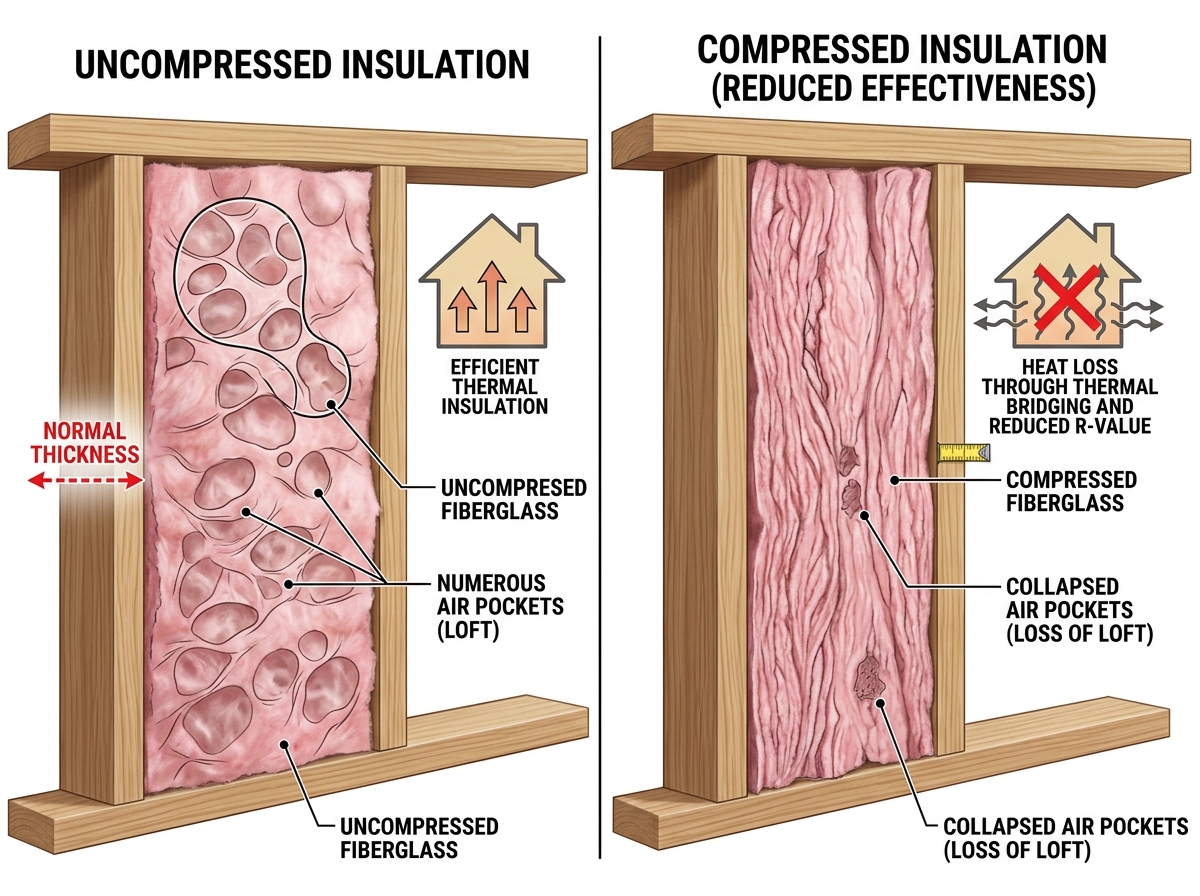
A common mistake homeowners make is thinking that more is always better, even if they have to squeeze it in. This is a myth. Insulation works by trapping tiny pockets of air. When you compress it, you squeeze those pockets out.
Compression Effects If you take an R-19 fiberglass batt (designed for a 5.5-inch 2×6 wall) and shove it into a 3.5-inch 2×4 wall, you don’t get R-19. You actually end up with about R-13. You’ve paid for R-19 but received R-13 performance—a 40% reduction in efficiency! Always match the thickness to the cavity depth.
Thermal Bridging Your wall isn’t just insulation; it’s also wood studs. Wood conducts heat 3–4 times faster than the insulation between it. In a standard wall, about 25% of the surface area is actually lumber. This “thermal bridge” allows heat to bypass your expensive insulation. Adding just R-5 of exterior rigid foam (continuous insulation) can bump your whole-wall R-value by 27% by breaking that bridge.
Temperature Sensitivity Some materials are “fair-weather friends.” Polyisocyanurate (Polyiso) is a great example. It is rated at R-6.0 or higher at 75°F. However, when the temperature drops below 25°F, its R-value can plummet to R-3.5. In cold climates, it’s often best to pair Polyiso with another material like XPS to maintain performance. You can read more about these quirks in Comparing the Properties of Insulation Materials.
For those looking to fix drafty walls specifically, we recommend looking at these exterior wall insulation choices.
Cost vs. Performance: Choosing the Right Material
When we look at the Return on Investment (ROI), the “best” insulation is usually the one that hits the sweet spot between material cost and energy savings.
- Blown-In Cellulose: At roughly $0.07 per square foot per R-point, this is often the most cost-effective attic upgrade. It fills gaps better than batts and can even provide a two-hour firewall if installed correctly.
- Fiberglass Batts: These are the DIY favorite. They are inexpensive and easy to handle, though they require precise cutting to avoid gaps.
- Spray Foam: While it can cost six times what fiberglass does, its ability to air seal and insulate in one step often makes it worth the price for “critical” areas like rim joists or cathedral ceilings.
The Law of Diminishing Returns There is a limit to how much insulation makes financial sense. After about R-38 in an attic, the return on your investment begins to slow down. While going to R-60 is great for comfort and the environment, the “payback” in energy savings takes longer. However, upgrading from a measly R-19 to R-49 in a 1,500 sq ft attic can save you $200–$400 per year, paying for itself in just 2 to 5 years.
Don’t forget the “low-hanging fruit.” Attic caps—insulated covers for your attic stairs—cost under $150 but can reduce heating/cooling loss by 20% annually. On a $3,000 annual heating bill, that’s a $600 saving, meaning the cap pays for itself in three months!
For more tips on maximizing your budget, see our attic insulation tips and energy saving methods. If you’re overwhelmed, we have a guide on hiring an insulation company to help you navigate the professional route.
Frequently Asked Questions about Insulation R-Values
Can I add new insulation on top of old layers?
Yes! R-values are additive. If you have 4 inches of old fiberglass (roughly R-12) and you add R-38 of blown-in cellulose on top, you now have a total of R-50.
The most important rule is to never sandwich insulation between two vapor barriers. If your existing batts have a paper or foil facing (the “kraft face”), ensure the new insulation you add on top is “unfaced.” Trapping moisture between two layers of plastic or paper is a recipe for mold. For older homes, check out our guide to modern insulation for old houses and our attic insulation roadmap.
How does compression affect the R-value of fiberglass?
As mentioned earlier, density matters. Standard fiberglass is about R-3.1 per inch, while “high-density” batts can reach R-4.3 per inch. If you compress a standard R-19 batt into a 3.5-inch cavity, you lose about 40% of its rated value. If you need more power in a small space, buy a high-density batt specifically rated for that depth (like an R-15 batt for a 2×4 wall). You can master these nuances in the ultimate DIY guide to batt insulation.
Which insulation is best for wet areas like basements?
Fiberglass and cellulose are poor choices for damp basements because they can soak up water like a sponge, leading to mold and sagging. For “wet zones,” you want materials that are moisture-resistant:
- Closed-Cell Spray Foam: Acts as its own vapor barrier and won’t degrade if it gets damp.
- Rigid Foam Board (XPS or EPS): These are excellent for foundation walls.
- Mineral Wool: It is naturally hydrophobic (it repels water) and won’t rot.
For more on this, read about the best insulation for wet zones and our crawl space DIY roadmap.
Conclusion
At Financefyx, we believe that understanding your home’s “envelope” is the first step toward financial and physical comfort. Using an r value insulation comparison chart allows you to make an informed decision that balances upfront costs with long-term energy savings.
Whether you are blowing cellulose into an old attic or spray-foaming a new addition, R-value is only half the battle—air sealing and proper installation are what truly make those numbers work for you. By hitting the recommended R-values for your climate zone, you can slash your utility bills and enjoy a home that stays cozy regardless of what the weather is doing outside.
Ready to save more? Explore our full library of Energy Saving Tips to keep your home—and your wallet—in top shape.
