
20 Creative and Cheap Basement Remodeling Ideas
Your Basement Is Costing You More Than You Think
Basement remodeling ideas on a budget are exactly what millions of homeowners need right now — especially if you’re already dealing with high heating bills and cold drafts creeping up from below.
Here’s a quick look at the most cost-effective ways to transform your basement:
| Idea | Estimated Cost | DIY Friendly? |
|---|---|---|
| Paint concrete floors and walls | $100–$200 | Yes |
| Luxury Vinyl Plank (LVP) flooring | $2–$4 per sq ft | Yes |
| Carpet tiles (324 sq ft) | Under $700 | Yes |
| Rigid foam board insulation | ~$150 | Yes |
| Painted exposed ceiling (industrial look) | $300–$500 | Yes |
| Recessed LED lighting (12 fixtures) | $600–$1,000 installed | Partial |
| IKEA built-in shelving | $400–$800 | Yes |
| Peel-and-stick wall treatments | $150–$250 per wall | Yes |
| Full DIY basement finish (basic) | ~$2,780 total | Yes |
The average homeowner can finish a basic basement for under $3,000 with DIY effort — and potentially recoup up to 75% of that cost in added home value.
Most people treat their basement like a storage closet. Boxes, old furniture, the occasional spider — you know the drill.
But that unfinished space under your feet is actually untapped living square footage. And finishing it is one of the most cost-effective ways to expand your home without building an addition.
The good news? You don’t need a massive budget or a full contractor crew. Real homeowners have transformed dark, forgotten basements into cozy family rooms, playrooms, and home offices for a few thousand dollars — sometimes less.
One DIY project documented online came in at just $2,780 total, covering everything from insulation and framing to drywall, paint, carpet, and even a small dry bar area. It took about 4–5 months working on weekends — but the result was a fully finished, livable space.
This guide covers 20 creative and affordable ideas to help you do the same — from quick cosmetic wins to smart structural upgrades that keep your home warmer and your energy bills lower.
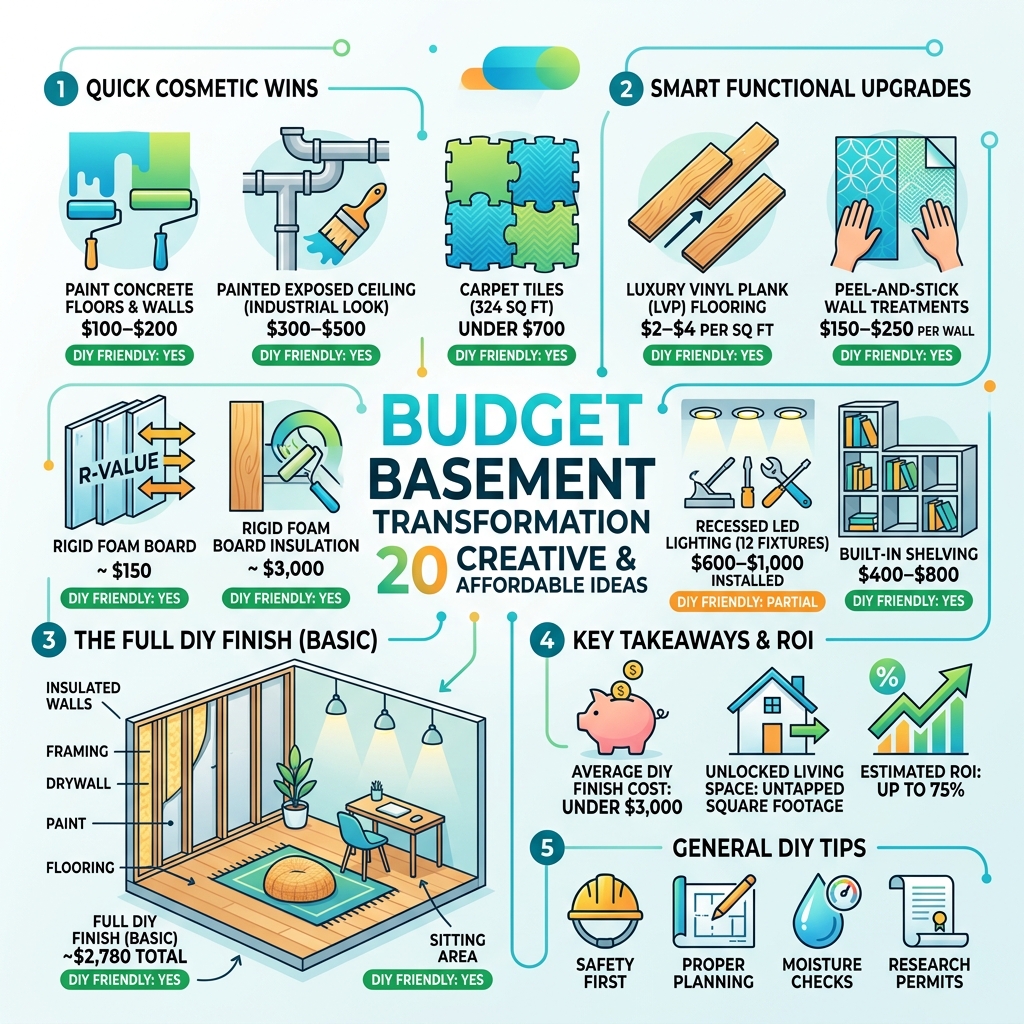
Simple basement remodeling ideas on a budget word guide:
Planning Your Basement Remodeling Ideas on a Budget
Before we pick out paint swatches or hunt for thrifted mid-century modern chairs, we have to talk about the “boring” stuff. If you skip the planning phase, your beautiful new basement could become a moldy, expensive headache in six months.
The Foundation: Moisture and Layout
The first step in any basement project is a moisture inspection. Wait for a heavy rain and check every corner. Are there damp spots? Efflorescence (that white, powdery stuff on concrete)? If so, you need to address it now.
We recommend starting with a high-quality block sealer (about $100) to coat the masonry walls. For air quality, The Ultimate Guide to Buying a Dehumidifier for Lower Energy Bills explains how keeping humidity between 40-60% prevents that classic “basement smell” and protects your investment.
When it comes to the floor plan, What to Know Before Finalizing Your Basement Renovation Layout is essential reading. An open-concept layout is almost always the best move for basement remodeling ideas on a budget. Why? Because every wall you don’t build saves you $2,000–$4,000 in framing, drywall, and electrical labor.

Permits and Safety
Don’t be tempted to skip building permits. In most areas, if you are adding living space, a bedroom, or changing electrical/plumbing, you need a permit. This ensures your space is up to code, especially regarding egress windows. If you’re adding a bedroom, a large window that a person can climb out of in an emergency is a legal requirement.
DIY vs. Professional: Where to Spend Your Money
To keep costs low, we suggest a “phased renovation.” You don’t have to do it all at once. Start with the structural and safety elements, then move to cosmetics.
| Task | DIY Cost | Professional Cost | Savings |
|---|---|---|---|
| Framing (2x4s) | $300 | $1,500+ | $1,200 |
| Drywall (36 sheets) | $350 | $2,500+ | $2,150 |
| Painting | $120 | $800 | $680 |
| Electrical | $100 (materials) | $1,000+ | $900 |
Tip: Always include a 10-15% budget contingency. Basements are full of surprises like hidden pipes or uneven floors.
Cost-Effective Flooring and Wall Finishes
Flooring is often the biggest expense in a basement, but it’s also the most vulnerable to moisture. Traditional hardwood is a no-go here. Instead, look at these budget champions.
Luxury Vinyl Plank (LVP) and Carpet Tiles
LVP is the reigning king of basement remodeling ideas on a budget. It’s waterproof, scratch-resistant, and looks remarkably like real wood. You can find quality planks for $2–$4 per square foot. If you prefer warmth underfoot, modular carpet tiles are a genius DIY solution. You can cover over 300 square feet for under $700. If one tile gets a stain, you simply pop it out and replace it!
For those looking for more eco-conscious choices, check out Green Flooring Solutions for Your Home.
Painted and Stained Concrete
If your budget is razor-thin, embrace the concrete. Rent a sander, clean the floor thoroughly, and apply an acid wash stain or high-quality epoxy. This creates a sleek, industrial look for the cost of a few cans of product. Just remember to use a moisture-blocking primer first.
Insulation: The Key to Comfort
A cold basement is a basement no one uses. The Ultimate Guide to Insulating Your Home highlights that rigid foam board (XPS or EPS) is often the best choice for basements. It provides a vapor barrier and high R-value in a thin profile. For roughly $150, you can insulate a standard basement wall, significantly lowering your heating bills.
Smart Basement Remodeling Ideas on a Budget for Walls
You don’t always need traditional drywall. If you’re going for a specific vibe, consider these alternatives:
- PVC Wall Panels (Trusscore): These are pre-finished, water-resistant, and incredibly easy to screw into studs. No mudding or sanding required!
- Beadboard or Shiplap: These can be installed over existing walls or directly to studs to add texture.
- Color Drenching: This is a high-impact, low-cost trend where you paint the walls, trim, and even the ceiling the same color (like a moody charcoal or deep navy). It hides imperfections and makes the room feel intentional and cozy.
- Peel-and-Stick Wallpaper: Perfect for a feature wall behind a TV or desk. It adds a “wow” factor for about $200.
If you are framing walls in areas near a bathroom or laundry hookup, make sure you know The Best Insulation to Use Between Studs in Your Wet Zones to prevent rot and mold.
Lighting and Ceiling Solutions for Dark Spaces
Basements are notoriously dark. To make them feel like “real” rooms, you need to layer your lighting. Start with Affordable LED Lighting Solutions.
Layered Lighting on a Dime
- Recessed Lighting: Ultra-thin LED “wafer” lights are a game-changer. They don’t require heavy housings and can fit in tight spaces between joists.
- Battery-Operated Sconces: Want the look of high-end wall lights without the $500 electrician bill? Buy beautiful sconces, skip the wiring, and use remote-controlled, battery-operated LED puck lights inside them.
- Smart Bulbs: Use these to control brightness and color temperature from your phone, helping you transition the space from a bright “office” during the day to a dim “movie theater” at night.
Creative Basement Remodeling Ideas on a Budget for Low Ceilings
Low ceilings (often 7 feet or less) make a basement feel like a cave. A traditional drop ceiling with acoustic tiles can cost $6–$9 per square foot and actually lowers your ceiling height.
Instead, try these:
- Painted Exposed Joists: This is the ultimate budget move. Rent a paint sprayer and hit everything — pipes, ducts, and wood — with “dry-fall” paint in flat black or bright white. It gives the space an industrial loft feel and preserves every inch of height.
- Beadboard Ceilings: If you hate the exposed look, framing beadboard directly to the joists only takes up about an inch of height but provides a clean, finished look.
- Height Perception Tricks: Paint your walls and ceiling the same light color, or use vertical shiplap to draw the eye upward.
While you’re working on the ceiling, it’s the perfect time to learn How to Seal Air Leaks to Save Energy. Sealing gaps where the foundation meets the wood framing (the rim joist) is one of the most effective ways to stop drafts.
Furniture, Storage, and Multi-Functional Zones
Once the “shell” of your basement is done, it’s time to make it functional. Because basements often serve multiple purposes — gym, office, playroom — we need to be smart about furniture.
The Power of the “IKEA Hack”
Custom built-ins can cost $5,000+. You can get the same look for $600 by using IKEA Kallax or Billy units. Secure them to the wall, add some decorative trim and crown molding, and paint them to match your walls. Suddenly, you have a high-end library or media center.
Defining Zones Without Walls
Walls are expensive. Curtains are not.
- Velvet Curtains: Use floor-to-ceiling velvet curtains on a simple track to hide storage areas or structural posts. They add softness and sound dampening to the room.
- Area Rugs: Use large rugs to signal where the “living room” ends and the “playroom” begins.
- Rolling Carts: These are perfect for “stations.” A craft cart, a bar cart, or a home office cart can be moved around as needed.
To manage your new space efficiently, look into Affordable Smart Energy Devices: An Essential Buying Guide. Smart plugs for your basement lamps or a programmable thermostat can keep your energy bills from spiking.
Storage Solutions
Don’t let storage be an afterthought.
- Pegboards: Install a wall of pegboard in an unfinished corner for tools, sports gear, or craft supplies.
- Storage Benches: Use these for seating at a small table; they double as a place to hide bulky blankets or board games.
- Under-Stair Nooks: The space under your basement stairs is prime real estate. Turn it into a “Harry Potter” reading nook or a built-in dog house.
Frequently Asked Questions about Budget Basement Remodels
Does finishing a basement on a budget add value to a home?
Yes, absolutely. While a “luxe” remodel might have a higher price tag, a budget-friendly finish often provides a better Return on Investment (ROI). On average, you can expect a 70% to 75% return on your investment.
Adding a functional living area increases your usable square footage, which is a major selling point. If you manage to add a bathroom (even a small half-bath), you could boost your home’s value by 10% to 40%. The key is making sure the work is permitted and looks cohesive with the rest of the house, following standard real estate appraisal practices.
How can I address moisture and insulation affordably?
The most affordable way is to do it yourself before you finish the walls.
- Seal the outside: Ensure your gutters are clean and downspouts carry water at least 6 feet away from the foundation.
- Block Sealer: Use a heavy-duty masonry sealer on the interior walls.
- Vapor Barrier: Always install a 6-mil polyethylene vapor barrier behind your studs or under your flooring.
- Rigid Foam: Use R5 insulation (1″ thick rigid foam) to keep the walls warm and dry.
For more on this, read about Remodeling Your Home for Energy Efficiency.
What are the best DIY projects to save money?
The “Big Three” of basement savings are Demolition, Painting, and Flooring.
- Demolition: If you’re clearing out old wood or junk, doing it yourself saves hundreds in labor.
- Painting: Professionals charge a premium for basements because of the awkward corners and lack of light. Doing it yourself (especially with a sprayer) is a huge win.
- Flooring: Installing LVP or carpet tiles is essentially like putting together a giant puzzle. It requires very few specialized tools and can be done in a weekend.
Check out Eco-Friendly Home Renovations to Save Energy for more DIY-friendly ideas that help the planet and your wallet.
Conclusion
Transforming your basement doesn’t have to be a $50,000 project that takes a year to complete. By focusing on basement remodeling ideas on a budget, we can take back that “scary” unfinished space and turn it into the most popular room in the house.
At Financefyx, we believe that smart home improvements are the best way to build equity and improve your quality of life. Whether you start with a simple coat of paint on the concrete or go all-in on a DIY framing project, the key is to start with a solid plan and a dry foundation.
Ready to keep saving? Check out our guide on how to Save Energy with Cost-Effective Home Improvements or explore More info about energy saving tips to see how your new basement can actually help lower your monthly bills. Happy remodeling!
