
Stop the Search and Hire Your Next Solar Panel Pro Today
Why Getting the Right Solar Technician Matters Before You Sign Anything
Hire solar panel technician is one of the smartest moves you can make as a homeowner looking to cut energy costs — but only if you hire the right one.
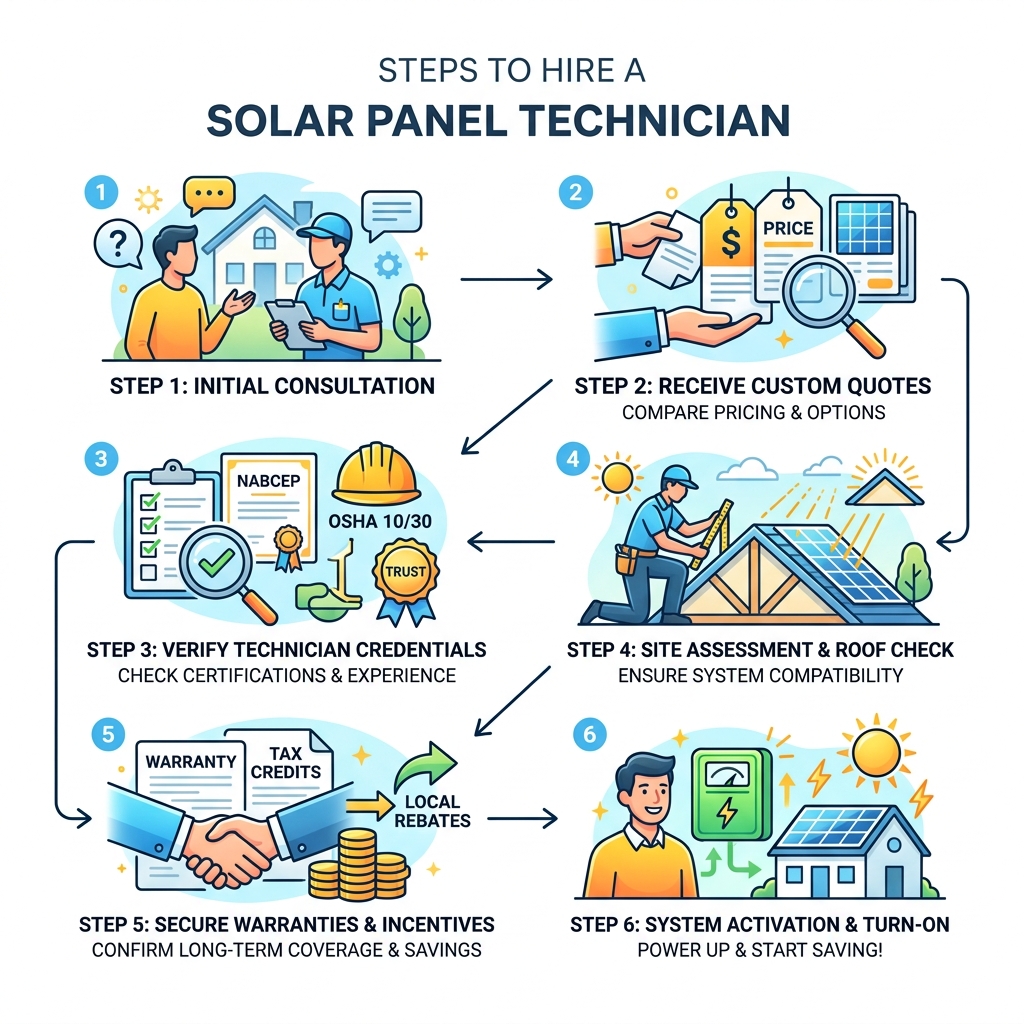
Here’s a quick look at what to do:
How to hire a solar panel technician:
- Verify credentials — Look for NABCEP certification and OSHA 10 or 30 training as a baseline.
- Check experience — Choose installers with at least 3 years of hands-on installation work.
- Ask about warranties — Both equipment and workmanship warranties should be covered.
- Confirm roof readiness — A good technician assesses your roof before installation, not after.
- Request multiple quotes — Interview at least 2-3 installers and compare modules, pricing, and timelines.
- Ask about incentives — Your technician should know the federal tax credit and any state or local rebates that apply to your project.
The solar industry is growing fast. Employment for solar PV installers is projected to grow 42% from 2024 to 2034 — far outpacing nearly every other trade. That means more workers are entering the field, and quality varies widely.
Not every person on a rooftop with a drill is qualified to design, wire, and activate a system that will power your home for the next 25 years. The difference between a skilled technician and an underqualified one can mean a poorly sealed roof, a failed inspection, or a system that underperforms from day one.
This guide will help you cut through the noise and find someone you can actually trust.
How to Hire a Solar Panel Technician for Your Home
When you decide to hire solar panel technician services, you aren’t just buying hardware; you are investing in a decades-long relationship with a power plant on your roof. Vetting a professional requires more than just checking a Yelp review. We recommend starting with a deep dive into their technical process. A true pro doesn’t just slap panels on shingles; they perform a comprehensive site assessment.

Before any glass touches your roof, a qualified technician should evaluate the structural integrity of your home. If your roof is nearing the end of its lifespan, a reputable installer will tell you to repair it first. We’ve seen many homeowners fall into the trap of installing a 25-year solar system on a 15-year-old roof, only to pay thousands later to “detach and reset” the panels for a roof replacement. For a deeper look at the setup process, check out our home-solar-panel-installation-guide.
Furthermore, understanding the basics of the technology helps you vet the person standing in your driveway. If you are new to photovoltaics, our solar-energy-guide-for-beginners is a great place to start so you can speak the same language as your installer.
Essential Responsibilities of a Hire Solar Panel Technician
What exactly does a technician do all day? It’s a mix of heavy lifting, precision engineering, and electrical wizardry. According to the Solar Technician III | ACP standards, a high-level professional is responsible for:
- System Layout and Assembly: Measuring and marking the roof to ensure the racking system is bolted into the rafters, not just the plywood.
- Electrical Wiring: Connecting the panels in “strings” and routing that DC power down to an inverter, where it becomes the AC power your fridge and TV use.
- Weatherproofing: Applying high-grade sealants to every roof penetration to ensure your home stays dry.
- System Activation and Testing: Using multimeters to check voltages and ensuring the monitoring software is communicating with the cloud.
Key Questions for Potential Installers
When you interview a candidate to hire solar panel technician expertise, don’t be shy. You are the boss in this scenario. Use these questions to separate the experts from the amateurs:
- How long has your business been operating? A good rule of thumb is to look for companies with at least three years of local experience.
- What modules do you use and why? Not all panels are created equal. Ask why they prefer specific brands over others.
- Can you explain the current solar energy incentives? If they can’t explain the 30% federal tax credit or local net-metering rules, they haven’t done their homework.
- Who is responsible if the roof leaks? Ensure their workmanship warranty specifically covers roof penetrations.
For those looking at the industry from the inside, checking out a Solar Technician I Job Opportunity | PPM Solar – Gainesville, FL can give you a clear idea of the rigorous standards top-tier companies expect from their crews.
Understanding the Role: Solar Technician vs. Solar Electrician
One of the most common points of confusion for homeowners is the difference between a solar technician and a solar electrician. While they often work on the same roof, their training and legal capabilities differ significantly.
| Feature | Solar Panel Technician | Solar Electrician |
|---|---|---|
| Primary Focus | Mechanical installation, racking, and panel mounting. | Final AC connections, main breaker panel work, and code compliance. |
| Training | 6 weeks to 1 year (OJT/Technical school). | 4 to 5 years (Apprenticeship + Classroom). |
| Certifications | NABCEP PV Associate, OSHA 10. | Journeyman or Master Electrician License. |
| Pay Range | $18 – $30 per hour. | $30 – $60+ per hour. |
A solar technician is often the “boots on the ground” handling the structural aspects. However, for the high-voltage side of the project, you almost always need a licensed electrician to ensure the system meets the National Electrical Code (NEC). You can see this distinction in action by looking at roles like the SunVena Solar hiring for Electrical Technician, which requires specific electrical troubleshooting skills.
Building a solar array is essentially building a small power plant. If you’re interested in the “big picture” of how these systems come together, read our guide power-to-the-people-a-step-by-step-guide-to-building-a-solar-power-plant.
Specialized Skills for a Hire Solar Panel Technician
The industry is shifting. While “installing” was the gold rush of the last decade, “Operations and Maintenance” (O&M) is the future. As systems age, we need pros who can diagnose a failed micro-inverter or a ground fault. Modern technicians must be proficient with:
- Diagnostic Tools: Using thermal cameras to find “hot spots” on panels.
- Battery Storage: Integrating systems like the Tesla Powerwall or Enphase IQ Battery.
- Off-Grid Knowledge: Setting up systems that don’t rely on the utility company at all. For more on this, see our off-grid-solar-panel-tips.
Career Paths and Entry-Level Opportunities
If you’re looking to enter the field rather than hire, the path is wide open. Many start as a Solar Energy Installation Technician – Installer , gaining experience in “remove and replace” work. From there, you can specialize in O&M, move into solar sales, or begin an apprenticeship to become a licensed electrician.
Key Qualifications, Certifications, and Safety Standards
Safety isn’t just a buzzword in solar; it’s a survival skill. When you hire solar panel technician professionals, you are hiring people who work with high-voltage electricity while balanced on a pitched roof.
The “Gold Standard” for certification is NABCEP (North American Board of Certified Energy Practitioners). If your lead technician has a NABCEP PV Installation Professional certification, you know they’ve passed a rigorous exam and have documented field experience.
Additionally, insulation and heat management are critical for system efficiency. If panels get too hot, their voltage drops. Learn more about protecting your investment in how-to-master-solar-panel-insulation-without-getting-burned and the-ultimate-guide-to-solar-panel-heat-insulation.
Physical Requirements and Work Environment
It’s a tough job. A technician must be able to:
- Lift 50 to 80 pounds (a standard solar panel weighs about 40-50 lbs, but carrying them up a ladder is another story).
- Work in extreme temperatures, from blistering summer heat on a black shingle roof to freezing winter winds.
- Spend 8 to 10 hours a day on their feet, often in harnesses and confined attic spaces.
Essential Safety Protocols
Professional crews follow strict safety standards to protect both themselves and your property. These include:
- LOTO (Lock Out Tag Out): Ensuring electrical circuits are de-energized and locked before work begins.
- JHA (Job Hazard Analysis): Assessing the site for risks like overhead power lines or unstable ground before starting.
- Fall Protection: Using anchors and harnesses for any work above 6 feet.
Companies like Solar Field Service Technician (Operations and Maintenance) | Pearce Renewables emphasize these protocols because one mistake can be catastrophic in a high-voltage environment.
The Cost of Professional Service and Industry Outlook
How much does it cost to hire solar panel technician talent? While prices vary by region, the median annual wage for installers was approximately $51,860 in 2024. However, top-tier professionals and those with electrical licenses can earn upwards of $80,000.
When budgeting for your project, labor typically accounts for about 10% to 25% of the total system cost. To avoid overpaying, check out our guide on dont-overpay-for-solar-a-breakdown-of-5kw-installed-prices and our detailed the-2025-guide-to-5kw-solar-panel-system-costs.
Earning Potential and Market Demand
With a projected 42% growth rate, the demand for these workers is skyrocketing. This is driven by:
- Federal Incentives: The Inflation Reduction Act has extended lucrative tax credits.
- Lower Equipment Costs: Panels are cheaper than ever, making solar viable for more families.
- Corporate Sustainability: Large companies are building massive solar farms, requiring thousands of utility-scale technicians.
To see how these costs translate into long-term wealth, read our analysis of solar-panels-cost-and-savings.
Emerging Trends in Solar Operations and Maintenance
As the “first wave” of residential solar systems hits the 10-to-15-year mark, we are seeing a surge in demand for O&M specialists. These technicians don’t just install; they troubleshoot. They use software to monitor system health in real-time and perform “preventative maintenance” like cleaning and wire inspections.
While some homeowners attempt diy-solar-panel-projects, we always recommend a professional for anything involving the electrical grid. A small wiring error in a DIY project can lead to a house fire, which is a very expensive way to save a few bucks on labor.
Frequently Asked Questions about Solar Technicians
What is the difference between a solar installer and a solar technician?
While the terms are often used interchangeably, an “installer” usually refers to entry-level workers who handle the physical mounting of panels. A “technician” typically has more advanced training in troubleshooting, system design, and electrical diagnostics.
Do I need a licensed electrician for my solar panel installation?
Yes. In almost every jurisdiction, a licensed electrician must sign off on the final connection to your home’s main service panel and the utility grid. This ensures the system is safe and meets local building codes.
How do I verify a solar technician’s NABCEP certification?
You can go directly to the NABCEP website and use their “Professional Directory” tool. You can search by name or location to ensure the person working on your roof actually holds the credentials they claim.
Conclusion
At Financefyx, we believe that the transition to renewable energy should be as stress-free as possible. Choosing to hire solar panel technician professionals who are certified, experienced, and safety-conscious is the only way to guarantee your system pays for itself over the next two decades.
Don’t settle for the lowest bid if it means sacrificing quality. A well-installed system is an asset that increases your home’s value and slashes your utility bills. A poorly installed one is a liability waiting to happen.
Ready to dive deeper into clean energy? Explore more renewable energy resources on our site and take control of your energy future today!
