
Low-E Windows: The Secret to a Lower Carbon Footprint
Why Energy Efficient Low-E Glass Could Be the Smartest Upgrade for Your Home
Energy efficient low-e glass is a type of window glazing with an ultra-thin, nearly invisible metallic coating that reflects heat back into your home in winter — while still letting natural light through.
Here’s a quick summary of what it does:
- Reflects indoor heat back inside during cold months, reducing heating costs
- Blocks solar heat from entering during summer, cutting air conditioning demand
- Filters up to 78–99% of UV radiation, protecting furniture and flooring from fading
- Reduces energy loss — since 10–50% of a home’s heat escapes through windows and doors, and 90% of that goes straight through the glass itself
- Achieves U-values as low as 0.9 W/(m².K) in advanced double-glazed units, compared to 5.8 W/(m².K) for single glazing
Most homeowners don’t think much about their windows until the heating bills arrive in January.
But here’s the thing: your glass is likely your biggest source of heat loss. Standard clear glass has a thermal emissivity of around 0.9 — meaning it lets almost all of your hard-earned warmth escape straight outside.
Low-e coatings change that equation dramatically. By applying layers of metal oxide thinner than a human hair to the glass surface, manufacturers can drop emissivity to as low as 0.05. That’s the difference between a window that leaks heat and one that acts as a thermal shield.
And the payoff goes beyond comfort. Lower energy demand means a smaller carbon footprint — which is why low-e glazing has become a cornerstone of sustainable building design worldwide.
What is Energy Efficient Low E Glass and How Does It Work?
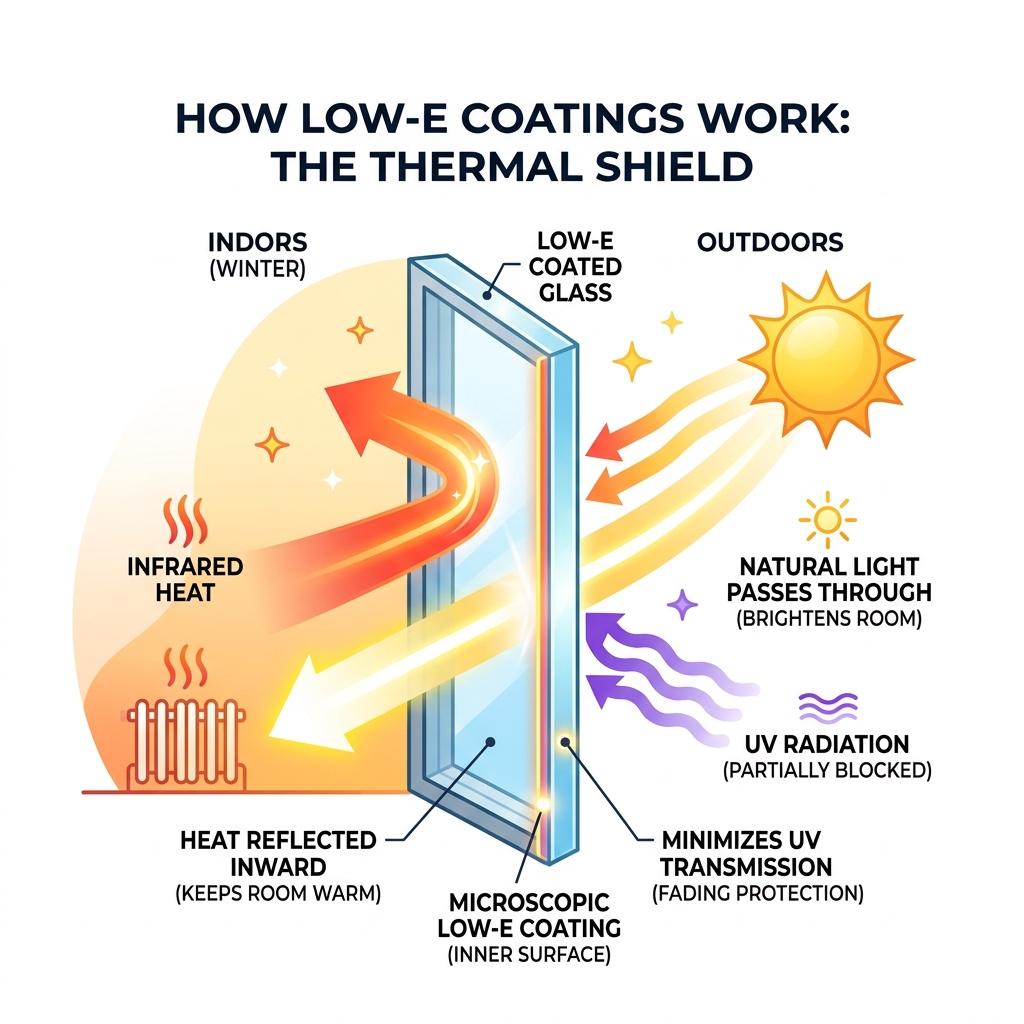
To understand energy efficient low e glass, we first have to talk about “emissivity.” In physics, emissivity is the ability of a material to radiate energy. Standard clear glass is a bit of a “heat sponge”—it absorbs thermal energy and then radiates it away. Low-E, which stands for “low emissivity,” refers to a glass surface that has been engineered to do the exact opposite.
We achieve this by applying a microscopic, transparent coating to the glass. This coating is so thin it’s practically invisible—often 1/500th the thickness of a sheet of paper—yet it acts as a powerful thermal shield. It allows visible light to pass through so your home stays bright, but it reflects infrared radiation (heat) back to its source.
In the winter, when you’re running your heater, the coating reflects that expensive indoor warmth back into your living room instead of letting it escape into the cold night air. In the summer, it does the reverse, reflecting the sun’s long-wave heat energy away from your windows to keep your home cool. This is a much more permanent and effective solution than simply trying to stop the chill with these easy ways to fix drafty uPVC windows, as it addresses the heat loss happening through the glass itself, not just the cracks around the frame.
The Science of Low-Emissivity Coatings in Energy Efficient Low E Glass
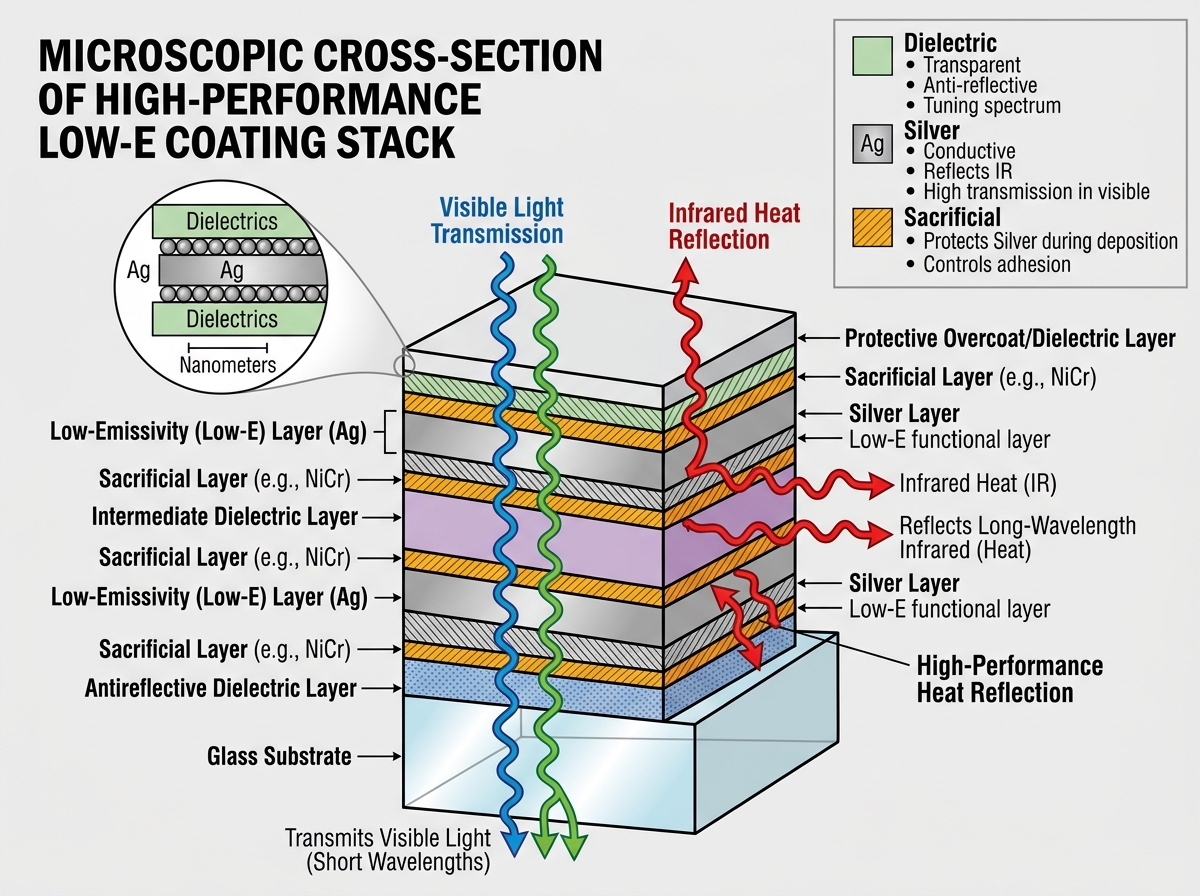
The magic happens within those microscopic layers. High-performance coatings typically involve a stack of materials, including nanometer-scale silver layers. Silver is an incredible reflector of thermal energy. By sandwiching silver between layers of metallic oxides, manufacturers create a “spectral filter.”
This filter is highly selective. It “chooses” which parts of the electromagnetic spectrum to let through. It welcomes visible light (the stuff we see) but gives the cold shoulder to ultraviolet (UV) rays and infrared radiation. By reducing the thermal emissivity of the glass from 0.9 down to as low as 0.05, we effectively turn the window into a mirror for heat while maintaining the clarity of a standard window.
Hard-Coat vs. Soft-Coat Energy Efficient Low E Glass
Not all energy efficient low e glass is created equal. There are two primary ways these coatings are applied, and choosing the right one depends on your climate and project needs.
- Hard-Coat (Pyrolytic): This coating is applied while the glass is still hot during the manufacturing process. The coating essentially fuses to the glass surface, making it incredibly durable and difficult to scratch. Because it’s so tough, it can be used on single-pane windows or on the exposed surfaces of glass. However, its U-value performance is generally lower than its soft-coat cousin. It’s often used in “passive solar” applications where you want some of the sun’s heat to enter the home to help with heating in extremely cold climates.
- Soft-Coat (Sputter Coating): This is the high-performance athlete of the glass world. It is applied “off-line” in a vacuum chamber using a process called Magnetron Sputtering Vapor Deposition (MSVD). This allows for multiple layers of silver to be applied with extreme precision. Soft-coat glass offers superior U-values and better UV protection. Because the coating is more delicate, it must be sealed inside an Insulating Glass Unit (IGU)—the space between the panes in double or triple glazing—to protect it from the air and physical damage.
Comparing Performance: From Double Glazing to Vacuum Technology
When we look at the numbers, the evolution of glass technology is staggering. If you’re still living with single-pane windows, you’re essentially living with a hole in your wall in terms of energy efficiency.
| Glazing Type | U-Value (W/m².K) | Light Transmission |
|---|---|---|
| Single Glazing | 5.8 | ~90% |
| Standard Double Glazing | 2.8 | ~80% |
| Low-E Double Glazing (Argon Fill) | 1.1 – 1.4 | 70% – 75% |
| Low-E Triple Glazing | 0.5 – 0.7 | 60% – 65% |
| FINEO Vacuum Glazing | 0.7 | ~80% |
As you can see, moving from single glazing to a energy efficient low e glass double-glazed unit can reduce heat loss by over 75%. If you’re tired of feeling like your house is a walk-in freezer, you might be looking for how to seal window drafts without losing your mind, but upgrading the glass is the only way to reach these high-performance metrics.
Modern innovations like vacuum glazing (such as FINEO) are changing the game again. By removing the air between two panes of glass to create a vacuum, these units can achieve the insulation of triple glazing (Ug-value of 0.7) in a profile only 10mm thick. This is a dream for historic renovations where you want modern efficiency without bulky, heavy frames.
Understanding U-Values and Solar Heat Gain
To pick the best glass, you need to speak the language of metrics. The two most important are the U-Value and the SHGC.
- U-Value (or U-Factor): This measures how well the window keeps heat from escaping. The lower the number, the better the insulation. While standard glass sits at a dismal 5.8, advanced Low-E units paired with argon gas and warm-edge spacers (which reduce heat transfer at the edges of the glass) can get this down below 1.0.
- Solar Heat Gain Coefficient (SHGC): This measures how much of the sun’s heat enters through the glass. This is also known as the “G-value.” If you live in a hot climate, you want a low SHGC (around 0.25) to keep the sun from baking your interior. If you live in a very cold climate, you might want a higher SHGC to take advantage of “free” heat from the sun.
Understanding these numbers is the first step in learning how to seal air leaks to save energy and optimize your home’s thermal envelope.
Key Advantages for Sustainability and Indoor Comfort
Beyond just saving a few bucks on the electric bill, energy efficient low e glass fundamentally changes how it feels to live in your home. Have you ever sat by a window in winter and felt a “draft” even though the window was closed? That’s often not a draft at all, but “radiant heat loss.” Your body is literally radiating its heat toward the cold glass surface. Low-E glass stays warmer to the touch, eliminating that “chill” and making the space near windows usable year-round.
Protecting Interiors from UV and Solar Radiation
One of the most annoying things about the sun (besides sunburns) is how it bleaches the life out of your belongings. UV radiation is responsible for about 50% of the fading you see on your expensive hardwood floors, carpets, and artwork.
Standard glass lets about 58% of UV energy through. High-performance Low-E glass, especially when combined with laminated layers, can block up to 99% of these damaging rays. Experts use a metric called Tdw-ISO (Damage Weighted Transmittance) to measure this. While UV ratings only look at one part of the spectrum, Tdw-ISO looks at the entire solar spectrum to give a more accurate picture of how well your glass protects your home. By investing in Low-E, you aren’t just insulating your home for energy efficiency, you’re also extending the life of every fabric and finish inside it.
How to Choose the Right Low-E Specification for Your Project
Choosing the right glass isn’t a one-size-fits-all situation. You have to play matchmaker between the glass and your local weather.
- For Cold Climates: Look for “Passive” Low-E coatings (usually hard-coat or specific soft-coats). These are designed to let some solar heat in during the day while trapping your furnace’s heat inside at night. You want a low U-value but a moderate-to-high SHGC.
- For Hot Climates: You need “Solar Control” Low-E glass. This is almost always a soft-coat product with multiple silver layers. It’s designed to reflect as much of the sun’s heat as possible (low SHGC) while keeping your air-conditioned air inside.
- For Mixed Climates: Many homeowners opt for a “balanced” coating that provides good insulation in the winter without overheating the house in the summer.
Don’t forget about window orientation! You might choose a high solar-gain glass for your north-facing windows to catch the winter sun, and a high-reflectivity solar control glass for those west-facing windows that get blasted by the afternoon heat. You can further enhance this by knowing how to save energy with insulated window treatments to create layers of protection.
Real-World Applications in Residential and Commercial Buildings
Energy efficient low e glass is the reason modern skyscrapers can have “all-glass” facades without turning into giant ovens. In commercial settings, using “triple silver” coatings allows for massive amounts of natural light, which improves employee productivity and well-being, while drastically cutting the HVAC load.
In the residential world, Low-E glass is a lifesaver for:
- Conservatories and Sunrooms: Allowing you to enjoy the view without the “greenhouse effect” making the room unbearable in July.
- Historic Renovations: Using vacuum glazing to keep original frames while meeting modern building codes.
- High-Rise Apartments: Where wind and sun exposure are extreme.
If you’ve ever wondered why a certain room feels like the Arctic, it’s often because the glass isn’t doing its job. We’ve explored this in our guide on patio door drafts and why your living room feels like the Arctic.
Frequently Asked Questions about Low-E Glazing
Does Low-E glass significantly reduce natural light?
This is a common concern, but modern technology has largely solved it. While early versions of Low-E glass had a slight green or gray tint, today’s “neutral” coatings are nearly indistinguishable from clear glass to the naked eye. Most Low-E windows allow between 60% and 80% of visible light through. While that is a reduction from standard glass, it’s often a welcome change because it reduces harsh glare, making it easier to see computer screens and TVs.
How can I tell if my existing windows have a Low-E coating?
Since the coating is invisible, you have to be a bit of a detective. Try the “Match Test”:
- Hold a lit match or a small flashlight up to the window.
- Look at the reflections (in a double-pane window, you’ll see four reflections of the flame).
- If one of the reflections is a notably different color—usually slightly pink, blue, or green—than the others, you have a Low-E coating. If all four reflections are the same color, it’s likely standard clear glass.
Is the higher initial cost of Low-E glass worth the investment?
Absolutely. While Low-E glass can cost about 10–15% more than standard glass, the ROI is clear. Since 90% of window heat loss occurs through the glass, and windows account for up to 50% of your home’s total energy loss, the savings on your monthly utility bills can pay back the price difference in just a few years. Plus, you have to factor in the increased property value and the fact that your HVAC system won’t have to work nearly as hard, extending its lifespan.
Conclusion
At Financefyx, we believe that sustainable living shouldn’t be a sacrifice. Upgrading to energy efficient low e glass is one of the few home improvements that offers a “triple win”: it lowers your carbon footprint, slashes your energy bills, and makes your home significantly more comfortable.
As we move toward global net-zero goals, the role of our buildings becomes critical. By choosing glass that acts as a smart filter rather than a simple barrier, we can create homes that are in harmony with their environment. Whether you are building a new modern masterpiece or retrofitting a cozy historic cottage, Low-E technology is the secret to a more efficient future.
Ready to take the next step in your home efficiency journey? Check out more info about energy saving services to see how we can help you optimize your home and your budget.
